Feeds:
Posts
Comentários

Posts Tagged ‘Rei Arthur’


Estou horrível mas infelizmente só tenho esta foto da placa do Castelo.
I’m horrible, unfortunately this is the only photo I’ve got of the Castle sign.

O horário de visita às ruínas do castelo já tinha se encerrado naquele dia, portanto fiquei na pequena praia, cantando em voz alta enquanto ia de um lado para o outro batendo fotos. Devia estar parecendo uma maluca, pois percebi que duas moças estavam me olhando e rindo. Tive que rir também, e começamos a conversar. Eram tia e sobrinha em férias, a caminho de Newquay.

The Castle ruins were already closed for visitors that afternoon, so I strolled the little beach taking pictures, singing aloud. Then I noticed two girls looking and laughing at me, probably thinking me nuts. I had to laugh too, and we started  to talk. They were aunt and niece in holidays, on their way to Newquay.

Novas amigas / New friends

Eram quase sete da noite. Kimberly e Amanda iam jantar e me convidaram a acompanhá-las. Deixei a câmera no hotel e fomos ao King Arthur’s Arms, um pub ao qual eu iria voltar todos os dias. Foi quando fiz uma coisa horrível. Após fazermos os pedidos ao garçom, me levantei e fui ao banheiro. Quando retornei, os pratos já estavam na mesa. Meu salmão com ervilhas, batatas, cenouras e molho de manteiga estava divino. No Brasil, a conta vem no fim da refeição; lá paga-se na hora que se pede. Comemos, conversamos horas e só hora de ir embora, descobri que elas já haviam pagado a conta. Fiquei absolutamente sem graça, pois parecia que tinha feito de propósito.

It was almost 7pm. Kimberly and Amanda wanted to dinner and invited me to join them. I left the camera in my hotel room and we headed to King Arthur’s Arms, a pub where I’d be back each and every day. But then I did something regrettable. After ordering our plates, I went to the lavatory and the meal was already at the table when I got back. My grilled salmon with vegetables and butter sauce was divine, but… in Brazil the bill comes at the end. In England you pay when you order. So I ate, we talked for hours and only when it was time to leave I found out they had paid for my meal. That was so embarrassing, they probably thought I had done it on purpose.
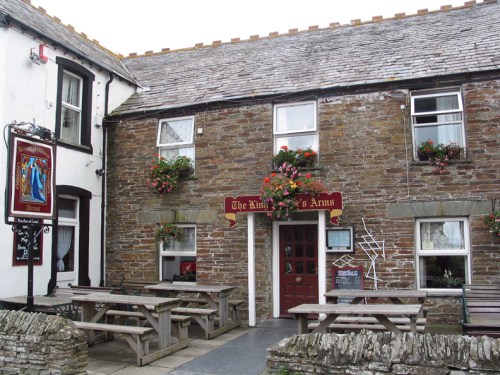
King Arthur’s Arms, Fore Street, Tintagel
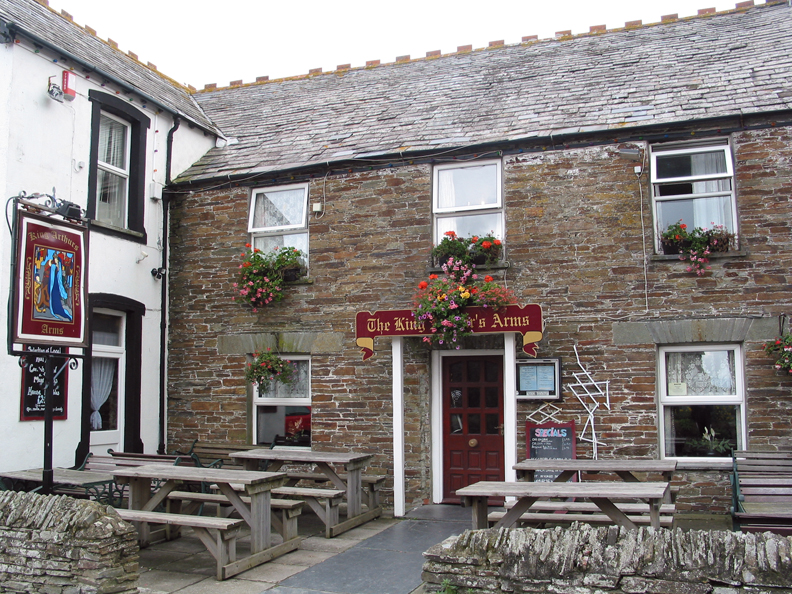
www.kingarthursarms.co.uk

Expliquei isso, mas minha tentativa de reembolso não foi aceita e ainda me perguntaram se eu gostaria de seguir com elas para Newquay. Fiquei arrasada, pois minha reserva no hotel era para duas noites e já tinha feito o check-in, assim declinei o convite. Por fim as moças foram embora, deixando o telefone e e-mail; achei que iríamos nos ver em Londres quando eu voltasse. Infelizmente isso não aconteceu. Os telefones não atendiam e o e-mail que enviei acusou erro.

I tried to explain but the girls didn’t accept my refund, and asked me to go with them to Newquay. I was devastated because I’d love to, but I had booked two nights at the Camelot Castle and had already checked in. So we said goodbye and eventually they took the road leaving their phone numbers and e-mail adresses. I thought we might meet in London when I went back, but unfortunately that never happened. Nobody answered the phone calls and the e-mails I’ve sent accused error.

National Trust Old Post Office

De volta ao Camelot Castle, percebi que o banheiro era uma cabine de fibra como as de avião dentro do quarto, com pia, vaso sanitário e box com ducha quentinha. Após o banho dormi profundamente numa cama muito macia. Na manhã seguinte, desci para o enorme salão de café do hotel, junto a uma varanda que dava para o mar. Podia-se escolher café da manhã inglês ou continental. Para provar, pedi o inglês e me arrependi amargamente: veio bacon, linguiça, um purê insosso de feijão, tomates e ovos – tudo frito com gordura escorrendo, um nojo. Feijão no café, que bizarro!Felizmente, havia também uma mesa com iogurtes e diversas caixinhas de cereais. Salvaram minha vida. Além de comer na hora levei para o quarto um pote de iogurte e granola, já pensando no jantar.

Back in Camelot Castle, I noticed that the bathroom was a fiberglass cabinet inside the room, like those of planes but provided with shower besides the sink and toilet. After a hot bath I fell deeply asleep in the soft bed. Next morning, breakfast was served in a massive room next to a balcony overlooking the sea. One could choose between Continental and English breakfast, and I decided to try the latest, which was a bad idea. I was served bacon, sausage, eggs, tomatoes and a tasteless beans purée, everything fried, still dripping oil, disgusting. How bizarre, beans in breakfast! Luckily there was a side table with a variety of yogurt and boxed cereal, which saved my life. I even took some to my room, saving it for dinner.
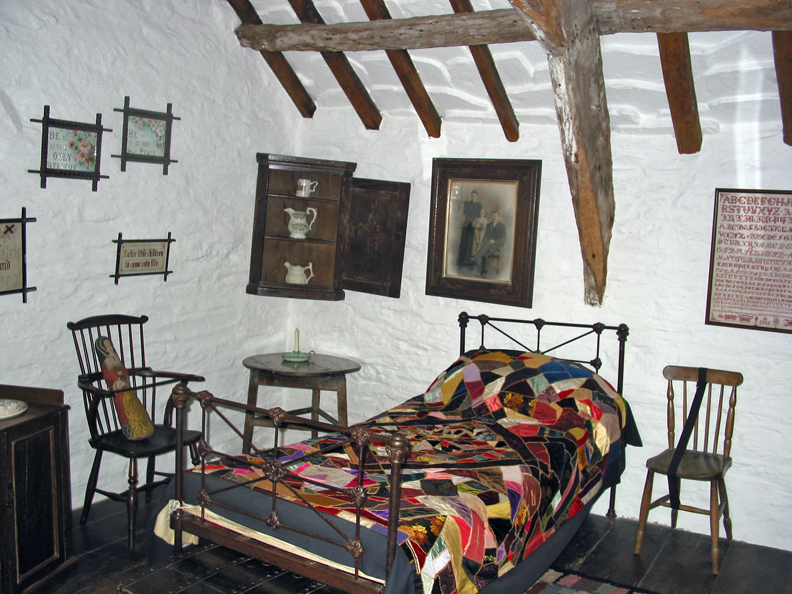
Interior do antigo Correio / Inside the Old Post Office
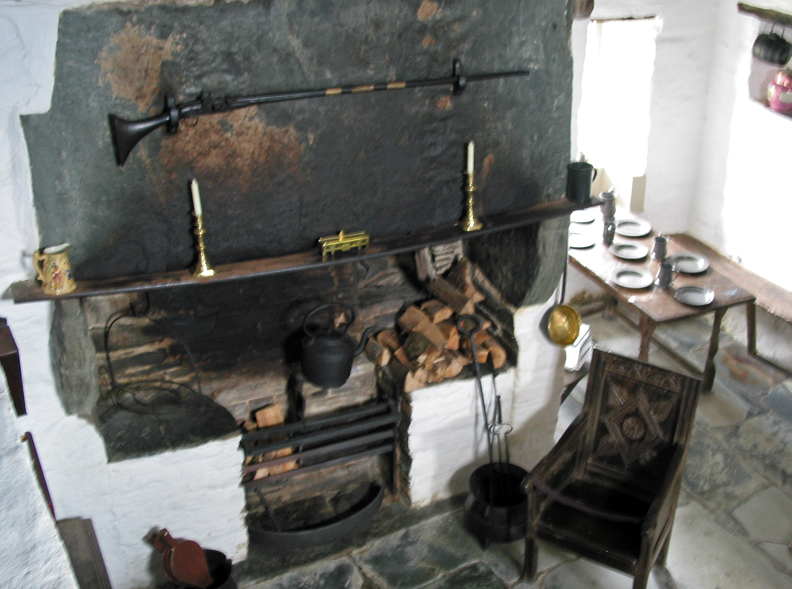
O dia estava bonito quando saí para conhecer a cidade, mas quinze minutos depois o tempo fechou. Eu estava chegando ao Old Post Office, o antigo correio que mais parecia uma casa de bonecas. No século XVIII, ali morava o funcionário que selava, despachava e recebia cartas. A correspondência era entregue a cavalo naquele tempo.

The weather was good at first, but clouded over as soon as I set foot on the street for a walk around. I was just arriving at the Old Post Office, an XVIII century building with the looks of a doll house. There lived the clerk who sealed and dispatched the mail, which went on horseback by that time.

Natureza morta no antigo correio / Still life in the Old Post Office

Mais uma / Another one


Porta para o jardim nos fundos / Backyard door

Dali fui pegar um ônibus até Slaughterbridge para ver a pedra que marca o lugar onde Arthur foi mortalmente ferido por Mordred.

From there I went to the station, in order to take a bus to Slaughterbridge, where a stone marks the place where Arthur fell deadly wounded by Mordred.

Read Full Post »


Cornwall – a Cornualha

Comprei a passagem de ônibus, o 505 para Penzance, sem retorno dessa vez. A Cornualha tem praias aonde todo mundo vai pegar onda nas férias, como Newquay. O bagageiro do ônibus encheu com pranchas de surf. Penzance é a ultima cidade, de onde se vai ao Land’s End, o ponto final que encontra o Oceano Atlântico a sudeste. Era domingo, dia 27 de julho de 2005. De Londres a Camelford, foram cinco horas.  A estrada cruzava cidades minúsculas, que pareciam ter aspecto medieval, mas era impossível dizer com certeza pois choveu torrencialmente durante a viagem toda. Não dava para ver nada pela janela, só o mundo branco de neblina. Fiz o trajeto lendo o livro A Druid Abroad, de Sandra Parsons, sobre sua viagem a Newgrange, na Irlanda, em companhia de sua mãe. Fui a única passageira a descer em Camelford.

I bought a bus ticket, boarding the 505 to Penzance, this time without return. Cornwall is a summer destiny where you find the surf beaches as Newquay. The luggage compartment was full of surfboards. The last city is Penzance, from where you reach Land’s End, England’s south-eastern border facing the Atlantic Ocean. It was Sunday, July 27th. It took five hours from London to Camelford, where I was supposed to drop off. The road crossed tiny villages that could have a medieval look but I wasn’t sure, because it rained torrentially the whole day and beyond the windowpane the world was mostly white. I spent the time reading the book “A Druid Abroad” by Sandra Parsons, about her journey to Newgrange, in Ireland, with her mother. I was the only passenger to get off the bus in Camelford.

Uma placa na estrada indicava “Bodmin” e “Dozmary Pool”. Fiquei meio histérica pois Dozmary pool é o lago de onde se ergueu a Dama do Lago empunhando a espada Excalibur para ser dada a Arthur. E no fim da história, quando o Rei está mortalmente ferido, entrega Excalibur a Sir Bedivere, um dos Cavaleiros, para que a jogasse de volta no fundo do mesmo Lago, a fim de evitar que caísse em mãos inimigas. Eu precisava fotografar o lago, mas até aquele momento não fazia idéia da sua localização. Pensei então em seguir para lá imediatamente após a estada em Tintagel. Eu não fazia idéia, porém, da distância entre todos esses lugares.

A sign on a crossroads pointed the way to “Bodmin” and “Dozmary Pool”. I was entranced because that was the Pool from which waters rose the Lady of The Lake, bearing the mighty sword Excalibur to be given to Arthur. In the end of the tale, when the King is deadly wounded, he hands Excalibur to Sir Bedivere, one of the knights, with orders to throw it back into the deep of the Lake, to avoid its capture by enemies’ hands. I had to photograph that lake, although up to that moment I didn’t have the slightest idea of its location. So my mind was instantly made up: after the days in Tintagel I would go that way. But I had no idea of the real distance between these places.

Camelot Castle – Tintagel, Cornwall PL34 0DQ, Reino Unido – 01840 770202
http://www.camelotcastle.com


A chuva parou quando saltei do ônibus em Camelford. Parecia um lugar bonitinho, que valeria a pena visitar, mas fui direto para o ponto do ônibus local que me levaria a Tintagel, onde havia feito reserva no hotel “Camelot Castle” para duas noites. O ônibus já estava no ponto, como se esperasse por mim. Cerca de vinte minutos depois, desembarquei na cidade de Igraine. Percorri a avenida principal virando à esquerda no fim: o hotel ficava em frente ao mar. A construção (aliás, muito brega, aquele castelo fajuto estragava o visual) ficava bem ao lado de uma escadaria que levava à praia, uma pequena enseada aos pés do maciço sobre o qual se erguem as ruínas do castelo de Tintagel. Após fazer o check in, deixei a mochila no quarto com banheiro e desci imediatamente para a praia.

The rain ended when the coach reached Camelford, which seemed to be a nice place, worth visiting, but instead I went straight to the stop where the bus that would take me to Tintagel was already ready to leave, as if was just waiting for me. After about twenty minutes, I got off in Igraine’s city. I had booked two nights in the Camelot Castle Hotel, that stands facing the sea, turning left in the end of the main street. The building was pretty tacky, a fake castle ruining the gorgeous landscape. Beside it there was a stairway leading to the beach, a small bay of sapphire blue sea like those in pirate’s movies, at the feet of the massive rock where Tintagel Castle ruins still stand. After check in, I left my backpack in the room (with a private bathroom!) and went down to the beach.

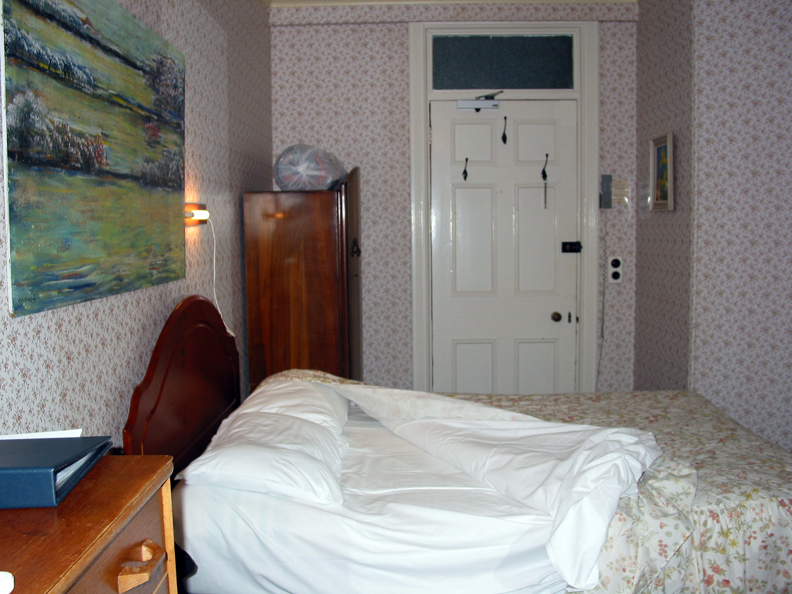
Pela primeira vez na viagem, um quarto com banheiro só para mim.
For the first time in this trip, a room with private bathroom, all only for me!

A vista da janela do meu quarto não era para o mar: algumas casas e a rua principal da cidade.
My room didn’t face the sea, but Tintagel’s main street  ahead

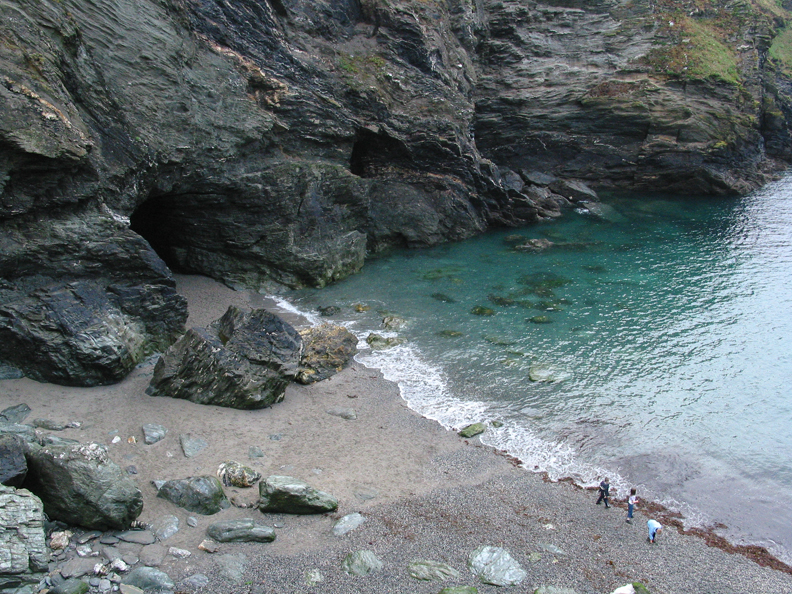
O tempo havia clareado, uma luz quase mágica banhava a paisagem. A enseada parecia cenário de filme de pirata, o mar cor de safira. Enquanto descia a trilha, um raio de sol irrompeu entre as nuvens, que pareciam se dissipar. Depois de ter viajado o dia todo em meio à tempestade e ao dilúvio, aquele sol era tão inacreditável que desapareceu mesmo instantes depois. Foi só para abençoar minha chegada. Agradeci aos deuses pulando na areia (ou melhor, seixos negros) como um cabrito drogado e gritando: “TINTAGEL! TINTAGEL!”

The weather had cleared, a magic light bathed the place, and while I was stepping down a golden sunbeam shone through the vanishing clouds. That was a blessing after travelling through storm and flood, an impossible ray of light so brief that it was gone as soon as I set my feet in the sand, or better, black pebbles. To thank the gods I started to jump like a goatling freaking out, and yelling: “TINTAGEL! TINTAGEL!”

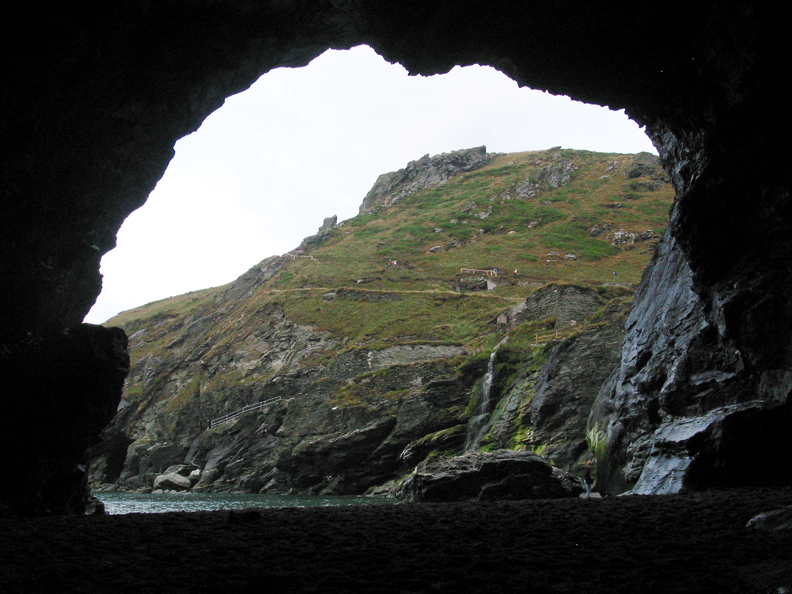
Na praia, a caverna sob o castelo de Tintagel por onde Uther se infiltrou para passar a noite com sua amada Igraine.Desse encontro nasceria Arthur.
The cave under Tintagel’s Castle where Uther penetrated the Castle to spend the night with his beloved Igraine. Of this meeting Arthur would be born.

Dentro da caverna, na maré baixa.  / Inside the cave, low tide

Outra ponta da praia / The other end of the beach

Vista do alto da escadaria / Overview from the stairway above

Magic

Read Full Post »


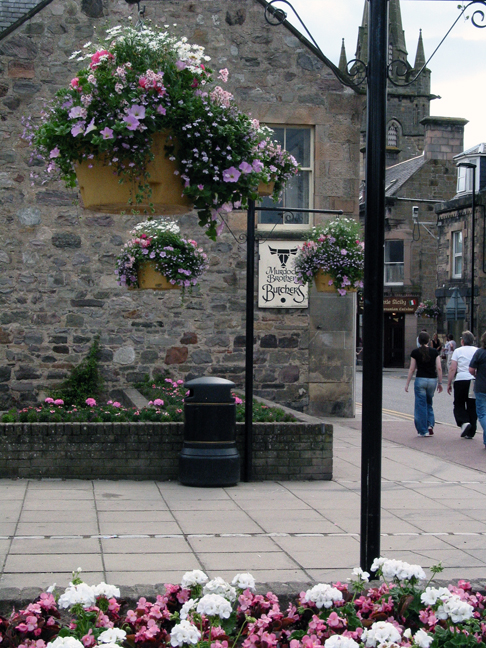
Rua em Forres / Street in Forres

Fiquei bastante tempo junto à Pedra das Bruxas, fazendo minhas orações para as mulheres que foram queimadas ali, e só fui embora porque começou a ameaçar chuva. Não havia nem um ponto de ônibus na longa rua, mas achei um posto de gasolina e fui pedir informações. Não havia frentista, mas um homem entrou  para abastecer o carro,  a ele me dirigi. Por sorte, conhecia Findhorn e ofereceu carona até o local de onde saía um shuttle gratuito para a Fundação. Sem pestanejar entrei no carro. Em dez minutos chegamos a um lugar que, a pé, eu levaria o dia todo para alcançar: Cluny, no alto de um morro, que foi um hotel na década de 60 e hoje faz parte da Fundação Findhorn, aonde chegaremos. Agradeci efusivamente ao gentil escocês de meia idade que se dispôs a sair de seu caminho para me levar até lá.

I stood longtime by the Witches stone, alone with my prayers for the women that had been scorched there, but under the threat of a gathering storm I eventually left. There was no bus stop in the long street, only a gas station, where I could ask for direction. There was no attendant, but a car came in to fuel so I addressed the driver. Fortunately he knew Findhorn and offered me a ride to a place where I could take a free shuttle to the Foundation. I accepted without a blink. The way up to the top of a high hill took us ten minutes; by foot it would take me the whole day to reach Cluny Hill College, a former hotel which now belongs to Findhorn Foundation, where we’re just about to arrive. I thanked heartily the Scot gentleman who had kindly strayed off his path to take me there.

Forres

A salvo da chuva que realmente caiu com vontade, esperei uma hora pelo shuttle, minha mente ainda ocupada pela questão da dominação cultural. Sabemos que a história é geralmente contada pelo ponto de vista do vencedor. A história do Rei Arthur, foco deste blog, também foi acrescida de elementos que não pertenciam à original, em momentos distintos, servindo a diferentes propósitos. No livro Aventuras da Távola Redonda (2003), o Prof. Antonio L. Furtado (org.) divide a literatura Arthuriana em três momentos distintos:
1ª fase – Crônicas pseudo-históricas;
2ª fase – Romances de cavalaria;
3ª fase – Histórias exemplares.

Next shuttle would leave in one hour, which I spent quietly sitting sheltered from the hard rain, my mind still busy with cultural subdue. It’s said that History is always told by the winner’s point of view. To King Arthur’s story, the main focus of this blog, elements were added which didn’t exist in the original tale, serving different purposes. In his book Adventures of the Round Table (2003), Prof. Antonio L. Furtado (org.) splits Arthurian literature in three distinct periods:
1st. – Pseudo-historical chronicles;
2nd. – Chivalry romances;
3rd. – Exemplary tales.

Praça principal de Forres / Forres main square

A primeira fase trata de relatos de batalhas e outras citações nas quais aparece o nome de Arthur, como em A história dos Reis da Bretanha, de Geoffrey de Monmouth, e nos Anais de Cambria (cidade no País de Gales) do ano 516, onde está escrito que “na Batalha de Badon, em que Artur levou a cruz de Nosso Senhor Jesus Cristo por três dias e três noites sobre seus ombros, e os bretões foram vitoriosos”. Um autor chamado Nennius, do século IX, afirma em sua História dos Bretões, que na batalha do Monte Badon, “morreram, em um dia, 960 homens numa investida de Arthur, e ninguém os abateu senão ele somente. E em todas as batalhas saiu vencedor”. Um certo Lucius Artorius Castus é citado por ter atingido o posto de “dux bellorum”, isto é, o Duque de Guerra. Foram encontradas duas placas com inscrições que atestam esta afirmação e a situam entre meados dos séculos II e III. Estes são exemplos de escritos em prosa, em latim, que sustentam a existência real de um Arthur.

The first phase concerns battle accounts and other reports where Arthur’s name appears, like Geoffrey de Monmouth’s “History of the Kings of Britain” and the “Annals of Cambria”(Welsh city), year 516, where the author states that “in the Battle of Mount Badon, where Arthur led the forces under our Lord Jesus Christ’s Cross banner for three days and three nights over his shoulders, and the Britons were victorious, utterly defeating the Saxons”.  Nennius, a IXth century writer, asserts in his “Historia Brittonum” that in Mount Badon “960 men died in one single day under Arthur’s onslaught and nobody slaughtered them but himself alone, and of all battles he was the winner”.  A certain Lucius Artorius Castus is mentioned as “dux bellorum”, what means “commander of war(s)”. Two plaques were found bearing inscriptions that prove this man’s existence in the late 2nd century or early 3rd century. These are a few examples of texts, written in latin prose, that support an Arthur’s true existence.

Lancelot & Guinevere

Na segunda fase, o romance é introduzido nestas histórias, que tratavam antes apenas de cavaleiros, seus duelos, sua coragem, feitos de bravura e guerras vencidas – aliás, um tanto enfadonhas. Os romances de cavalaria viraram moda nos salões da corte francesa, formatados em versos neste idioma. Chrétien de Troyes (escritor que traduziu A História dos Reis da Bretanha, de Geoffrey de Monmouth, para o francês) recebeu de sua patronesse a “encomenda” de uma história de Camelot, onde seria acrescida a narrativa de um romance entre a rainha e o melhor cavaleiro do rei, Lancelot, que até então nem existia nos relatos pseudo-históricos. A mecenas era a condessa Maria de Champagne, filha de Eleanor da Aquitânia (mulher de Henrique II da Inglaterra) que empregou Chrétien entre 1160 e 1172, ou seja, início do século XII.

The second phase had place when Chivalry Romances became the new fashion trend in Royal Courts, translated into French poetry, embodying chivalrous love in tales that formerly consisted only of jousts, knight bravery, victories in battle, very boring stuff, by the way. The writer Chrétien de Troyes, who translated the “History of the Kings of Britain” into French was hired to produce a Camelot novel, and the love story between Guinevere and Lancelot was thus inserted. Arthur’s best knight didn’t even exist in the original tale. Chrétien’s sponsor was the Countess Mary of Champagne, daughter of  Eleanor of Aquitania (who married the English King Henry II), from 1160 to 1172, early XIIth century.

A busca do Cálice Sagrado / The quest for the Holy Grail

A terceira fase é formada por escritos em francês, em prosa, onde o Santo Graal entra na narrativa. Isto se dá justamente quando a Igreja Católica quer incitar os cristãos às Cruzadas, mais adiante no século XII. O catolicismo varreu do mapa a antiga religião, nunca mais se concebeu nenhuma versão da história de Arthur sem a busca do Graal. O interessante é que a cultura pagã foi preservada no próprio interior dos monastérios por druidas que, para sobreviver, declararam-se convertidos ao catolicismo. Estes sábios registraram por escrito suas tradições, que até então eram transmitidas oralmente através das gerações. Devemos a eles tudo que hoje se conhece da cultura celta.

In the third phase, written in French prose, the quest for the Holy Grail is added to Arthur’s story. That happened a bit later in the XIIth century, when Catholic Church was urging the Christians to join the Crusades. Catholicism overwhelmed the ancient rites. Not a single version of the Round Table legend was written, after that, without the Grail quest. What’s interesting is that pagan culture was preserved in the very heart of Catholic Monasteries, by druids who, in order to survive, pretended to be converted to this new religion. These wise men put down in written words all they could about their traditions which were, so far, orally transmitted through the generations. To them we owe all our present knowledge of celtic culture.

Morgana em “Excalibur”: a bruxa má / the bad witch

Morgana em “Brumas de Avalon”: a sacerdotisa
Morgana in “Mists of Avalon”: the priestess


As Brumas de Avalon, da americana Marion Zimmer Bradley, lançado em 1979, é a abordagem da lenda de Arthur sob o ponto de vista feminino, reelaborando todo o universo mítico da trama. Pela primeira vez o estereótipo de bruxa má é retirado do personagem de Morgana.

The Mists of Avalon, by Marion Zimmer Bradley, 1979, approaches King Arthur’s legend under a feminine point of view, changing the mythical universe of the plot and for the first time releasing Morgana’s character of the bad witch stereotype.

Read Full Post »


Till the next time we say goodbye, Glastonbury!

No último dia da minha estadia no ashram, escapei de lavar a louça do almoço para não perder o horário do ônibus. Fui encontrar Selina e Jonathan na praça principal, onde nos despedimos. Ela ia para Leiceston pegar o trem para a Cornualha. Ele pegaria um avião de volta para os Estados Unidos. Eu ia de ônibus até Bristol e, de lá, para Londres onde fiquei uns dias para me recuperar e organizar fotos. Procurava dar uma força na casa, fazer um baby-sitting básico para que meus anfitriões economizassem preciosas libras, mas não queria abusar da sua hospitalidade.
A sequência lógica seria ir à Cornualha, pois os dias estavam lindos e ensolarados, entretanto eu queria ir à Escócia antes. Quando criança, li que havia um lugar onde, apesar de o solo não ser nada propício para a agricultura, pessoas plantaram e colheram abóboras e outros legumes gigantescos com a ajuda dos seres elementais, com quem conseguiam se comunicar. Esse lugar era Findhorn e tornara-se uma fundação onde são ministrados cursos e workshops de meditação, danças rituais circulares, agricultura orgânica, entre outros. A proposta é que os participantes vivenciem a espiritualidade aplicada ao cotidiano.

I escaped doing the dishes the last day in the Ashram, thanks to the bus timetable. Jonathan and Selina were leaving too, we met to bid farewell in the centre. She was on her way to Leiceston, to take a train to Cornwall and he was flying back to USA. I took a bus to Bristol and from there a coach to London, for a few days to catch my breath and organize the photos. I tried to be helpful to my host friends and did some baby-sitting to save them precious pounds, but I didn’t want to linger too long and abuse their hospitality.
The next logical destination would be Cornwall, because days were gorgeous, but I chose Scotland instead. As a child I had read about a place called Findhorn where a bunch of people planted vegetables and, despite the soil was unsuitable for agriculture, giant pumpkins and other stuff were grown, with the help of the devas (elemental beings) with whom these people were in touch, according to them. Findhorn became a Foundation that offers nowadays a range of workshops, as meditation, circular dances and other programmes in the environment of a working ecovillage, where students are supposed to apply spiritual values in daily life.
Paisagem nas Ilhas Orkney / Orkney landscape

Findhorn é banhada pelo Mar do Norte, onde ficam as Ilhas Orkney, onde, segundo As Brumas de Avalon, reinava Lot, com quem se casou Morgause, irmã de Igraine. De acordo com o livro, ambas eram filhas de Merlin, por isso tinham o sangue real de Avalon. Foi Morgause quem criou Mordred, filho de Arthur com sua meia-irmã Morgana. Esta era sacerdotisa de Avalon, onde se realizou o ritual de iniciação de Arthur, que devia entrar sozinho na floresta e, munido apenas de uma faca, enfrentar e matar um enorme cervo, tomando para si o título de Gamo-Rei. Tal ritual era fundamental para que as tribos do povo antigo reconhecessem seu direito ao trono. Mordred foi gerado quando Arthur voltou vitorioso da prova; era parte do ritual deitar-se com uma sacerdotisa virgem, justamente Morgana. Eles não se reconheceram, pois tinham sido separados havia muito tempo.

Findhorn is located on the shore, bathed by the North Sea, which surrounds the Orkney Islands.
According to The Mists of Avalon, Morgause married Lot, Lord of Orkney. She was Igraine’s sister; both were Merlin’s daughters, therefore descendants of the royal Avalon bloodline. Morgause raised Mordred, son of Arthur with his half-sister Morgana. She was priestess in Avalon, where took place Arthur’s initiation rite: he was to enter the forest alone and with one single knife kill a massive deer, taking upon himself the title of Deer King. Such rite was required otherwise the old tribes wouldn’t accept his leadership. Mordred was begot when Arthur came out of the woods victorious: he was supposed to lay with a virgin priestess to complete the rite, and that was Morgana. They didn’t recognize each other, because their lives had fallen apart too long ago.

Ring of Brodgar, Orkney Islands, Scotland

A escolha recaiu sobre Morgana pois se pretendia que o herdeiro do rei Arthur fosse da linhagem real de Avalon, comprometido com a antiga religião, disposto a evitar que os católicos a extinguissem. Mas Morgana assustou-se com a idéia de ter um filho do próprio irmão e o entregou para que a tia o criasse no reino distante de Orkney, o que foi um erro, segundo Marion Z. Bradley. Morgause era uma mulher ambiciosa que queria ser rainha. O garoto foi criado para odiar o pai e querer tomar seu lugar. Em outras versões da história Morgause não existe, e atribui-se à própria Morgana seu caráter cruel e malévolo. Já o escritor Bernard Cornwell, em suas Crônicas de Arthur, apresenta Mordred como filho legítimo de Uther Pendragon, herdeiro do trono, sendo Arthur seu irmão mais velho, bastardo, que faz o juramento de manter o reino coeso até que o garoto tivesse idade para governar.
Eu sabia também que nas Ilhas Orkney havia um gigantesco círculo de pedras chamado Anel de Brodgar, que despertara minha curiosidade. Isso foi motivo suficiente para pegar a estrada para Edimburgo, a capital da Escócia. De lá, acharia o caminho para Findhorn, Ilhas Orkney e também para a Capela Rosslyn, do livro O Código Da Vinci.

Morgana was chosen because Arthur’s heir should also be of the royal bloodline of Avalon, to avoid the extinction of the old religion by the hands of catholics. But the idea of giving birth to a son of her own brother scared Morgana so as soon as the baby was born she handed him over to her aunt, who fostered Mordred in the distant kingdom of Orkney. According to Marion Z. Bradley’s tale that was a great mistake. Morgause was an a greedy woman who wanted to be queen. The boy was raised to hate his father and plot to take his place. In many versions of the story Morgause doesn’t exist and this wickedness is assigned to Morgana’s role. The author Bernard Cornwell in his Arthur’s Chronicles, presents Mordred as Uther’s legitimate son and Arthur as an elder bastard who was sworn to keep the kingdom together until his brother comes of age.
I was also aware of a massive Stone Circle in Orkney, the Ring of Brodgar, which aroused my curiosity. Putting it all together, was reason enough to hit the road to Edimburgh, Scotland. From there I would find my way to Findhorn, Orkney Islands and Rosslyn Chapel as well, which appears in “Da Vinci’s Code” book.

Read Full Post »


Depois das ruínas, o jardim. We’ve seen ruins, let’s walk the garden now.

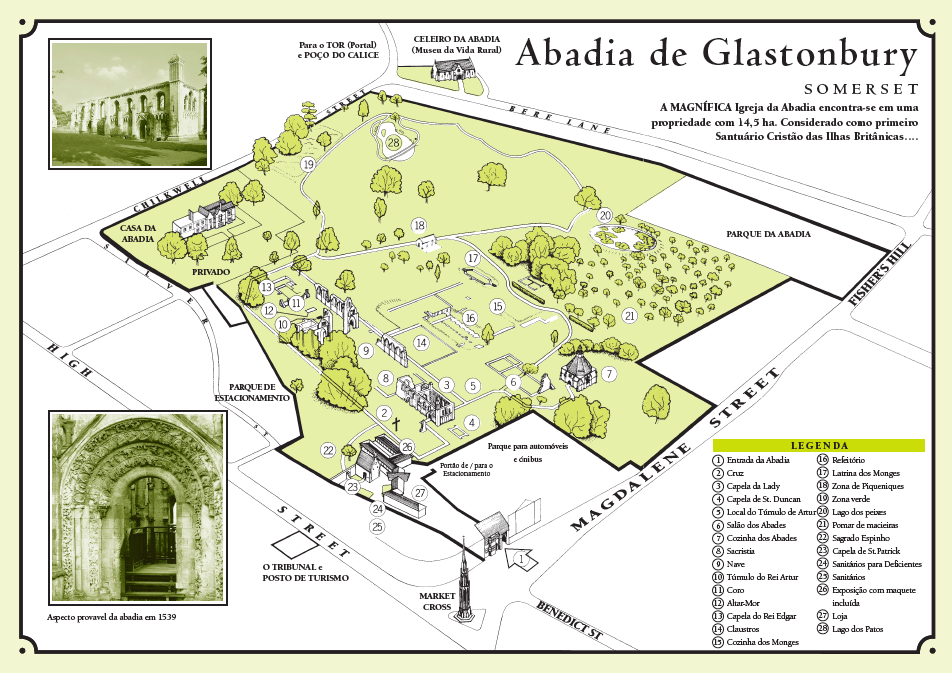
Abaixo o mapa desse lugar tão especial e a tabela com os preços de entrada. Os portões abrem às 9h da manhã. Em junho, julho e agosto só fecham às 20h. Março, abril e maio às 18h. Setembro, outubro e novembro às 17h e os demais meses (inverno) às 16h. Mais informações no site da Abadia.

Below goes the map of this unique place and the fares of admittance. The opening time is 9 a.m. but the closing time changes according to the season. In June, July and August it goes up to 8 pm. March, April and May 6 pm. September, October and november 5 pm and in wintertime the gates close at 4 pm.More information can be found in the site of the Abbey:

www.glastonburyabbey.com

Mapa em inglês / Map in English

Mapa em português / Map in portuguese

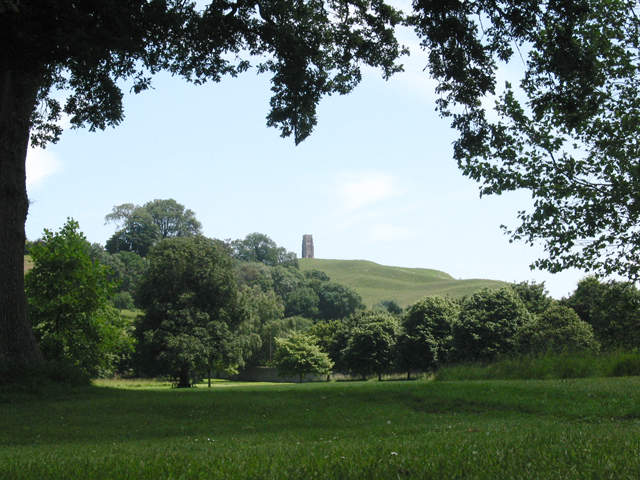
Vista do Tor / Tor View from the Abbey Garden.

O lago dos peixes / The Fish Pond

Um dos maiores carvalhos, junto ao lago. O carvalho é uma árvore sagrada para os druidas. One of the highest oak trees, close to the Fish pond. The oak is a sacred tree for druids.

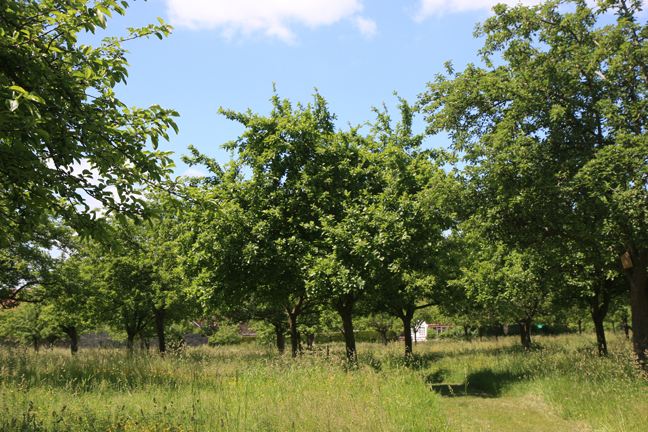
O pomar de macieiras. Avalon era antigamente conhecida como a Ilha das Maçãs.
The apple trees orchard. Avalon was known, in times of old, as the Isle of Apples.

Maçãs, embora pareçam romãs!
Apples, although they look like pomegranates!

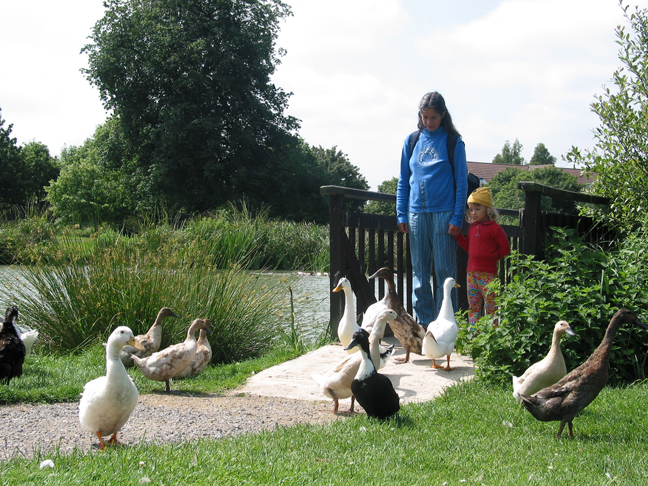
O lago dos patos / The Duck Pond

Os patos não são tão amistosos quanto deveriam, bati esta foto e saí correndo.
Ducks, not as friendly as they should be. I took the photo and ran.

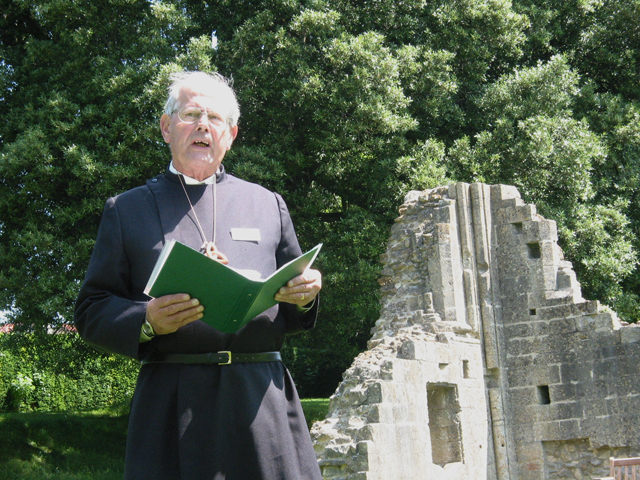
Um padre junto à cruz na entrada / A priest close to the Cross in the entrance

O padre é na verdade um capelão, e faz orações diariamente onde ficava o altar. The priest is actually a chaplain, who leads prayers everyday in the spot where once stood the High Altar.

Junto à loja de souvenirs encontra-se o Museu da Abadia.
The Museum, next to the Gift Shop.

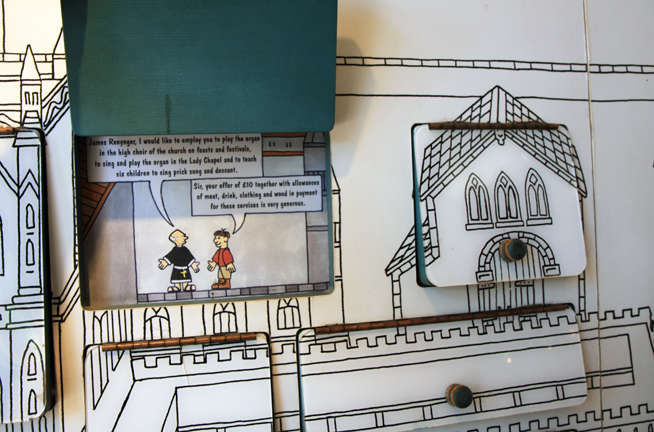
Painel interativo no Museu
Interactive panel in the Museum

Abrindo as janelinhas há informações sobre a vida na Abadia, ilustradas com personagens representando as pessoas que ali viviam e trabalhavam. As crianças adoram.
Behind each lid, characters present information on ancient life and work at the Abbey. Children love it!

Painel sobre Arthur. A ilustração mostra os monges desenterrando seu enorme caixão de carvalho, sobre o qual uma cruz trazia a inscrição: “His iacet inclitus Arturius in insula Avalonia” que significa ” Aqui jaz o Rei Arthur, enterrado na Ilha de Avalon”.
Panel about Arthur; monks are depicted unburying his massive oaken coffin, beneath a cross with the inscription “His iacet inclitus Arturius in insula Avalonia”, what means “Here lies King Arthur buried in the Isle of Avalon”.

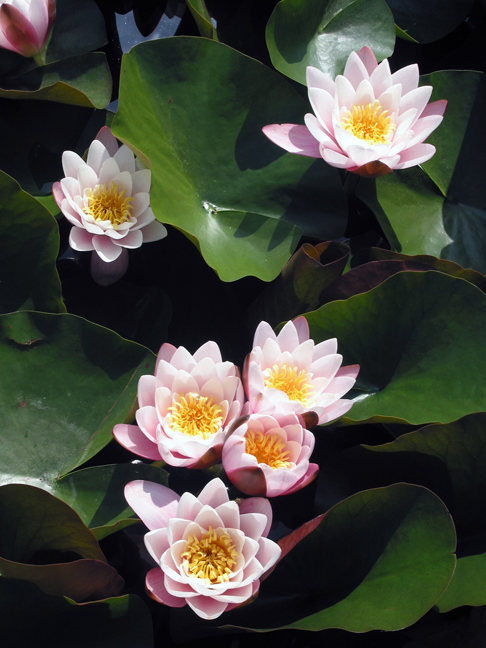
Fecho este post com as flores do amor-perfeito / It’s the end of this post, Forget-me-not!

Read Full Post »


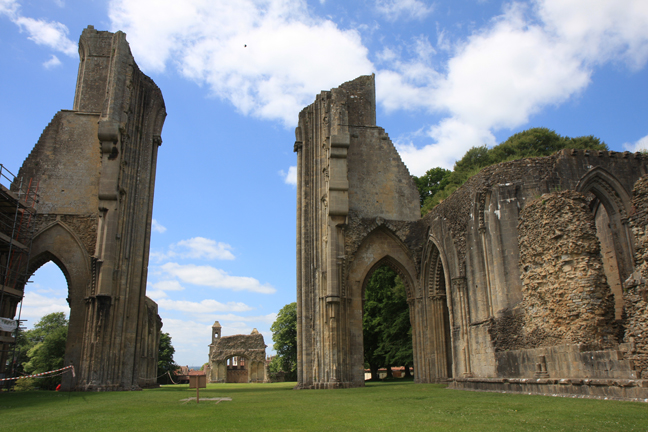
Abadia de Glastonbury / Glastonbury Abbey, Magdalene Street.

Este post é basicamente um álbum de fotos, fazendo um tour pela Abadia e Museu.
Somei fotos tiradas em diferentes dias, por isso a variação de luz.

This post is basically a photo album, a tour in Glasto Abbey and Museum. I added photos taken at different times and days, that’s why the light is not uniform.

Entrada / Entrance

Corredor de entrada, ao fundo loja de souvenirs e museu./
Entrance, at its end souvenir shop and museum.

Olhando para trás, ao fundo Magdalene Street.
Looking back at Magdalene St.

Estátua de José de Arimatéia, que trouxe o catolicismo à Grã- Bretanha.
Joseph of Arimathea statue. He brought catolicism to Britain.

Capela da Senhora à esquerda, jardins à frente e lanchonete à direita
Lady Chapel to the left, garden ahead and coffee shop to the right

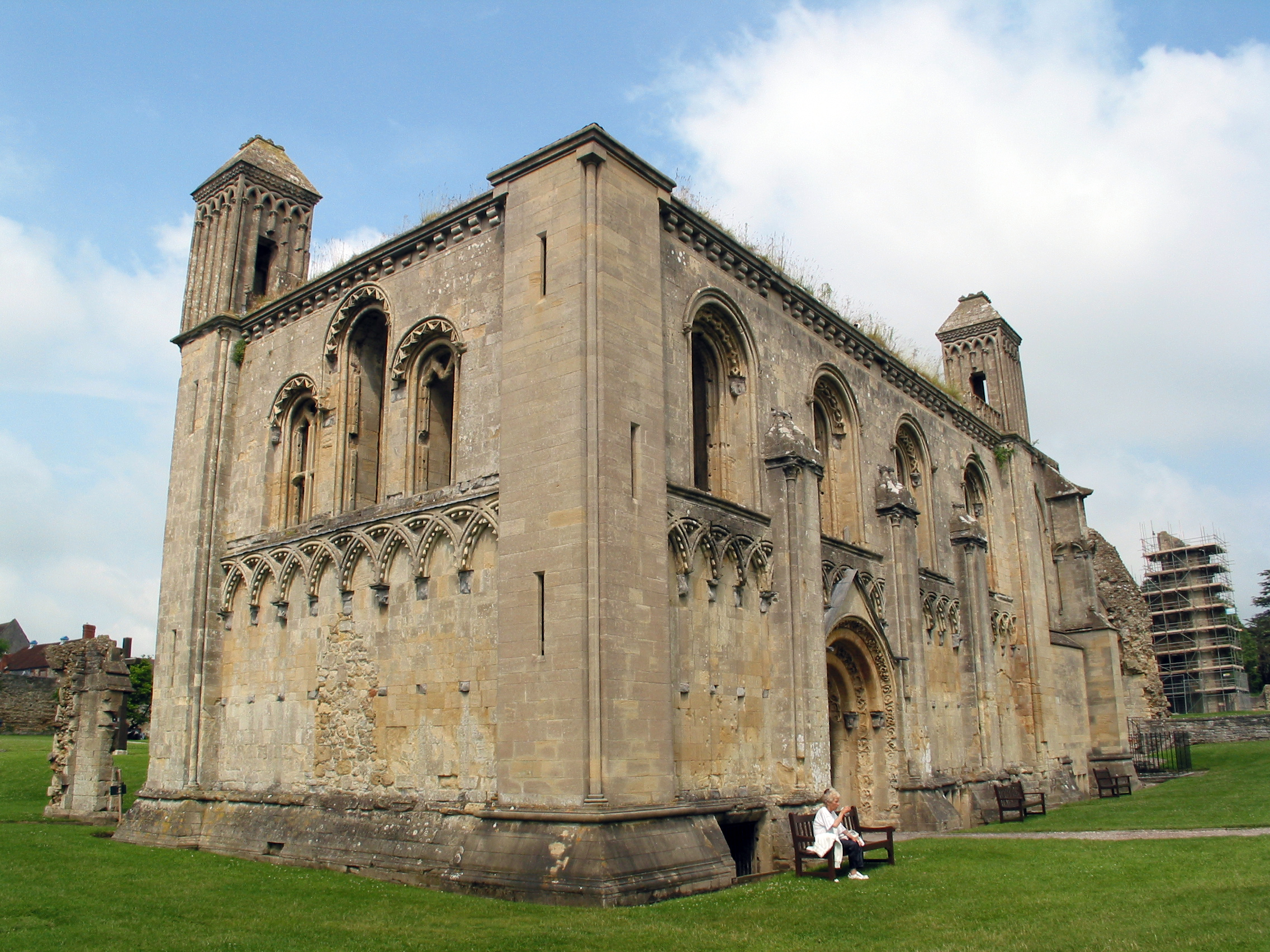
Lady Chapel

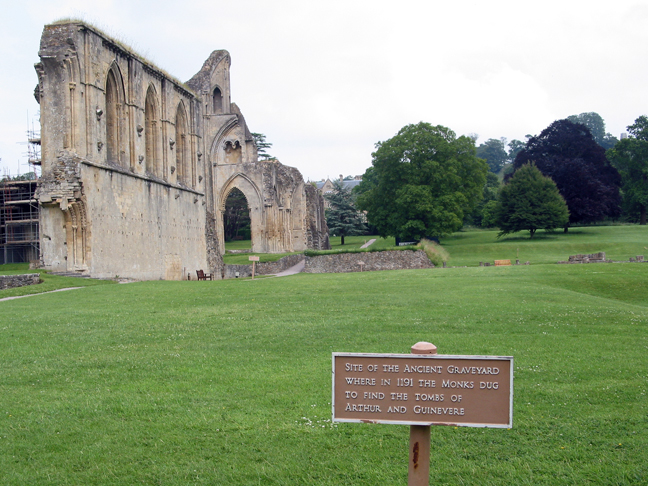
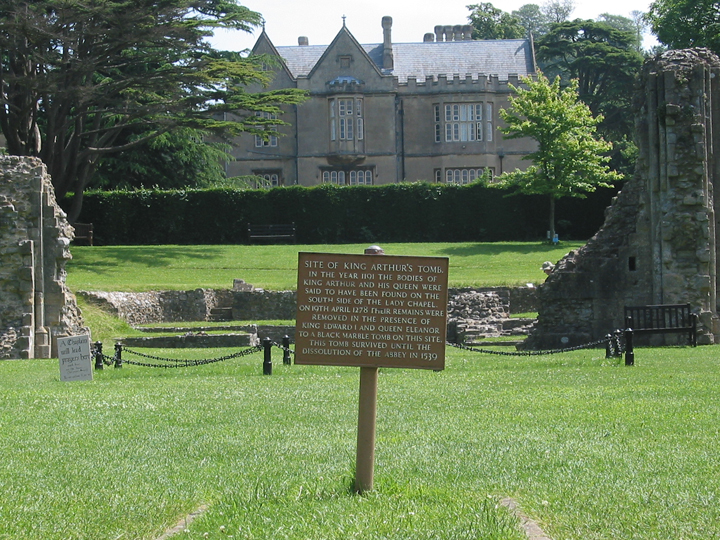
Local onde encontraram o túmulo de Arthur, ao fundo a Nave da Abadia
Site where Arthur’s grave was found; the Nave in the background

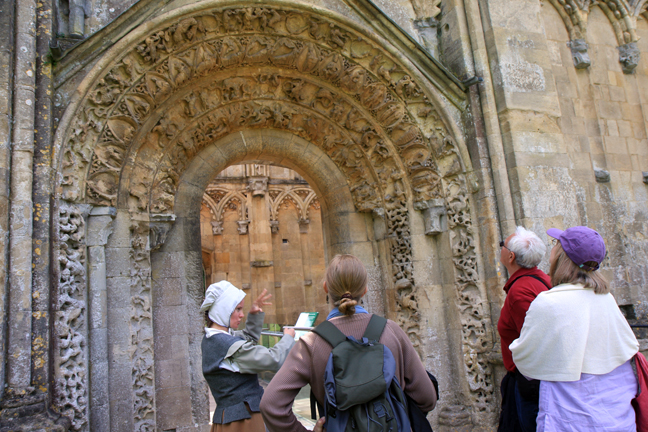
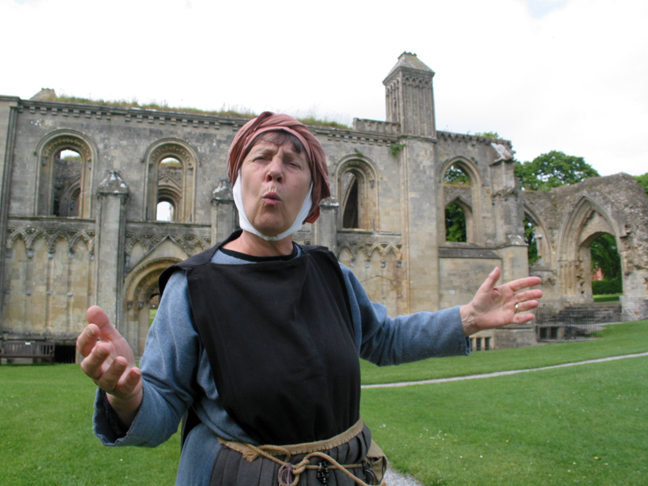
Guia em trajes de época mostrando detalhes do portal da Capela da Senhora
Guide wearing period clothes showing tourists details of Lady Chapel’s gate

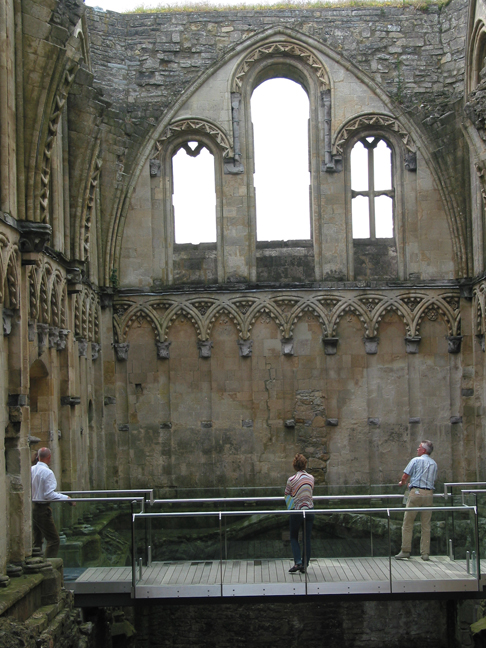
Inside Lady Chapel

Saindo da Capela em direção à Nave
Walking from Lady Chapel towards the Nave

A nave restaurada; ao centro o local onde foi construído o mausoléu de Arthur em 1278
The restored Nave; in the centre the place where Arthur’s Tomb was built in 1278

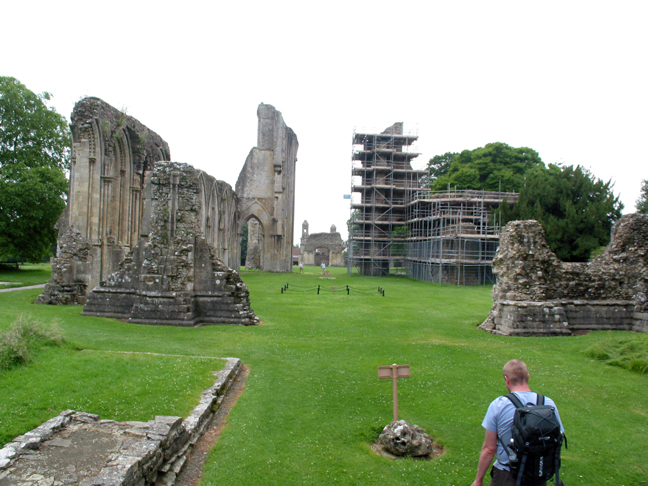
Vista da Capela do Rei Edgar, altar principal, coro e nave ainda em restauração, em 2005
Overview of Edgar Chapel, High Altar, choir and Nave still in restoration, in 2005

O que sobrou do túmulo de Arthur; ao fundo a Casa da Abadia, fechada a visitação
What remains of Arthur’s Tomb. In the background, the Abbey House, private.

Guia vestida de cozinheira
Guide dressed as a cook

A cozinha dos monges é uma das construções históricas mais bem preservadas da Inglaterra.
The Monk’s kitchen is one of the best preserved historic sites in England.

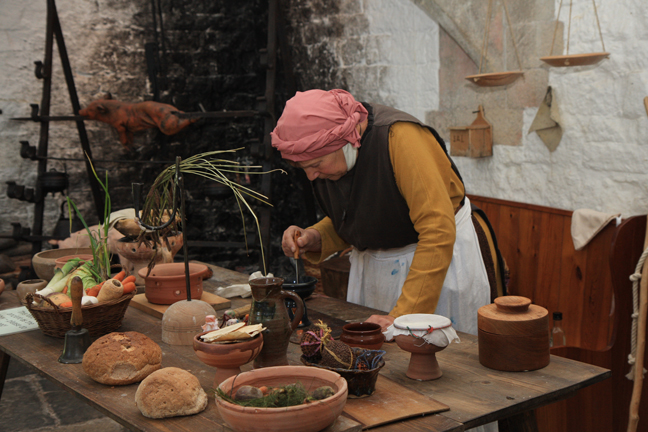
Ambientação no interior da cozinha com a cozinheira trabalhando, utensílios e alimentos de época.
Inside the kitchen, the period atmosphere is recriated with the cook working, food and vessels

Read Full Post »


Da janela do trem de Londres para Salisbury avista-se um enorme cavalo carvado na montanha, uma das tantas “figuras de giz” que existem no Reino Unido; postarei fotos em breve com mais informações. One of the many massive horses (chalk figures) of UK seen by the window, in the train from London to Salisbury. Soon more photos and information on the subject.

Minha viagem foi incrível, porém caótica. Como eu tinha casa em Londres, fiquei o tempo todo voltando para lá em vez de traçar uma rota e seguir sempre em frente. Mas não, fiquei indo e vindo como um peru tonto na véspera de Natal. Talvez por estar viajando sozinha pela primeira vez, ter a casa do Fernando como base me dava segurança. Além disso, carregar a mala para toda a parte seria… uma mala sem alça! Imagine ir ao Solstício com aquele trambolho. Deixava a mala em Londres e levava uma mochila para viagens curtas. As estações não tem guarda-volumes, por medo de atentados a bomba.  Além disso, a passagem ida e volta é mais barata.
A primeira viagem foi em 2005; não faz tanto tempo assim, mas a Internet evoluiu uma barbaridade nesse tempo. Não havia Google Maps, Wikipédia, Facebook, blogs ou Twitter. Nem celular acessava a Internet!
Recomendo sempre consultar na Wikipedia (em inglês) as cidades que se pretende visitar. Além das informações básicas, há sempre uma lista de links onde consta o site oficial das cidades, que facilita muito a reserva de acomodações.
Pessoalmente, gosto de me hospedar em albergues, pois são bons, baratos e você sempre pode fazer amigos. A palavra chave no Google é backpackers, mas adianto aqui alguns links.

My trip was amazing, but chaotic. As I had a “home” in London I kept going back there instead of going straight ahead. I went forth and back like a drunk turkey in Christmas’ Eve. Maybe I felt safe and warm with Fernando, that was my first trip all by myself. Besides, I had a suitcase to carry, it was such an encumbrance, imagine taking it to Summer Solstice! Lockers are not available in stations anymore, people are afraid of bomb attacks. And return tickets are cheaper. So I ‘d rather do with a backpack and shorter journeys, leaving the suitcase in London.
My first trip was in 2005, not so long ago, but Internet developed tremendously in the meantime. I had no Google, Wikipedia, Facebook, blogs or Twitter. Mobiles couldn’t access the web.
My advice is to search the cities you want to go in the english Wikipedia. There’s always plenty of basic information and links to the cities’ official sites, which helps a lot to book accomodation.
I’m fond of hostels because they’re fine and fair, and a good place to make friends.
The keyword in Google is backpack, but here you have some links:

www.backpackers.co.uk

www.hostels.com

www.bug.co.uk

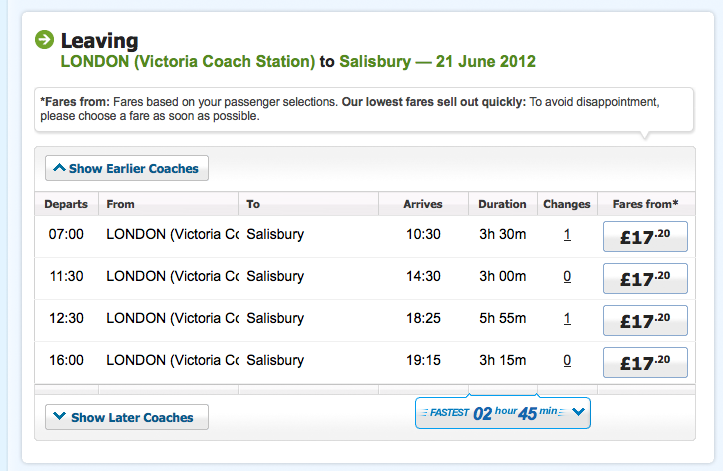
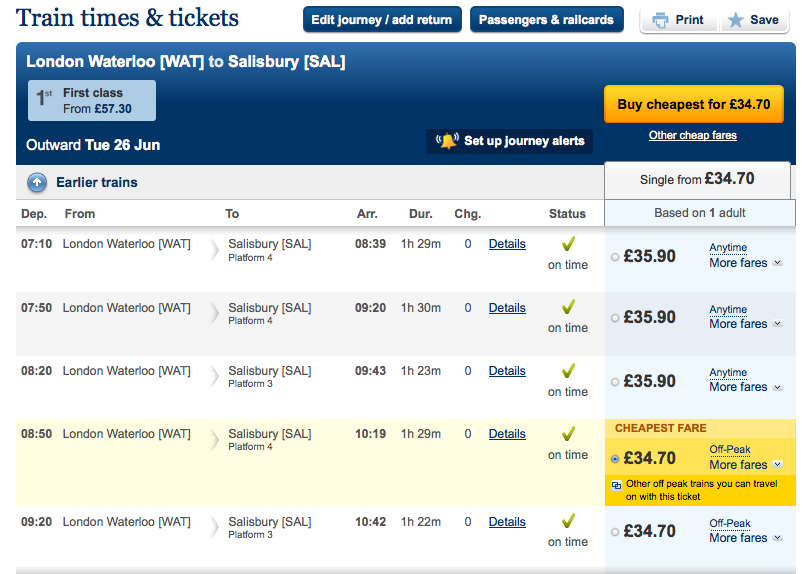
Para ir de Londres a Salisbury, você pode pegar o trem em Waterloo Station ou o ônibus em Victoria Station. Ambos tem saídas frequentes, mas compare preços e duração da viagem. Às vezes o preço da passagem é o mesmo mas um trem faz muito mais paradas que o de outro horário,  podendo a mesma viagem levar uma ou três horas. A quantidade de baldeações também faz muita diferença, especialmente se você carrega muito peso.

To go from London to Salisbury you can take a train in Waterloo Station or a coach in Victoria Station. Both provide frequent departures; you want to compare fares and duration. Sometimes the fare is the same but one train stops many times more than the next, so your trip can be twice or three times longer. Mind how many times you’ll have to transship, specially if you carry heavy bags.

Horários e preços de ônibus de Londres para Salisbury, partindo de Victoria Station

Trem de Londres para Salisbury: mais confortável, porém mais caro / From London to Salisbury by train: more comfortable, but more expensive

De Londres para Glastonbury não há trem, apenas ônibus com baldeação. Há quem vá de avião até Bristol, mas de lá terá que embarcar num ônibus. Saem vôos dos aeroportos de Heathrow e Gatwick.

From London to Glastonbury there’s no train, only coaches and buses. You can fly to Bristol but from there you can’t avoid the bus. Flights depart from Heathrow and Gatwick airports.

Londres/Glasto de ônibus
London/ Glasto by coach and bus

Viagem mista: London/Glasto de trem e ônibus, via Bristol
London/Glasto by train and bus changing in Bristol

Outra possibilidade de viagem mista: London/ Glasto Via Taunton, menos baldeações
Another possibility, through Taunton, you only change once

London/ Glasto through Bath

Analisando todos os trajetos, caso você queira refazer meus passos, partindo de Londres sugiro ir primeiro a Glastonbury. De Glastonbury pegue o ônibus para Bath, conforme linha acima. De Bath siga para Salisbury, para visitar Stonehenge. Salisbury é ponto de baldeação para: Cardiff, no País de Gales;Winchester, Avebury (a 37 km de Stonehenge) e outros lugares aonde chegaremos neste blog, como Tintagel, na Cornualha.

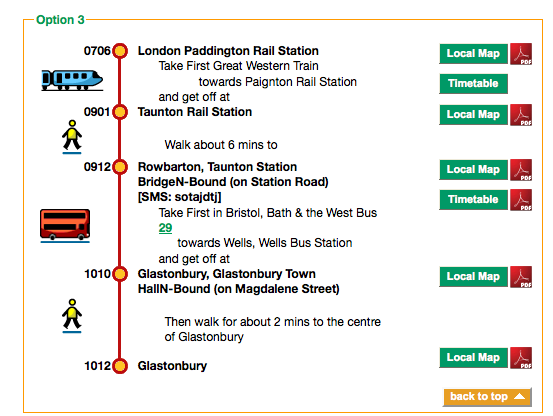
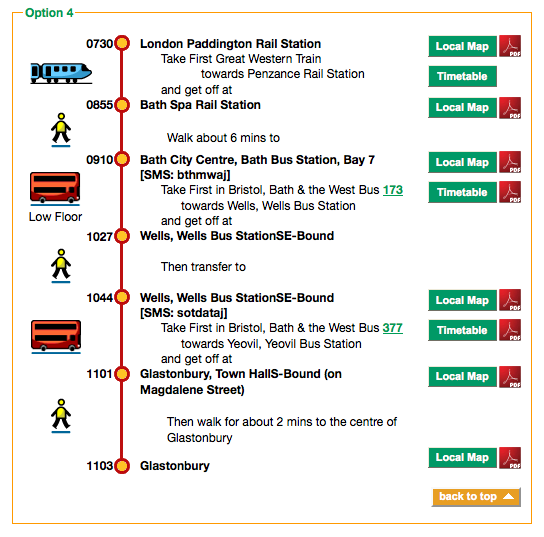
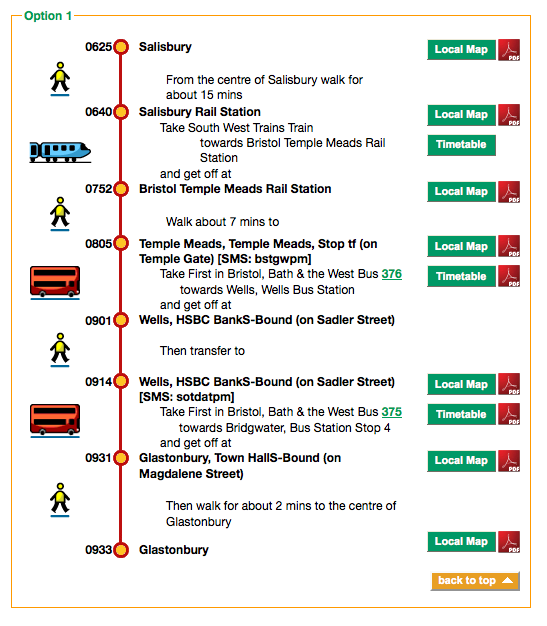
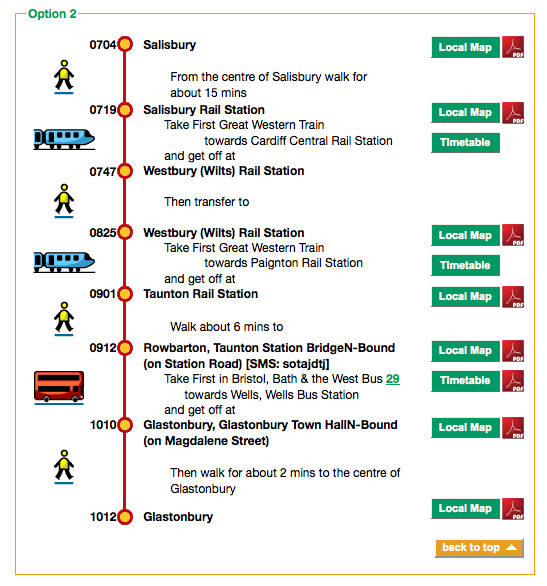
If you want to follow my steps, from London you better go straight to Glastonbury. From there take the bus to Bath. From Bath go to Salisbury, to visit Stonehenge. Salisbury is the place to change to Cardiff in Wales; Winchester, Avebury ( about 22 miles from Stonehenge) and many other places we’ll be arriving soon in this blog, as Tintagel in Cornwall. I got  these coach and train routes in this useful site for planning trips in UK. You’ll see below  the options to go from Salisbury to Glastonbury.

Estas viagens mistas obtive num site muito útil para planejar uma viagem no Reino Unido:

www.travelinesw.com

Aqui as opções para ir de Salisbury a Glastonbury:

Salisbury/ Glasto option 1

Salisbury/ Glasto option 2

Salisbury/ Glasto option 3

Para mais informações sobre trens/ More  train information:

www.nationalrail.co.uk

www.southwesttrains.co.uk

www.mytrainticket.co.uk

www.crosscountrytrains.co.uk

Ônibus / Coach:

www.nationalexpress.com

Read Full Post »


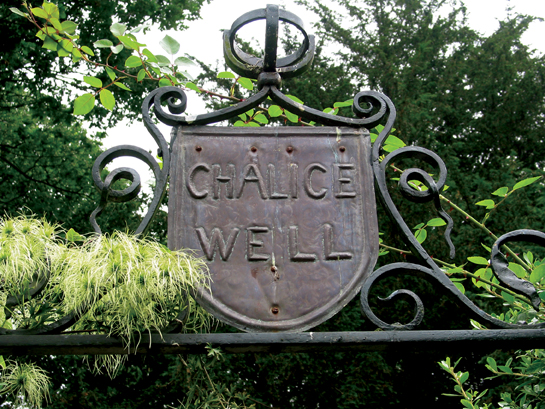
The Chalice Well Trust
Chilkwell Street, Glastonbury, Somerset – BA6 8DD – phone: 01458 831154

Existem evidências arqueológicas de que o poço vem sendo usado há pelo menos dois séculos. A água jorra abundante, cerca de noventa e cinco mil litros por dia, mesmo em épocas de seca.
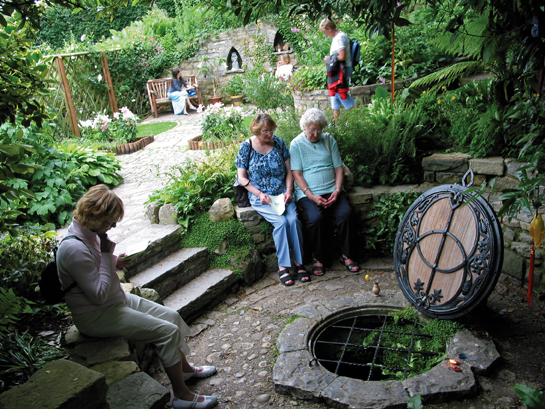
Nas mitologias galesa e irlandesa, os poços são portais para o mundo dos espíritos, e o desenho da tampa do poço (Vesica Piscis) representa justamente a interseção entre os dois mundos, cortados ao meio por uma lança ou espada associada à Excalibur, a legendária espada do rei Arthur.

Archaeological evidence suggests that the well has been in almost constant use for at least two thousand years. Water issues from the spring at a rate of 25,000 gallons per day and has never failed, even during drought. Wells often feature in Welsh and Irish mitology as gateways to the spirit world. In the well lid design, known as Vesica Piscis, the overlapping of the inner and outer worlds is represented by two interlocking circles, bisected by a spear or sword, a possible reference to Excalibur, King Arthur’s legendary sword.

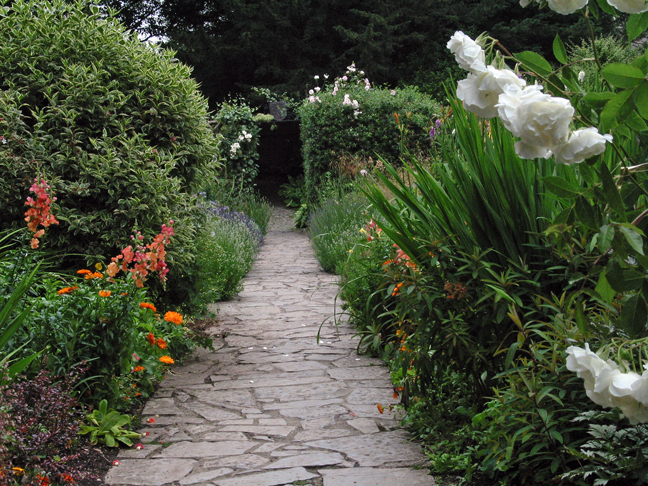
O lindo jardim, rumo ao poço / Inside the beautiful garden, heading to the well itself

Para os cristãos, dentro deste poço foi escondido o Graal, o cálice que teria recolhido o sangue de Cristo durante a crucificação. Isso, segundo a lenda, foi feito por José de Arimateia, um discípulo que fugiu para a Britânia de barco, dirigindo-se a Glastonbury.

Christians believe that in this well is hidden the Holy Grail, the chalice in which drops of Jesus’ blood was collected during crucifixion by Joseph of Arimathea, one of his disciples who fled by boat to Britain, heading for Glastonbury.

Poço do Cálice / Chalice Well

Vesica Piscis

O desenho de folhagens em torno do Vesica Piscis na tampa do poço faz referência ao Espinheiro Sagrado que teria brotado no exato local onde José fincou seu cajado, em Wearyhall Hill. Esta árvore era incomum por florir duas vezes por ano; a floração no inverno era considerada milagrosa. Embora sagrada, a árvore acabou morrendo. Antes, porém, os monges tiraram mudas e algumas estão lá até hoje.

Foliage around the Vesica Piscis represents the Glastonbury Holy Thorn, a tree supposed to have grown in the spot where Joseph thrust his staff, Wearyhall Hill. The thorn flowered twice in a year, what is unusual. Its flowering in mild weather just past midwinter was accounted miraculous. Despite its holiness, the tree died. However, many cuttings were taken from it by the monks and still live in Glastonbury.

Um pequeno lago dentro do jardim foi construído na forma do Vesica Piscis / A Vesica Piscis shaped pool inside the garden

Espinheiro em Wearyhall Hill, ao fundo o Tor / Thorn tree in Wearyhall Hill overlooking the city, the Tor in the background

Todo ano um galho do espinheiro de Glastonbury é enviado à Rainha no Natal. Isto começou no tempo da Rainha Anne.
Every year, a branch of the Glastonbury thorn is sent to the Queen at Christmas. This started in Queen Anne’s reign.

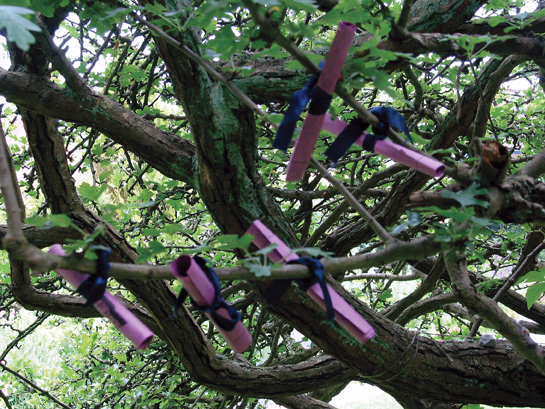
Espinheiro no jardim do Chalice Well, onde as pessoas amarram seus desejos por escrito / People tie their written wishes in the Thorn trees inside the Chalice Well garden

Read Full Post »


Avalon era uma ilha envolta em brumas, perto da Abadia de Glastonbury – daí esta cidade entrar na minha lista de lugares para serem conhecidos. No tempo do rei Arthur, o mar ficava pouco adiante. Na maré alta, o nível da água subia. Na maré baixa, o terreno ficava pantanoso, daí as brumas. Séculos de alterações climáticas e drenagens visando tornar aquela extensão de terra cultivável transformaram o terreno no lugar que é hoje a região de Somerset. O que era a Ilha de Avalon agora é apenas uma colina – o Monte Tor. Contudo, seu espírito ainda está lá, e jurei a mim mesma que haveria de pisar naquele solo sagrado.
Passei a procurar avidamente por livros sobre esse assunto. Quem nasceu na década de 60 não tinha computador, nem existia internet. Isso dificultava tudo. Em livrarias, apenas As Brumas tratavam da história de Arthur. Até que um dia caiu em minhas mãos The Crystal Cave, livro de bolso em inglês de autoria de Mary Stewart. Aliás, não um, mas quatro volumes contando a história a partir do ponto de vista de Merlin!
Existem controvérsias se Merlin era um determinado ser ou um título – o Merlin da Bretanha, o mais poderoso dos druidas, chefe dos demais. De toda forma, este personagem é associado pelos estudiosos ao País de Gales, onde se supõe que sua caverna esteja localizada – é a Crystal Cave do título do livro. Assim conheci novos personagens e mais luz foi lançada sobre outros. Foi um grande incentivo para desenvolver meu inglês, que não era tão mau.
Comecei a estudar Wicca (religião pagã ancestral, que tem paralelos com o druidismo) depois de ler A Cozinha da Bruxa, de Marcia Frazão, e aprendi sobre o ciclo das estações, foi assim que o sonho de presenciar o Solstício de Verão em Stonehenge veio à tona. Em 2005, trabalhava como freelancer, o que me dava certa liberdade. Sempre que ganhava algum dinheiro, comprava euros e libras. Certo dia, procurando na web, achei o site Isle of Avalon, de um pessoal justamente de Glastonbury. Pesquisando vi que ficava perto de Stonehenge, onde até hoje se comemora o Solstício de Verão. Rota traçada! Contatei um amigo que vive em Londres há anos; ele me garantiu uns dias de estadia. Ainda no site de Avalon, achei um ashram (comunidade que visa evolução espiritual), onde aceitavam hospedar voluntários. Fiz o contato por e-mail explicando que viria do Brasil e me propunha a pagar a estadia com trabalho, e alguém que assinava Ehlan respondeu. Achei que fosse uma mulher pelo nome, mas era um homem! Ele propôs uma data em que teriam vagas; como seria pouco depois do Solstício, aceitei.
Consegui a última passagem pelo preço de baixa estação na Air France, parcelada no cartão de crédito. Dois dias antes do Solstício. O passaporte já estava pronto havia mais de um ano. A primeira coisa que se faz quando se quer viajar é tirar um passaporte.
Desembarquei em Heathrow dia 18 de junho de 2005.

Avalon was an island amongst mists, near the Glastonbury Abbey; so this city entered my travel wish-list. In Arthurian times, the sea was just ahead. Flooded in the high tide, the terrain turned to a swamp in the low tide, what explains the mists. Centuries of climate changes and draining work to enable agriculture dried the land which is Somerset nowadays. Of the Isle of Avalon only a hill was left – The Mount Tor, but I knew its spirit lingered, so I swore I’d set my feet in that holy land.
I started looking for more books on the subject, unsuccessfully, until the day I found The Crystal Cave, of the english writer Mary Stewart. And it was not only one, but four books telling Arthur’s story from Merlin’s point of view.
There are controversies if Merlin was one person or a title – The Britain’s Merlin, the most powerful druid, chief to the others. Anyway, this character is related to Wales, where his cave was supposed to be located, the crystal cave of the title. This book threw light over some characters and introduced me to others in Arthur’s tale.
I started to study Wicca ( ancestral pagan religion, that holds resemblance to druidry) after reading The Witch’s Kitchen, written by Marcia Frazão, and learned about the wheel of the seasons. Then emerged my dream of going to Summer Solstice in Stonehenge. In 2005 I worked as freelance, what provided me some freedom. Everytime I could I set money apart to buy pounds and euros. And one day found in the web the site Isle of Avalon, from people in Glastonbury. After a bit of research, I realized the two places were a short run from each other. In the same site I found a hostel, actually an ashram where voluntaries were accepted, so I e-mailed them proposing to pay my lodging with work, and they had vacancies for a few days after the Solstice!
After set this up, I contacted a friend who has been living in London for years, who assured me I could stay with his family a few days. I got the last low-season ticket in Air France, to pay in my credicard in six parcels, and my passport was ready. First thing to do when you want to travel is have a valid  passport, I had seen to that one year before. So, the 18th June of 2005 I landed in Heatrow.

Read Full Post »


Todos os jovens desejavam se tornar cavaleiros. Arthur, tido como bastardo, tornou-se escudeiro de Kay, que pensava ser seu irmão mais velho.  O tempo passou e, quando Arthur tinha quinze anos, Sir Hector e Kay puseram-se em marcha para um torneio ao qual iriam todos os cavaleiros do reino, pois entre eles seria escolhido o sucessor de Uther, que não teve outros filhos. O território britânico continuava dividido em vários pequenos reinos – o feudalismo que estudamos nas aulas de História. Conta a lenda que a espada de Sir Kay desapareceu na hora do torneio. Arthur, então, saiu correndo para buscá-la. Talvez ele mesmo tivesse  esquecido de levá-la…  Mas no caminho perdeu-se na floresta, e deparou-se com uma pedra e uma bigorna onde estava cravada uma magnífica espada. Coisa digna de um rei. Em algumas versões existe apenas a pedra, sem bigorna (enorme bloco usado como ferramenta pelos ferreiros), mas  o disco de Rick Wakeman começa com o narrador lendo a frase gravada na pedra: “Who pulleth out this sword from the stone and anvil is the true born king of all Britain”, ou seja, “Aquele que tirar esta espada da pedra e da bigorna é o verdadeiro rei, por direito de nascença, de toda a Bretanha”.
Arthur não sabia ler – poucos além dos padres sabiam – mas viu aquela espada sem dono ou
propósito aparente, e resolveu levá-la para o irmão. Puxou a espada, que se desprendeu facilmente da
pedra, como se estivesse espetada em massa de modelar. Ninguém no torneio acreditou que o menino houvesse realizado tal feito. No entanto, Merlin surgiu e revelou a identidade secreta de Arthur, que acabou
reconhecido como rei, apesar da discordância dos nobres que cobiçavam o trono para si.

Every kid wanted to become a knight. Arthur, as a bastard, became a squire to his foster brother Kay.
Thus time went by and, when Arthur was fifteen, Sir Hector and Kay set their company in march to a tournament. Each and every knight of all realms was doing the same, because amongst them would be chosen King Uther’s sucessor, for he had no more sons with Igraine. British lands were still divided in lesser kingdoms – the feudalism we studied in History class. The tale tells that Kay’s sword disappeared when his time to joust was come, so Arthur hurried back to the camp to find it. Maybe he had forgotten it himself…
But Arthur, on his way, got lost in the forest and ran into a massive stone, with an anvil and a magnificent sword stuck in it. A sword fit for a king! Some authors only mention the stone, without anvil, but Rick Wakeman’s album starts with the  storyteller’s voice reading the words carved in the stone: “Who pulleth out this sword from the stone and anvil is the true born king of all Britain”.
Arthur couldn’t read – few people but the priests did – but saw that sword that seemed to belong to no one, in that weird place, and decided to take it to his brother. He easily pulled the sword free from the stone as if it was stuck in modeling clay. Back in the tournament, nobody believed that the boy had done that deed. Then Merlin appeared and revealed Arthur’s bloodline. He was crowned King in the end, despite many lords disagreed because they greeded the throne for themselves.

Read Full Post »

« Newer Posts