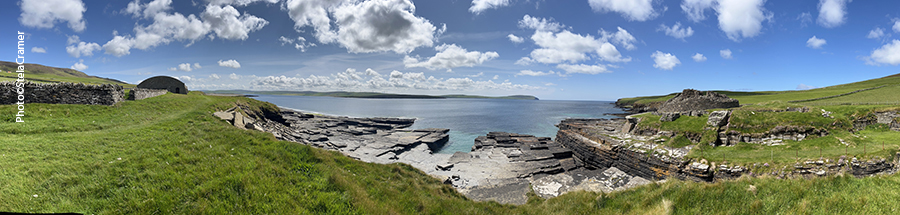
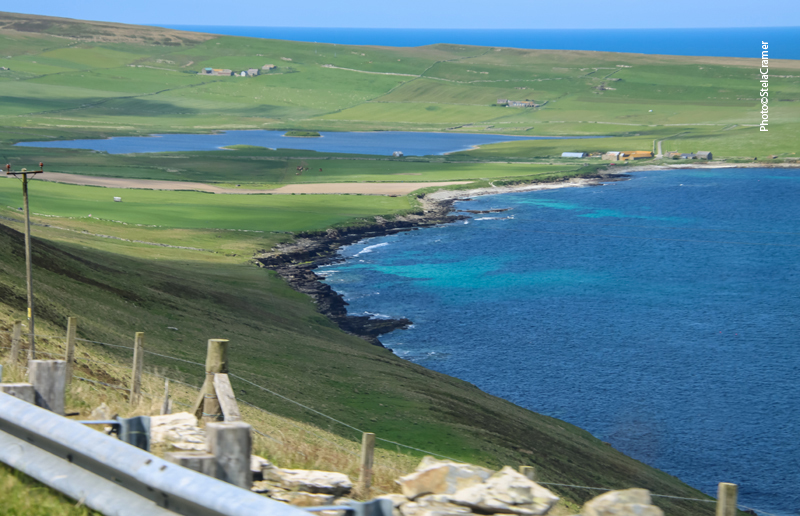
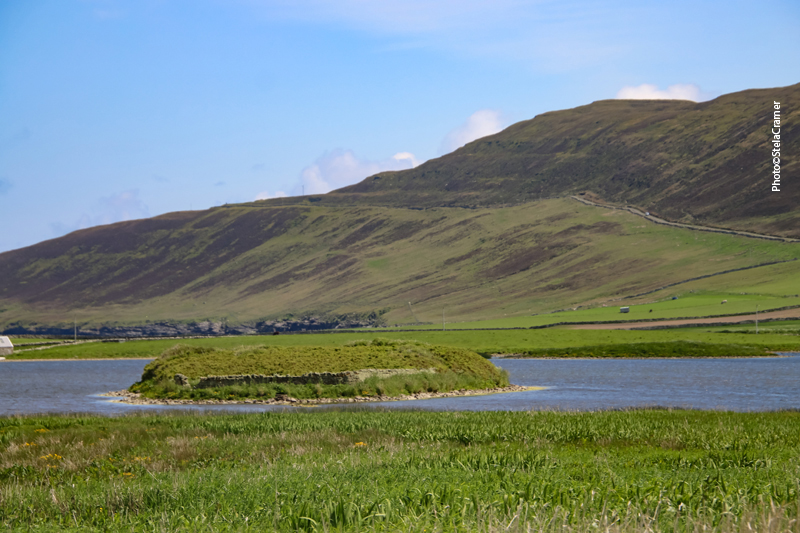
Feeds:
Posts
Comentários

Posts Tagged ‘Ilhas Órcades’


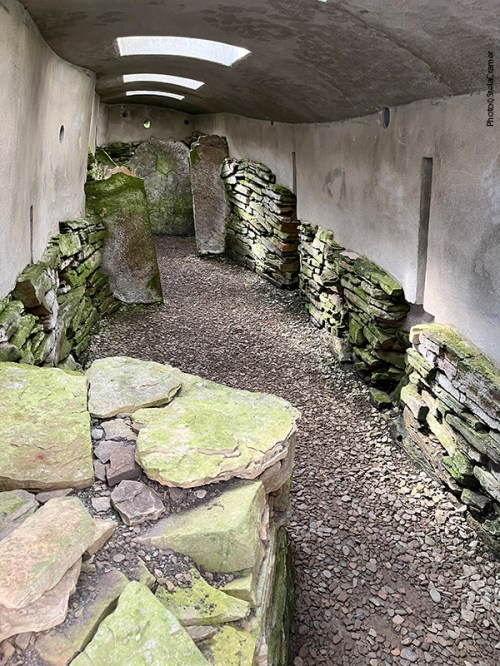
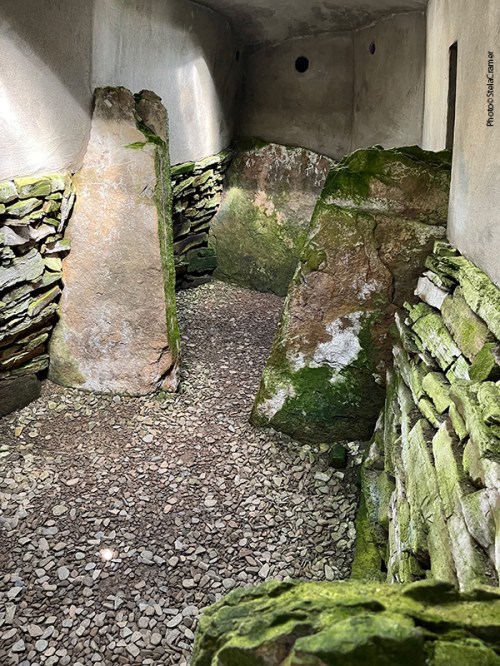
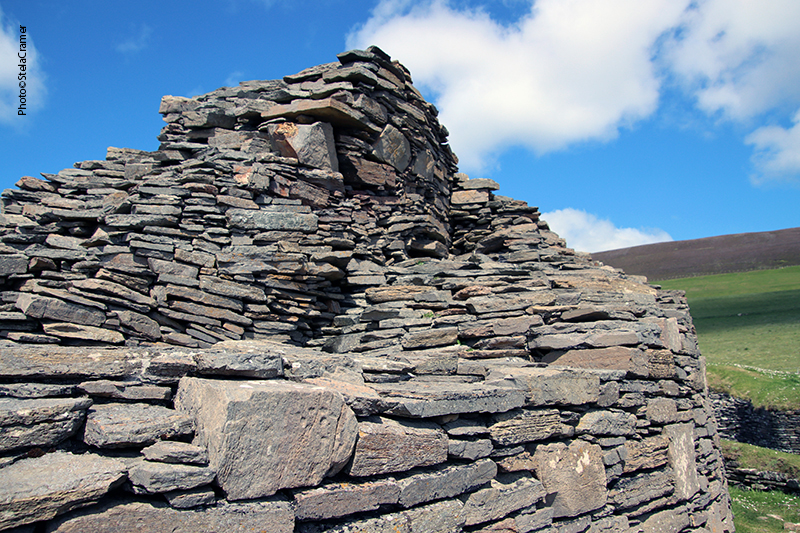
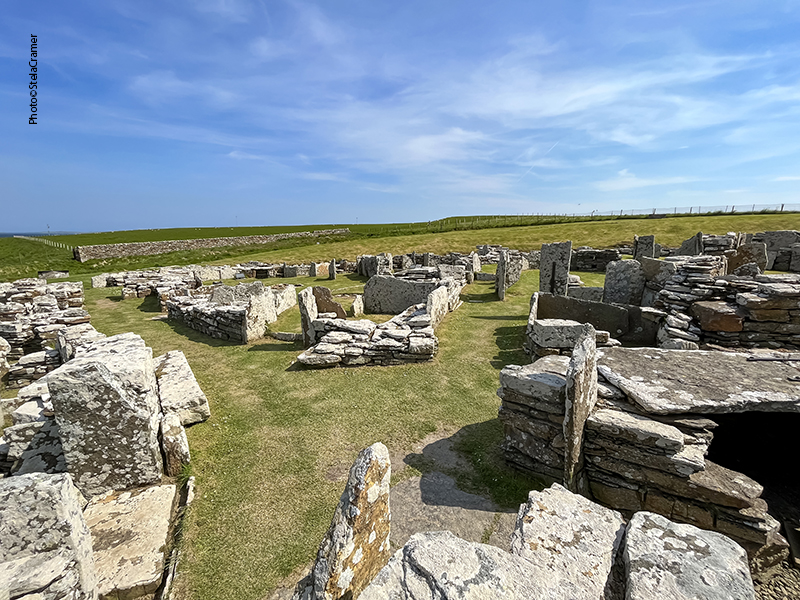
O tour de Rousay terminou com a visita a mais duas câmaras mortuárias: Blackhammer e Taversoe Tuick. Ambas estão protegidas da erosão por uma redoma de concreto. Blackhammer era meio mais do mesmo mas T Tuick foi uma surpresa.

Rousay tour ended with two more burial chambers: Blackhammer e Taversoe Tuick. Both are protected from erosion by a concrete dome. Blackhammer was pretty average but T Tuick held a surprise!


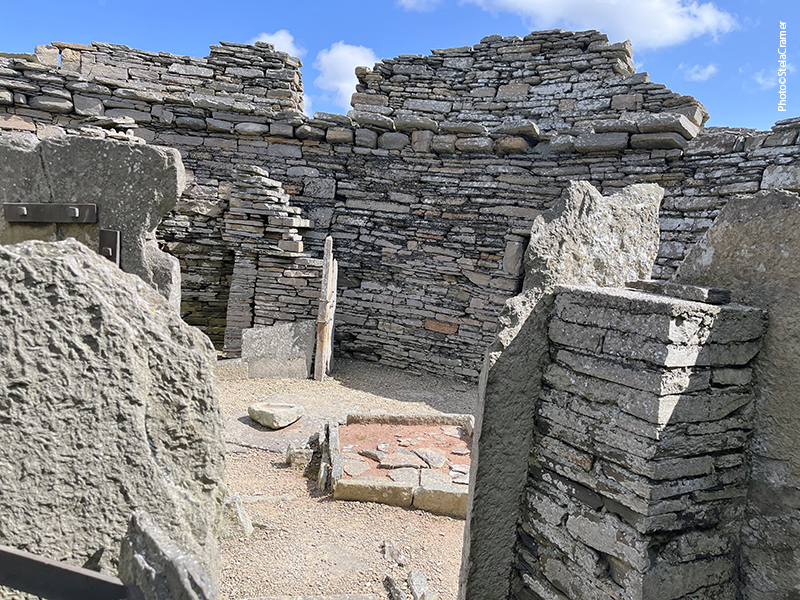
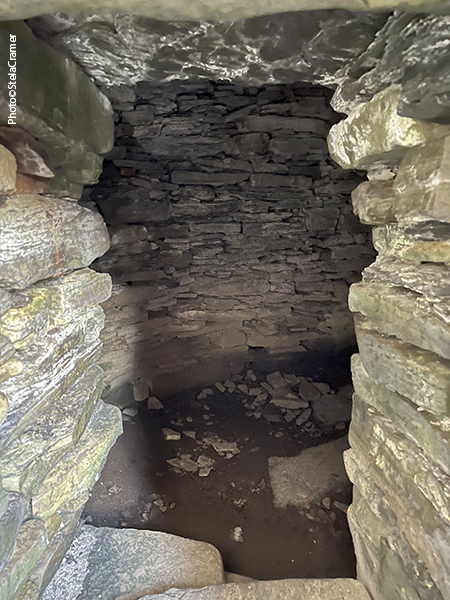
Em Blackhammer foi construída uma clarabóia ao lado da entrada que permite a visão da câmara e iluminação natural. /A skylight built beside the entrance allows the chamber’s view and natural light inside.
A placa mostra um corte de Blackhammer, foto da câmara original e dos arqueólogos que comandaram a escavação em 1936. / The sign shows a section through Blackhammer and photos of the archaeologists and the chamber before being excavated in 1936.
Restos humanos e objetos foram encontrados em Blackhammer./ Human remains and objects were found in the chamber.
Blackhammer Interior

Pouco mais adiante chegamos a Taversoe Tuick, o grand finale do tour. Daqui, Patrick levaria o grupo para pegar o ferry em Trumland Pier de volta a Kirkwall. Eu ainda pernoitei no B&B The Taversoe , só retornaria a Kirkwall na manhã seguinte.

We eventually arrived at Taversoe Tuick, tour’s grand finale. From here, Patrick would drive the group to Trumland Pier, to take the ferry back to Kirkwall. I still stayed the night at The Taversoe B&B, only leaving for Kirkwall the next morning.
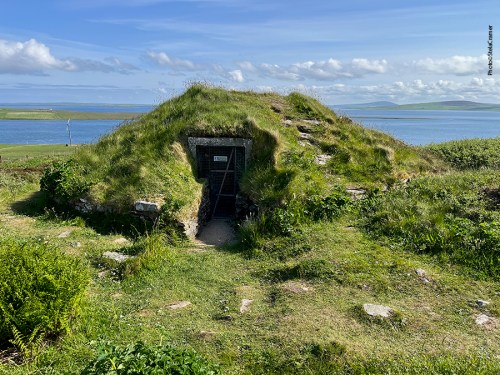
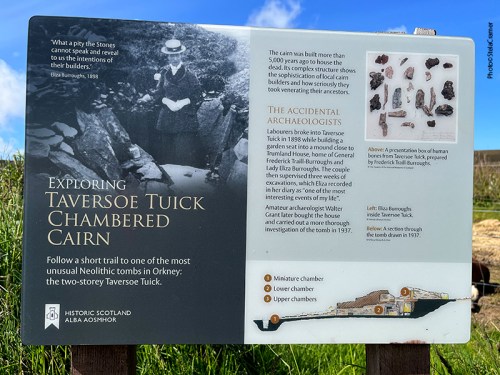
A 1km do Trumland Pier, com uma bela vista de Wyre Sound, Taversoe Tuick foi descoberto no fim do século 19, mas a principal escavação aconteceu apenas em 1930. / Situated overlooking Wyre Sound, only half a mile west of Trumland Pier, the Taversoe Tuick was first found in the late 1800s, before being excavated in the 1930s.

Este é o mais extraordinário dos túmulos em Orkney, pois apresenta dois andares. Este design é incomum: até hoje, apenas um outro foi encontrado com a mesma característica, em Eday.

It’s the most remarkable of all the Orkney cairns: a two-storeyed chambered cairn. This design is highly unusual, only another one like it was found ,so far, on Eday.

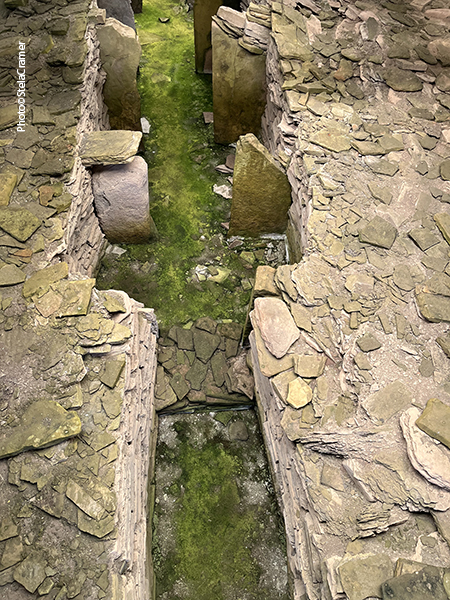
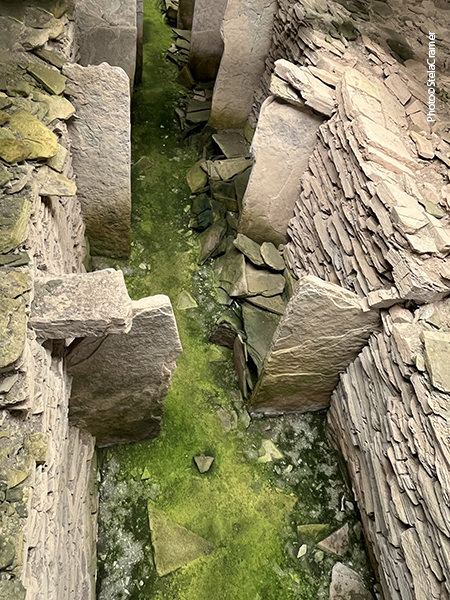
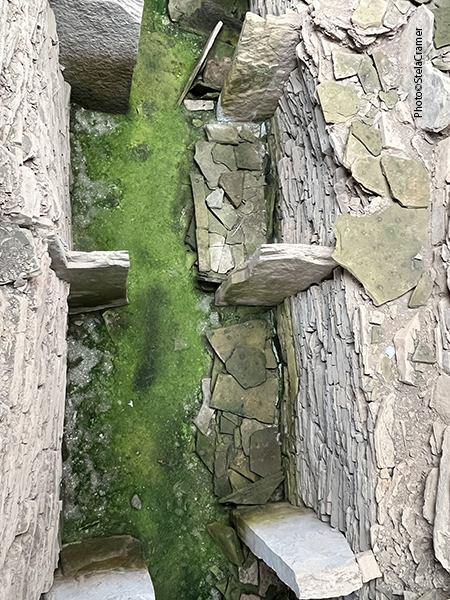
O grupo examinando a câmara externa de Taverson Tuick, no fim de um canal de pedra. Ao fundo, a bela paisagem de Wyre Sound. / The group examining Taversoe Tuick’s outer chamber at the end of a stone channel; Wyre Sound landscape in the background.

Restos humanos foram encontrados nas duas câmaras, e cacos de cerâmica numa pequena câmara externa, conectada à estrutura principal por um canal feito de pedra. Arqueólogos ainda não sabem qual era a função desta.

Excavations uncovered human remains in both chambers, and pottery shards in an outer chamber too. This outer chamber is connected to the rest of structure by a stone-channel, but there is still discussion about what it was actually used for.
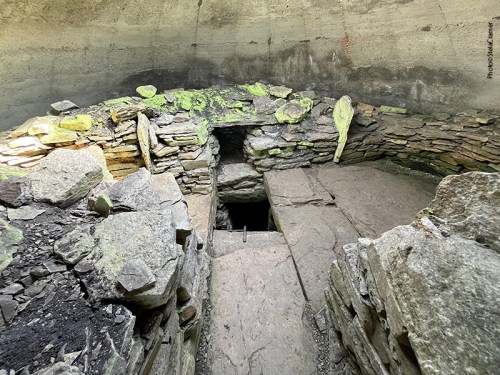
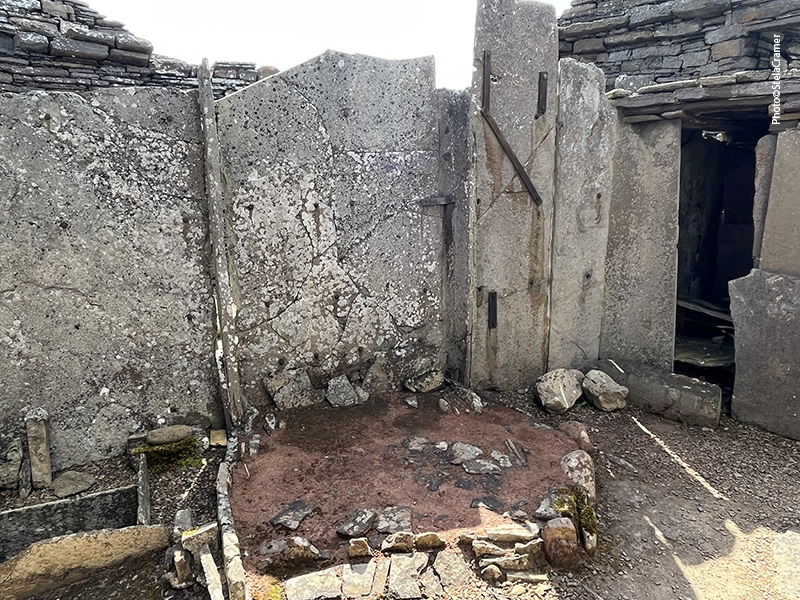
Inside the concrete dome / Interior da cúpula de concreto

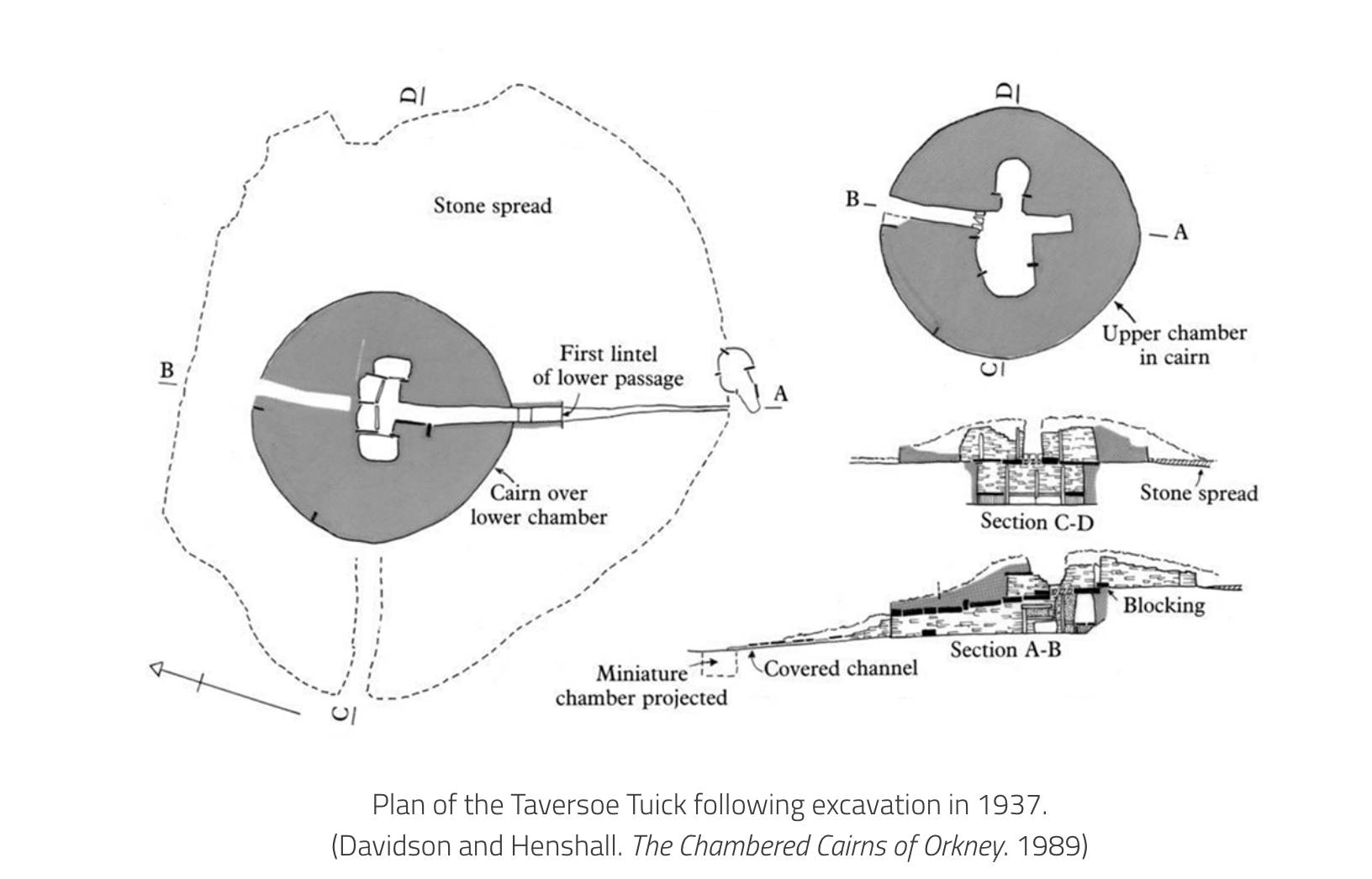
As primeiras explorações no séc XIX encontraram ” uma parede bem preservada, com lajes de pedra inseridas verticalmente sobre a câmara subterrânea”. Na época não ficou claro do que se tratava, embora tenha-se discutido a possibilidade de ser uma segunda câmara. Os arqueólogos hesitaram em acreditar serem duas estruturas contemporâneas, pois nunca havia sido encontrado antes uma câmara mortuária de dois andares. Entretanto, as escavações de 1937 confirmaram que era exatamente isso: um andar de cima e um andar de baixo, ambos construídos na mesma época, dentro do mesmo monumento, um bem em cima do outro, cada um com sua entrada separada.

During their 19th century explorations, a “well-preserved, rough-built wall with uprights of stone slabs was found on the ground above the underground chamber”. At the time, what this represented was not clear. It was subsequently mooted to have been a second chamber, but antiquaries were reluctant to believe that the two chambers were contemporary, since “a two-storeyed burial vault would be unprecedented”. The 1937 excavations, however, confirmed that was exactly what it was – an upper storey contemporary with the subterranean chamber, both constructed and enclosed within the same stone cairn, one placed almost exactly over the other and each with a separate entrance passage.
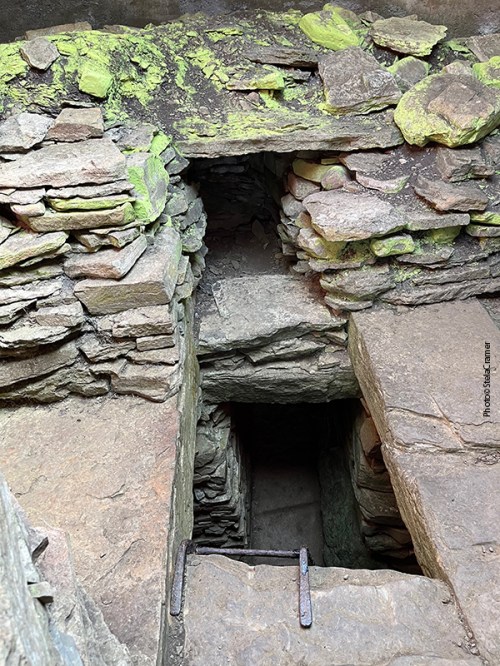
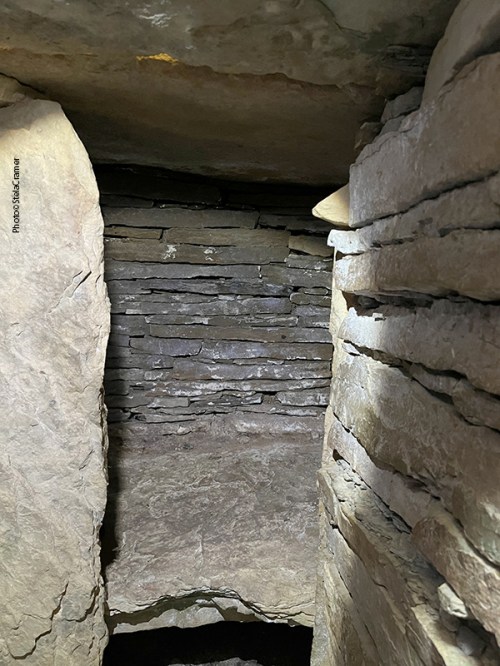
Os dois andares não eram originalmente conectados. Criou-se um acesso por meio de uma escadinha de ferro, num alçapão no chão do andar de cima. A entrada da câmara superior fica do lado norte, voltada para o interior; o acesso à inferior era por uma longa passagem voltada para o sudeste, na direção do mar.

The two layers of the interior were inaccessible from one another. Today they are connected by a hatch in the floor of the upper tomb and a short iron ladder. The upper chamber had its entrance on the north side of the cairn,facing inland, while the lower chamber was entered via a longer passage facing south-east towards the sea.
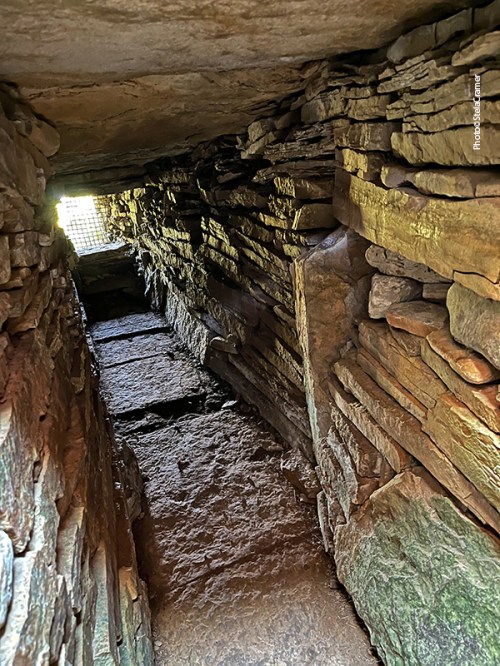
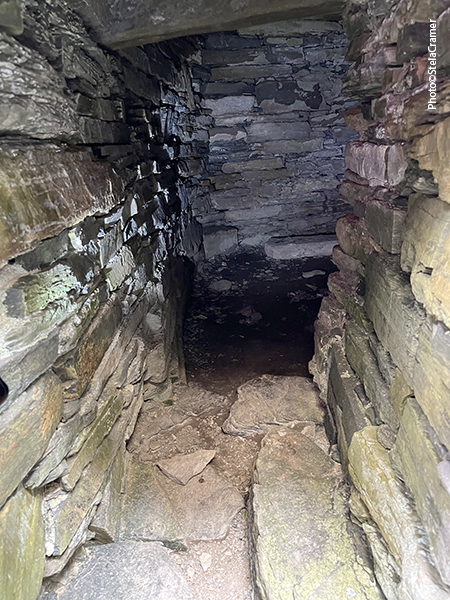
Antiga entrada da câmara inferior / Lower chamber ancient entrance

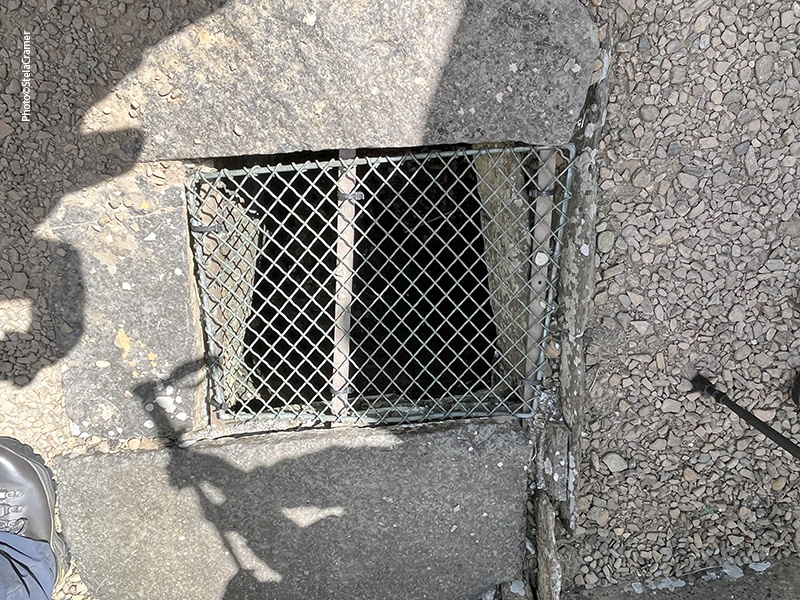
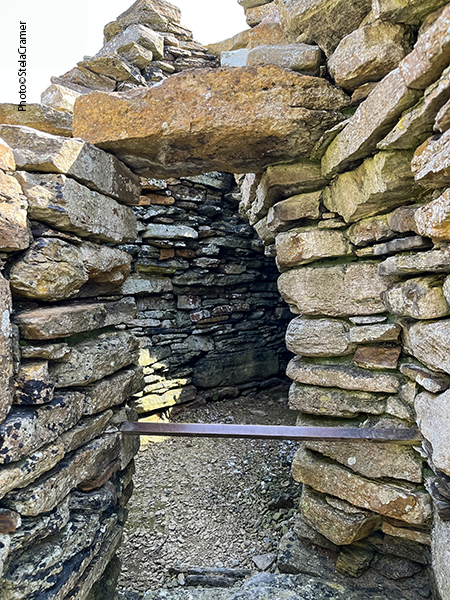
A entrada da câmara inferior foi fechada por uma grade de ferro. / The lower chamber entrance passage has been closed with an iron grate.
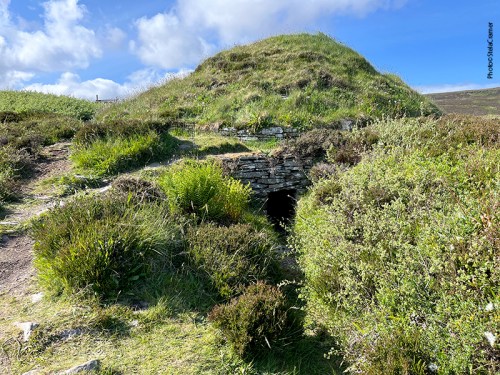
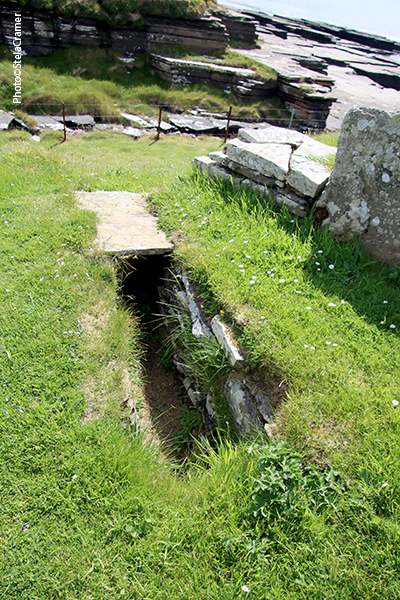
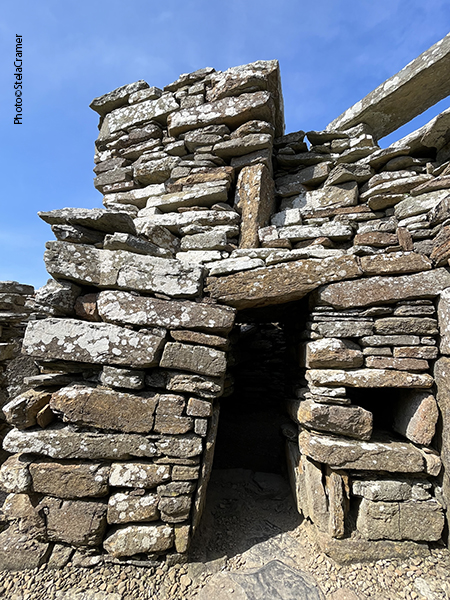
Entrada da câmara inferior vista de fora / The lower chamber entrance passage from the outside

A escavação em 1937 revelou também que a entrada da câmara superior havia sido bloqueada com alvenaria. Isto não é incomum em túmulos Neolíticos, mas as evidências apontavam claramente para a câmara ter sido selada na Idade do Bronze. Sob a alvenaria, mas 30 cm acima do chão na passagem, estavam os vestígios de um colar: 35 contas e um pendente de pedra-pome perfurados, identificados como da Idade do Bronze, isto é, contemporâneo às urnas de cerâmica que tinham sido encontradas na primeira escavação, 40 anos antes. O fato do colar estar acima do material, mas debaixo do bloqueio, prova que a passagem foi selada na Idade do Bronze. Este e outros achados levam a crer que a importância desta estrutura permaneceu para além do Neolítico e que, aparentemente, foi largamente modificada na Idade do Bronze.

The 1937 excavation also found that the inner end of the upper entrance passage had been blocked with masonry. Again, this is not uncommon in Neolithic chambered cairns but at the Taversoe Tuick the evidence clearly pointed to the chamber being sealed in the Bronze Age. Beneath the blocking material, but 30cm above the passage floor, were the remains of a necklace – 35 stone disc beads and a perforated pumice pendant recognised as Bronze Age, prompting that the necklace, and its deposition, was contemporary with the cists found almost four decades before. The fact the necklace lay on top of material, but beneath the blocking, is proof the passage was sealed in the Bronze Age. This, and other recorded finds, strongly suggests the structure remained a focus long after the Neolithic and, it appears, was also extensively modified in the Bronze Age.
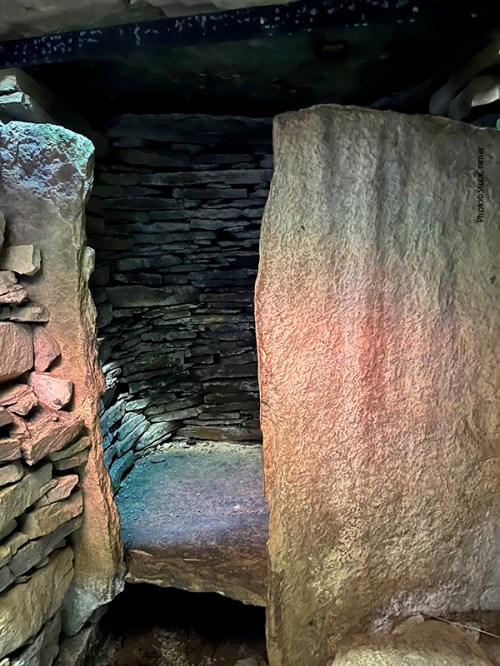
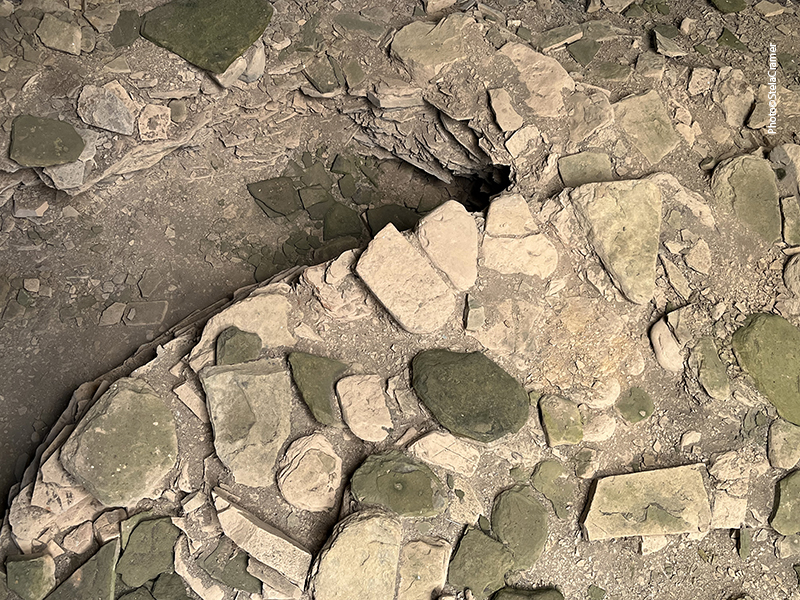
O andar de cima consiste numa área central rodeada por quatro compartimentos. / The upper chamber consists of a central area surrounded by four compartments.
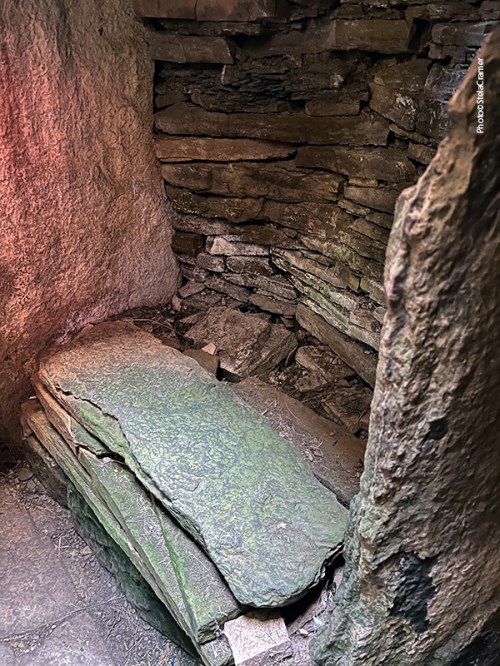
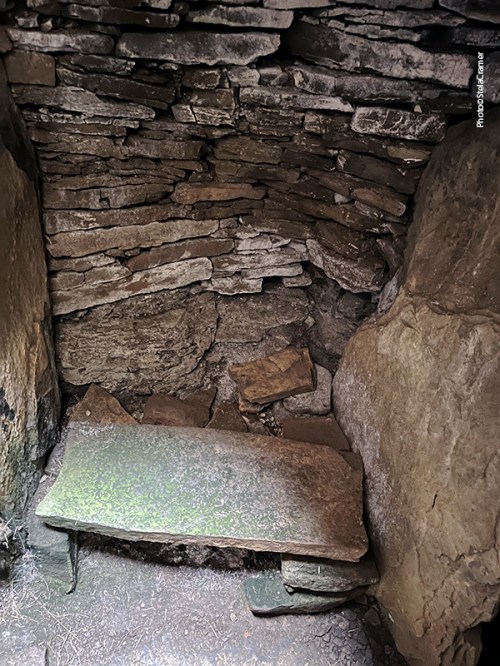
E se fosse o primeiro edifício de apartamentos conhecido na História? Uma família em cada andar…E se os cairns não fossem túmulos, mas simplesmente dormitórios, construídos subterrâneos como proteção contra o frio e predadores? Que falta faz uma máquina do tempo, para nos proporcionar respostas a tantos mistérios.

What if this was History’s first known apartments building? One family on each floor? What if the cairns were not graves but just bedrooms, built underground to protect the inhabitants from the cold and predators? How useful would be a time-machine, to provide us with answers to so many mysteries.
Abaixo um link para o modelo em 3D de Taverson Tuick.

Link to Taversoe Tuick 3D model:
https://skfb.ly/6zvsv

Read Full Post »


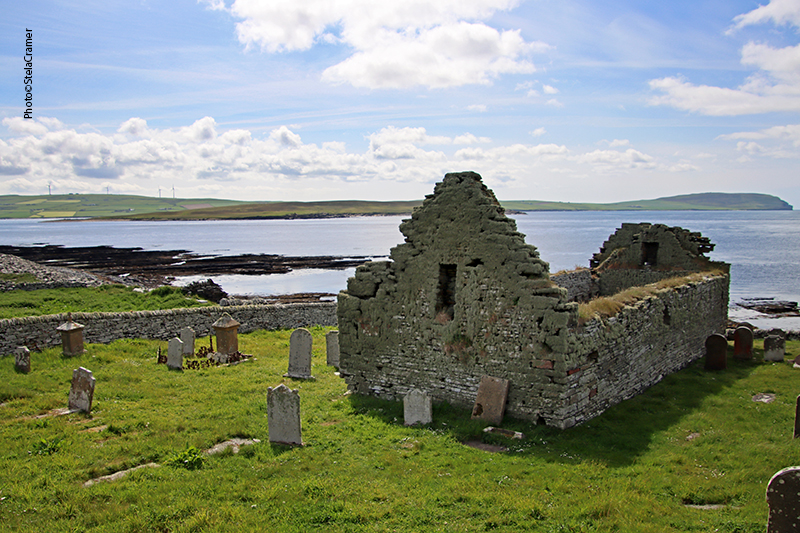
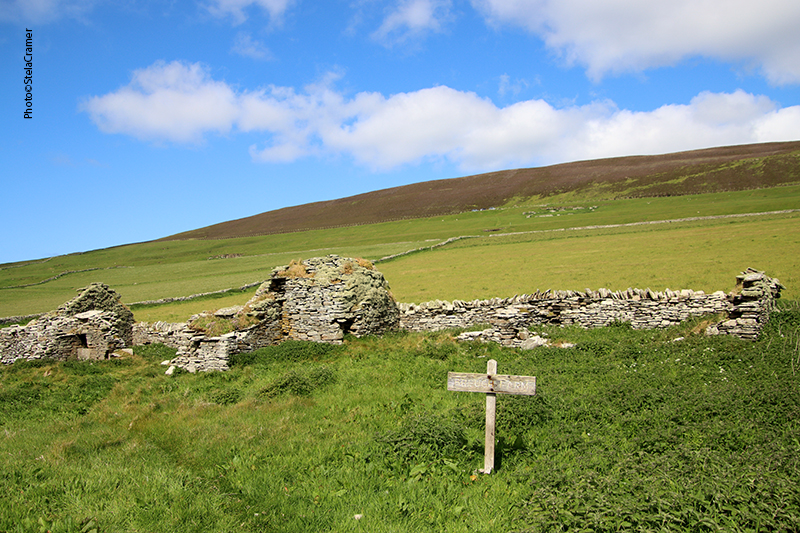
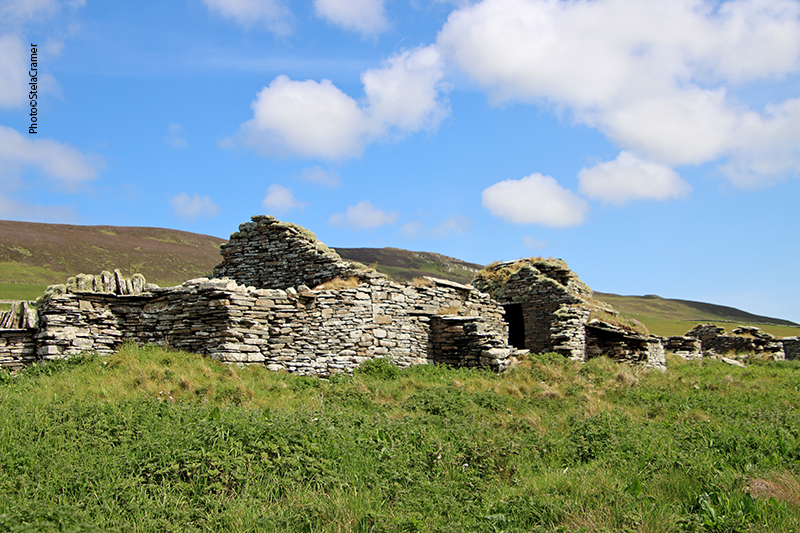
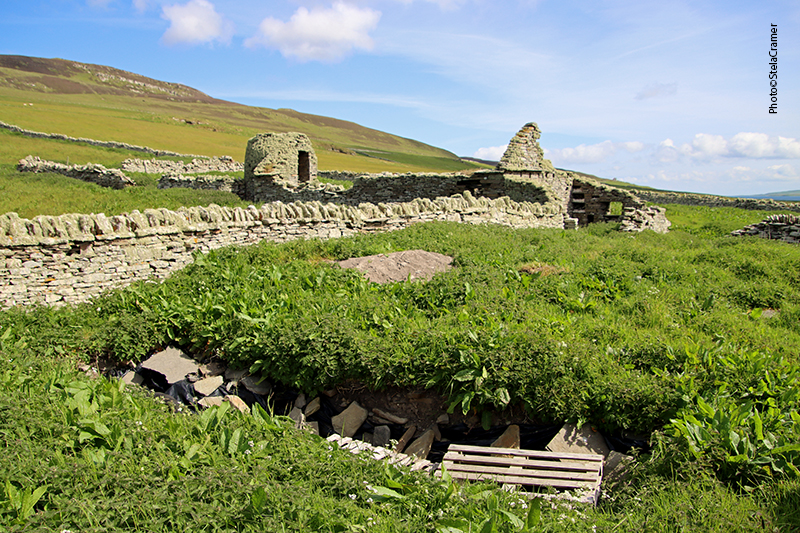
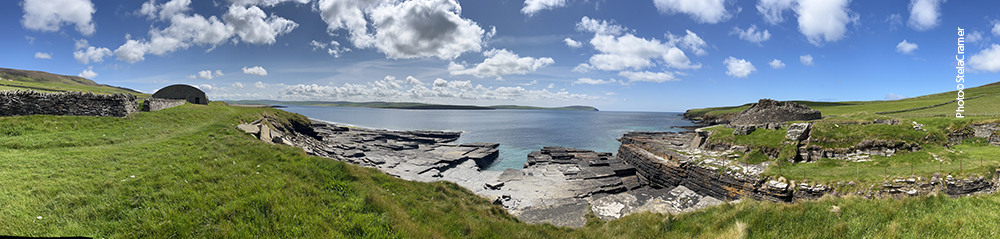
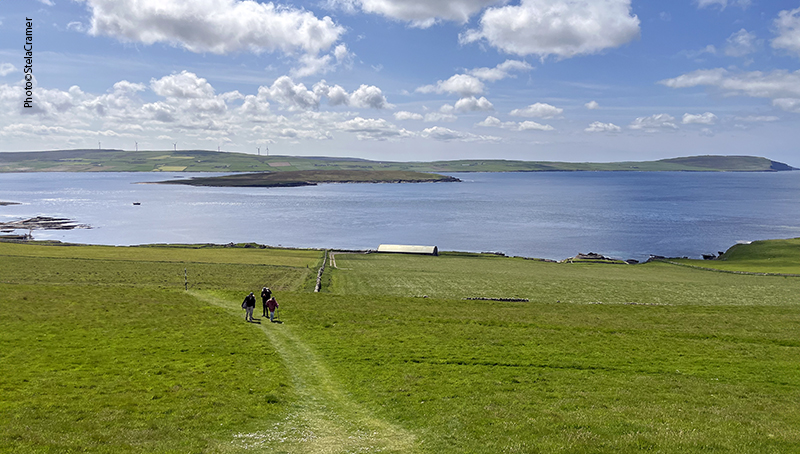
Eram umas 3h da tarde quando iniciamos a árdua subida de volta para o estacionamento, após visitar Midhowe Broch ( à direita na foto) e Chambered Cairn (no galpão, bem no meio da foto). Há mais ruínas (à esquerda do galpão), embora não tão antigas, das quais deixo aqui um breve registro. Ainda tínhamos mais alguns túmulos para visitar antes de dar o tour por encerrado. Algumas pessoas ainda iam pegar o ferry de volta para Kirkwall.

It was around 3 p.m. when we started the strenuous climb back to the parking lot, after visiting Midhowe Broch ( to the right in the pic) and Chambered Cairn (inside the shed, in the middle). There are more ruins (to the left near the shed), although not so ancient, of which I leave a quick register here. We still had a couple tombs to visit before considering the tour ended. Some people were going to take the ferry back to Kirkwall.

Igreja de St. Mary, séc. XVI / Ruins of 16th century St Mary’s Church
Brough Farm
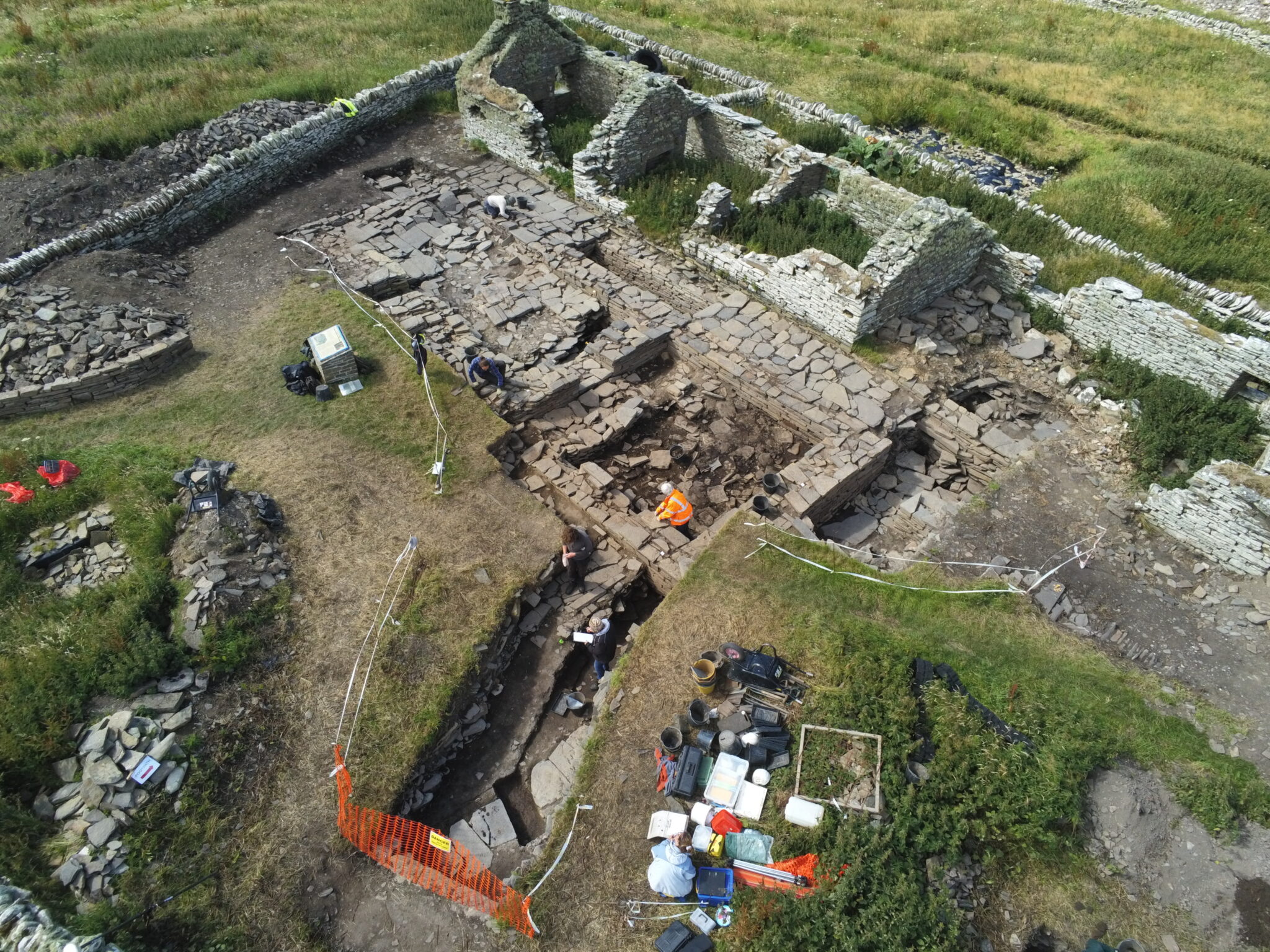
Skaill Farm, dig in progress / Escavação em andamento

Um grupo de arqueólogos, estudantes e moradores de Rousay há anos vem fazendo escavações neste complexo de fazendas, inclusive em seus montes de lixo, investigando especialmente práticas de criação de animais e pesca, e a dieta dos habitantes desde o período de ocupação Nórdica até seu abandono no século 19. A escavação é parte do projeto Paisagens de Mudança.

A team of archaeologists, Rousay residents and students have been digging at the site for years, investigating the later stages of the farm complex and its middens (waste heaps), with a particular focus on past diet, farming and fishing practices. The excavation’s aim is is to explore the farmstead at Skaill from the Norse period to its abandonment in the nineteenth century, as part of the Landscapes of Change project.

Em fevereiro de 2023, um grupo internacional de especialistas em cerâmica medieval esteve em Orkney examinando achados que incluíam os fragmentos encontrados aqui na Fazenda Skaill. Eles identificaram não só cerâmica do leste da Inglaterra e Escócia mas também proveniente da Alemanha, França e Escandinávia. Isto confirmou que Orkney fazia parte da rede de rotas comerciais na Europa.

In February 2023, an international team of pottery specialists was in Orkney examining pottery finds, including those from the Skaill farm excavation in Rousay. They not only identified pottery from eastern England and mainland Scotland, but from northern Germany, southern Scandinavia and France. This confirmed Orkney’s place in a European network of trading routes.

Link para mais informações sobre escavações em Rousay:

https://www.visitrousay.co.uk/archaeology

Link for more info on Rousay excavations

Escavação na Fazenda Skaill, Rousay, em 2023 – foto: Bobby Friel
Excavation under way at Skaill farm, Rousay, in 2023. (photo by Bobby Friel)

Read Full Post »


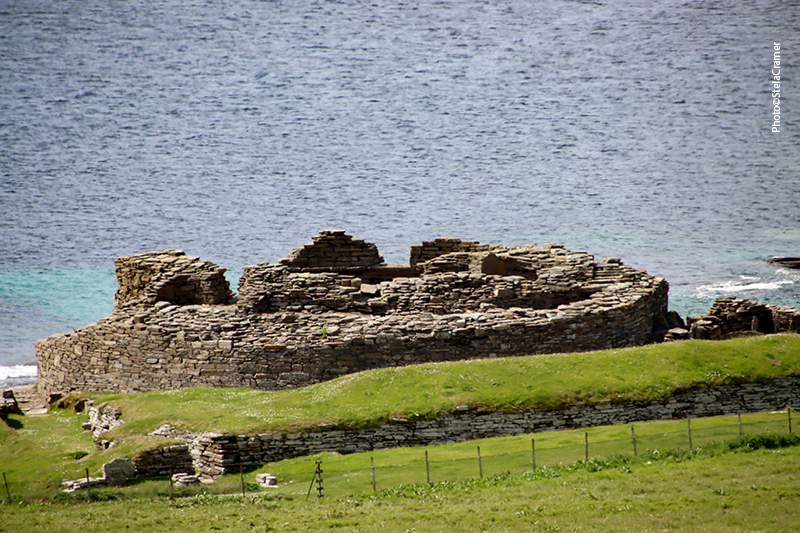
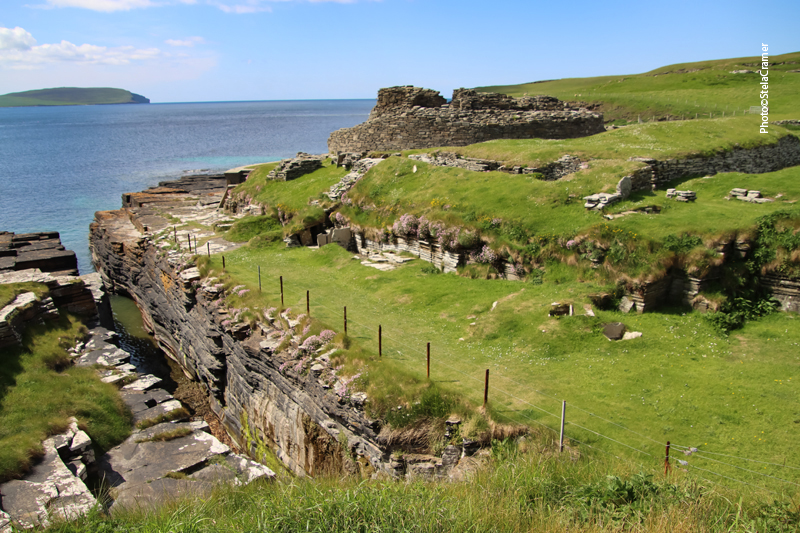
Midhowe Broch foi construído num estreito promontório em Eynhallow Sound há mais de 2000 anos atrás. “Midhowe” significa o monte do meio, sendo este um de três Brochs próximos: North Howe Broch e South Howe Broch, como o nome diz, um a noroeste e um ao sudeste. Há mais quatro outros Brochs ao longo dos 12 km de litoral entre este ponto e o Pier onde atraca o ferryboat vindo de Kirkwall. Parece que estes ainda não foram escavados.

Midhowe Broch was built on a narrow promontory beside Eynhallow Sound more than 2,000 years ago. The name “Midhowe” means middle mound and this is just one of three brochs closely grouped together: North Howe Broch to the north-west, and South Howe Broch to the south-east. There are remains of another four brochs along the five miles of shoreline between these and Trumland Pier, where the ferry from Kirkwakk moors. Apparently, these haven’t been excavated yet.

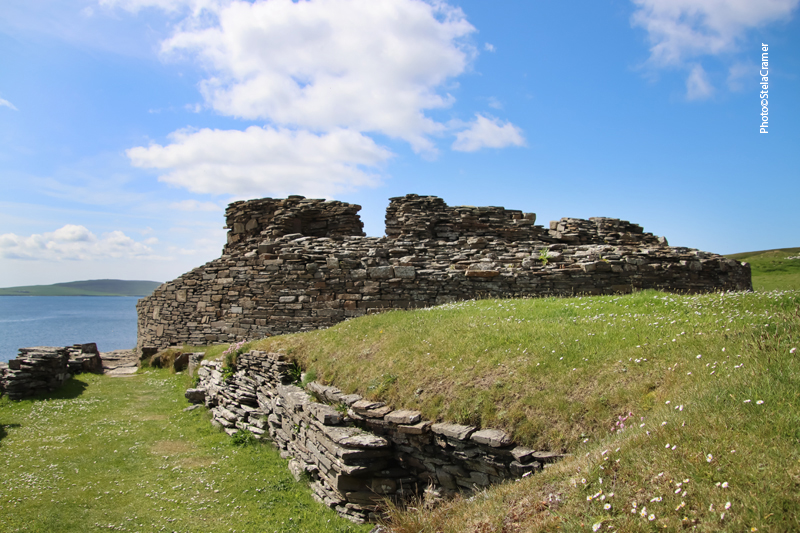
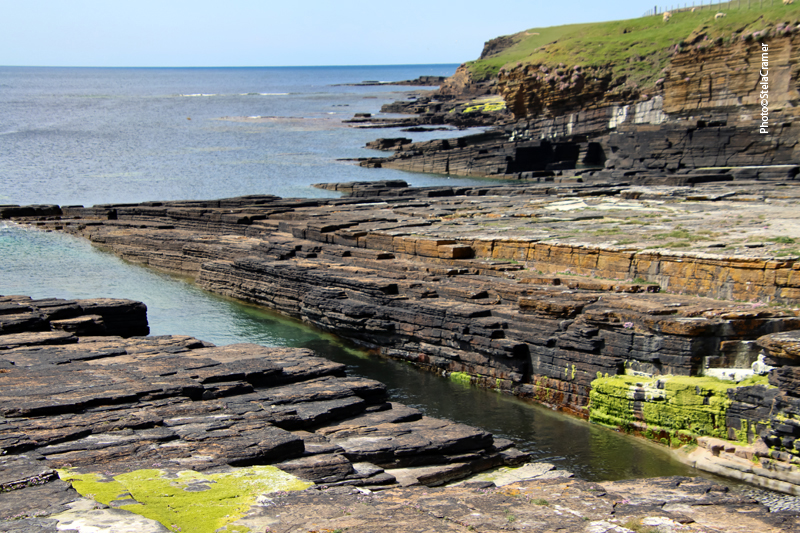
O promontório sobre o qual o Broch se ergue foi acentuado por canais cortados na pedra, dificultando o acesso pela costa. Por terra, as defesas consistiam em dois fossos e uma muralha. Outro muro (o que parece uma paliçada, mais ou menos no meio da foto acima) foi construído em 1930 para proteger o sítio da erosão.

The promontory on which the broch stands has been emphasised by channels cut into the rock making access along the shore much more difficult. Access from the landward side was deterred by two ditches and a rampart. A wall that today encloses the seaward side of the broch ( vertical spikes , more or less in the middle of the photo above) was built to defend it from the sea in the 1930s.

Vista com o fosso sudoeste, cortado na rocha, em primeiro plano. Ao fundo, cruzando o Eynhallow Sound, se encontra quase oposto o Broch de Gurness.
The Broch with the South-Eastern rock cut ditch in the foreground. In the background, across Eynhallow Sound, stands the Broch of Gurness, Brochs are almost opposite one another.
Vista do litoral (nordeste) / Northeast view, from the shore
Muro externo / Outer wall
Entrada / Entrance
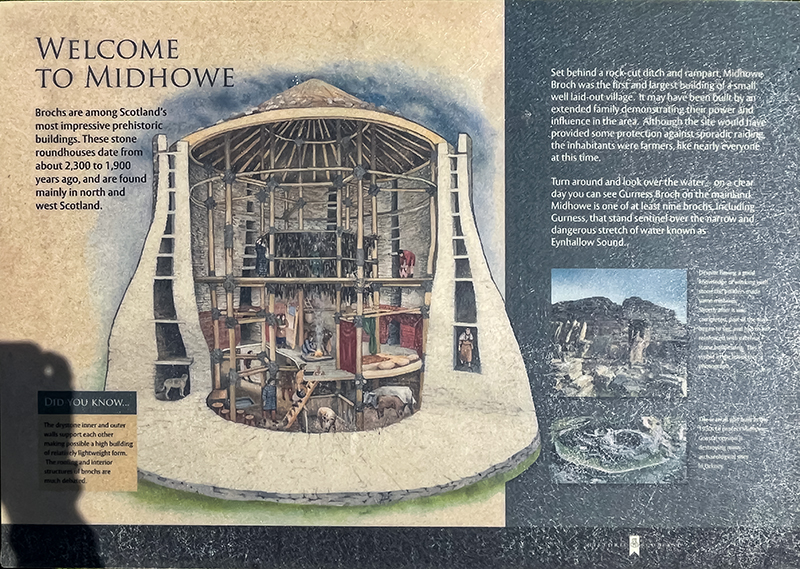
Como teria sido o interior do Broch / How it should have been inside the Broch
Primeiro salão principal / Main room One
A cisterna é abastecida por uma fonte e, mais de 2000 anos depois, ainda funciona ! / The spring-fed water cistern, after more than 2,000 years, still seems to work as the original builders intended.
Vala para esgoto / Trench for water sewage
Segundo salão principal. Grandes lajes dividem o espaço em áreas para trabalho e armazenagem. / Main room Two. Large flags divide the space into two smaller areas used for working and storage.

Estas lajes maiores também foram usadas para construir “mobília” / These large slabs have been used to build various items of “furniture”.

Edificações externas / Outer buildings

As estruturas externas para acomodação, armazenagem e ferraria foram acrescentadas posteriormente, pois foram construídas por cima do fosso interno original.

External additional structures used for accommodation, storage and iron working. These were added at a later date, as some were built over the original inner ditch of the landward defences.

Escavações em 1930 encontraram uma notável quantidade de artefatos, incluindo ferramentas de pedra e de osso, associadas ao processamento de grãos, fiação e tecelagem; fragmentos de cadinhos e moldes indicativos de trabalho em bronze. Cerâmica e pedaços de tigelas Romanas foram especialmente importantes para os arqueólogos, como prova de que estes Brochs estavam habitados na época em que a região tinha ligações comerciais com o Império Romano. Isto confirma o que escreveu o historiador romano Eutropius: que o Rei de Orkney havia se submetido ao Imperador Claudius em 43 DC.

Archaeologists digging here in the 1930s found a remarkable array of everyday artefacts, including stone and bone tools, associated with grain processing, spinning and weaving; pieces from crucibles and moulds, indicating bronze-working. Pottery and fragments from Roman vessels had special interest to archaeologists, as evidence that these Brochs were still in use by the time the area had trading links with the Roman Empire. This corroborates Roman historian Eutropius, who wrote that the king of Orkney had submitted to Emperor Claudius in AD 43.

Câmaras no interior das paredes / Chambers inside the walls

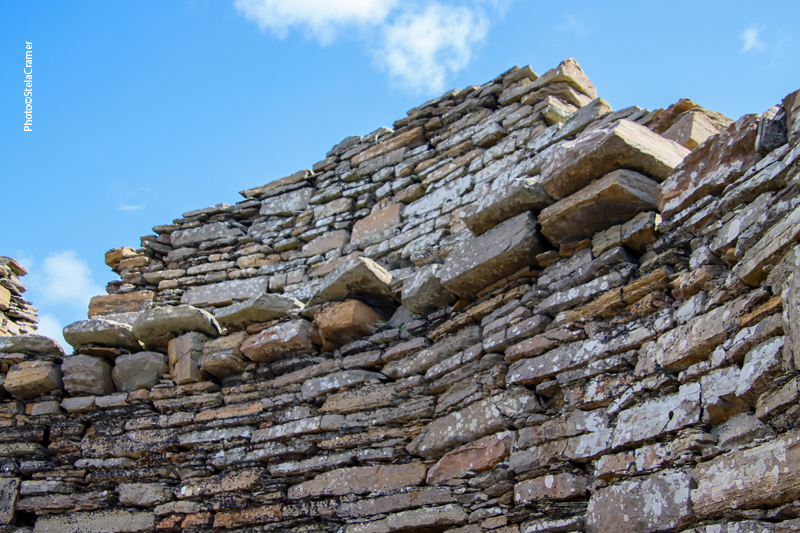
As grossas paredes continham escadas para os andares superiores.

Within the thickness of the walls, stairs gave access to the top level and upper floors of the broch.

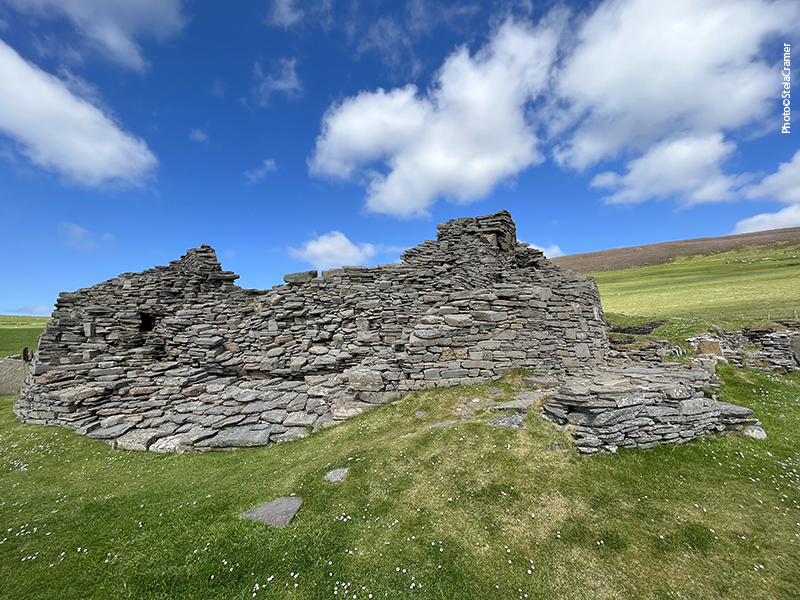
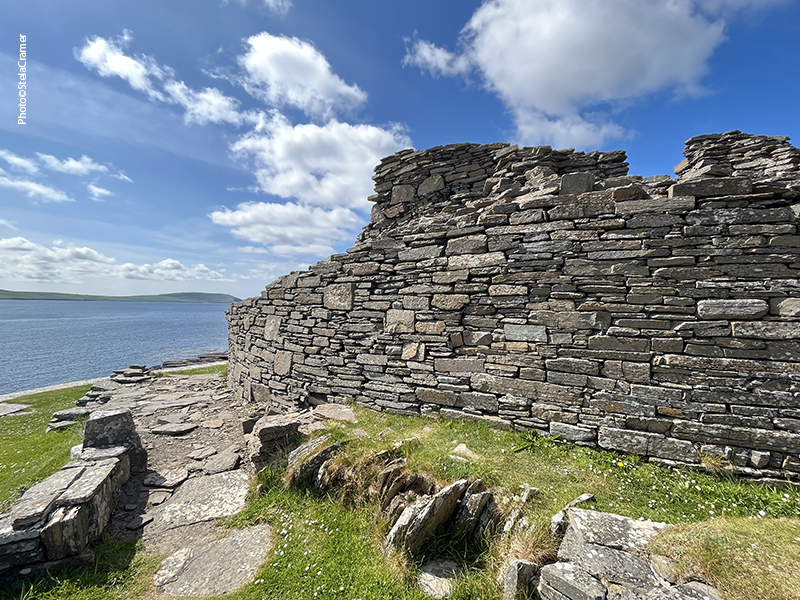
A torre tem 9 m de diâmetro interno, cercada por paredes de 4,5m de espessura, atualmente com 4,5m de altura. Originalmente teria o dobro ou mesmo o triplo dessa altura. /
The Broch tower has an internal diameter of 9 metres within a wall 4.5 metres thick, which still stands to a height of over 4 metres. Originally it would have risen to two or three times this height.
Patrick e senhoras do grupo / Mr. Patrick and some of the ladies in the group
A impressionante alvenaria que se mantém firme através dos séculos / Impressive stonemasonry, keeping strong throughout the centuries

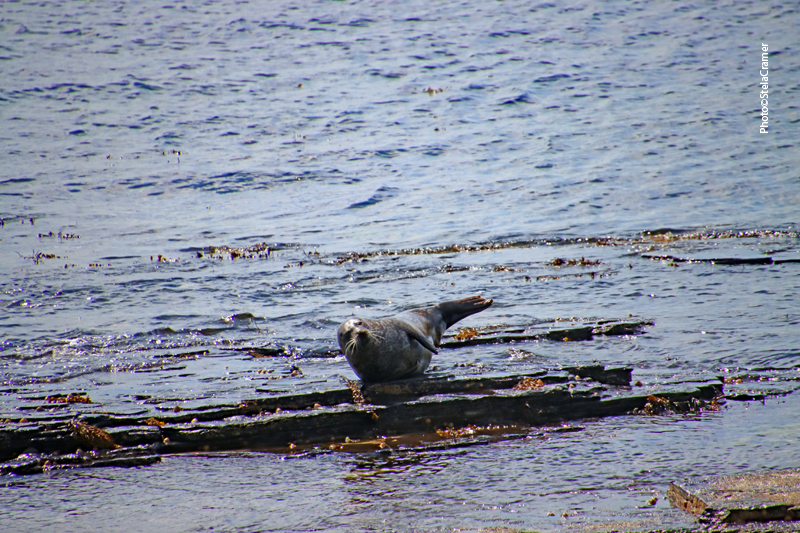
Vamos prosseguir pela costa, rumo às demais escavações existentes em Midhowe. Adivinha quem nos espera no caminho???

Let’s move on by the shore, towards Midhowe’s other excavations. Guess who’s waiting for us on the way?

Hello, lovely!

Read Full Post »


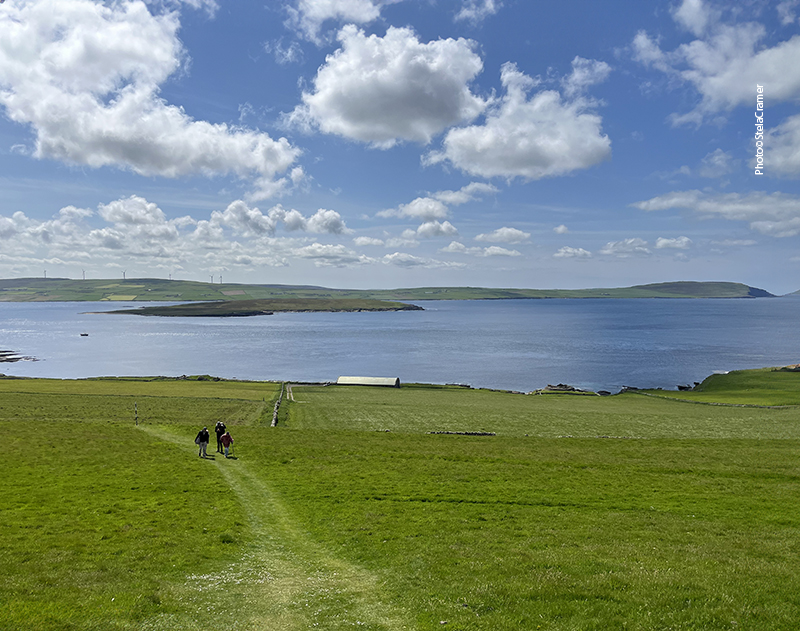
O melhor do tour estava reservado para depois do almoço: o sítio arqueológico de Midhowe. A partir de um pequeno estacionamento na beira da estrada, é preciso descer quase 2km. até a beira-mar, atravessando pastos com uma considerável inclinação. O problema seria subir depois! Faziam parte do grupo duas senhoras idosas, uma inclusive de muletas (que podem ser vistas na foto acima) e confesso que achei que seria preciso alguém carregá-las na volta. Só que não! Devagar e sempre , foram e voltaram felizes e contentes, sem bufar nem reclamar.

The best part had been saved for the afternoon, after lunch: Midhowe archaeological site. From a small parking lot by the road you go down to the coastline, a steep descent half a mile across fields, quite a strenuous climb back to car park. There were two elderly ladies in the group, one on crutches ( as you can see in the photo above), I must confess I thought they would need to be carried back somehow. But no! Slowly but unrelenting they happily went, never complaining.

Midhowe: To the right, the Broch. To the left, the Chambered Cairn and the remains of a 13th century ceremonial hall, 16th century church and ongoing dig site where neolithic and viking buildings are being uncovered. / à direita, o Broch. `A esquerda, a câmara funerária, e as ruínas de um salão do séc. XIII, de uma igreja do séc. XVI e uma escavação em progresso de construções neolíticas e vikings.

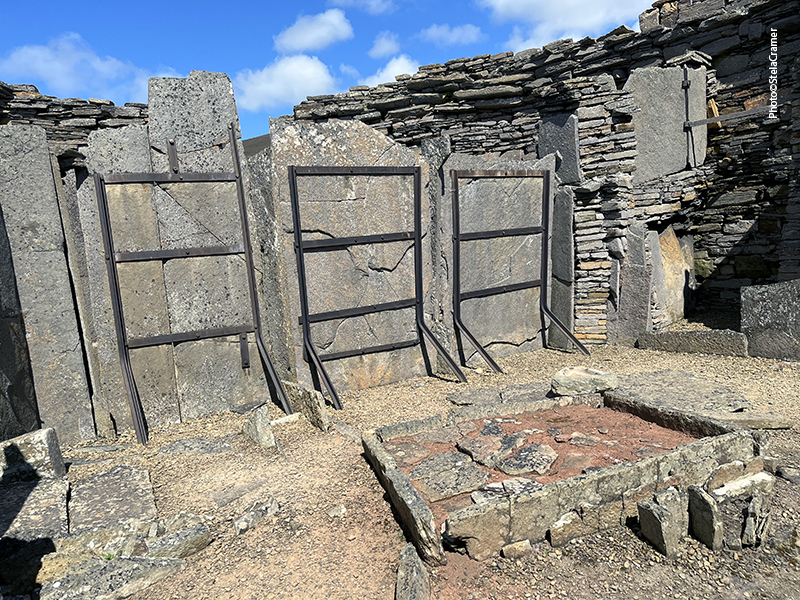
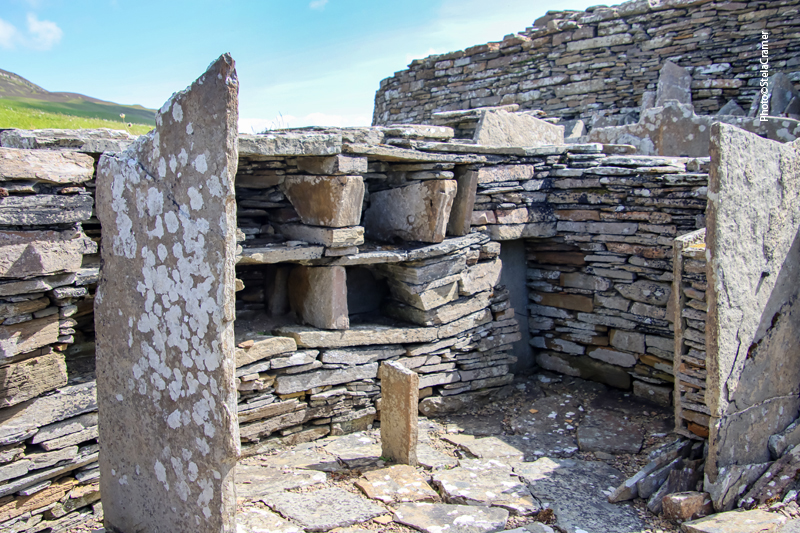
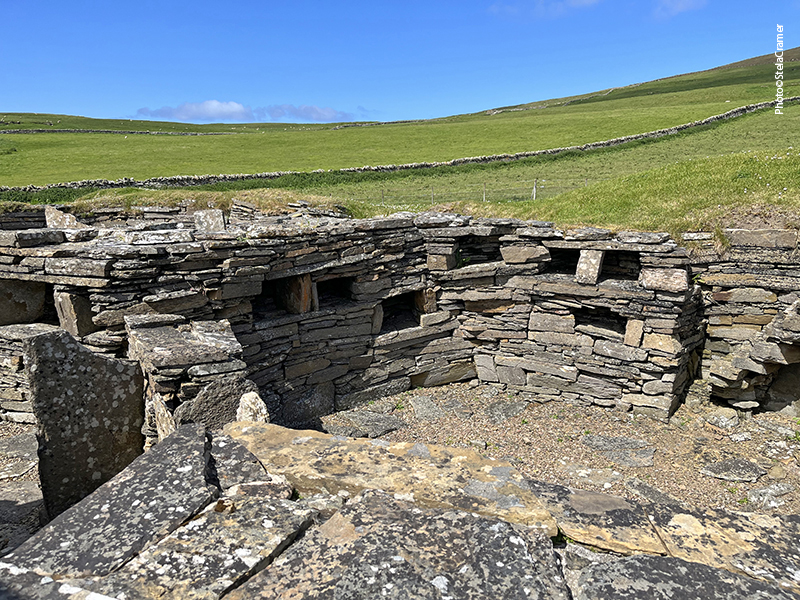
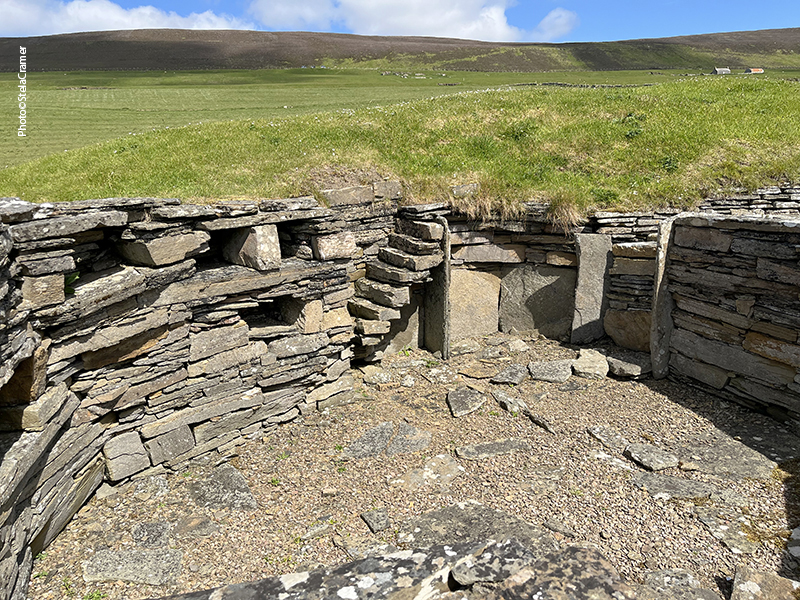
O Cairn tem cerca de 4000 anos e foi escavado em 1932/ The Cairn dates from around 4000 years ago and was excavated in 1932.

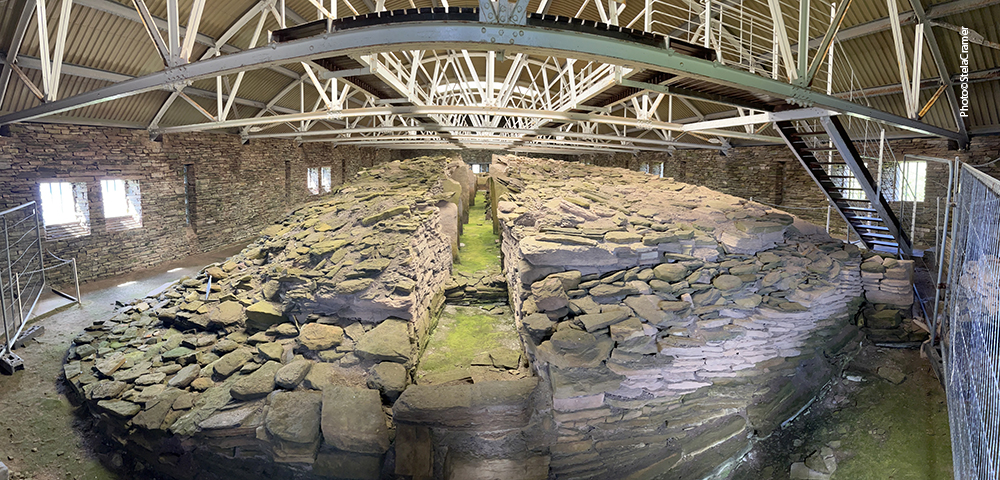
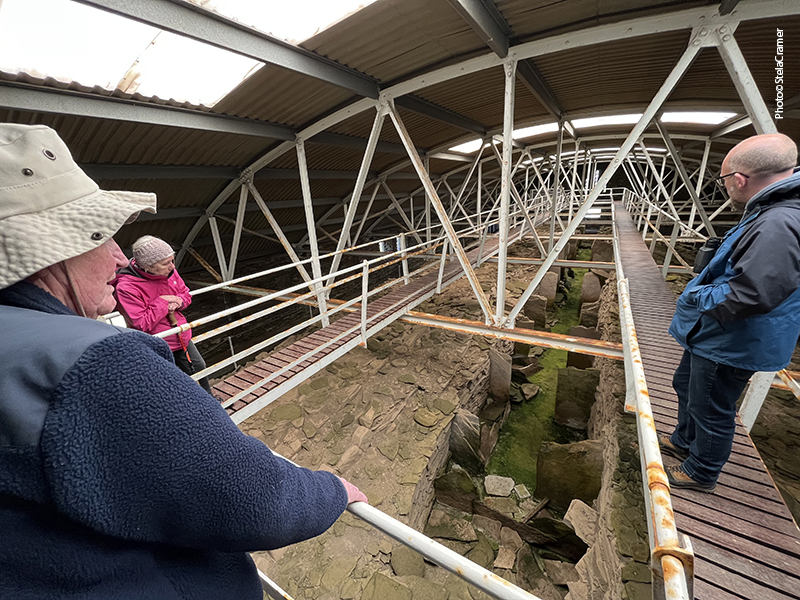
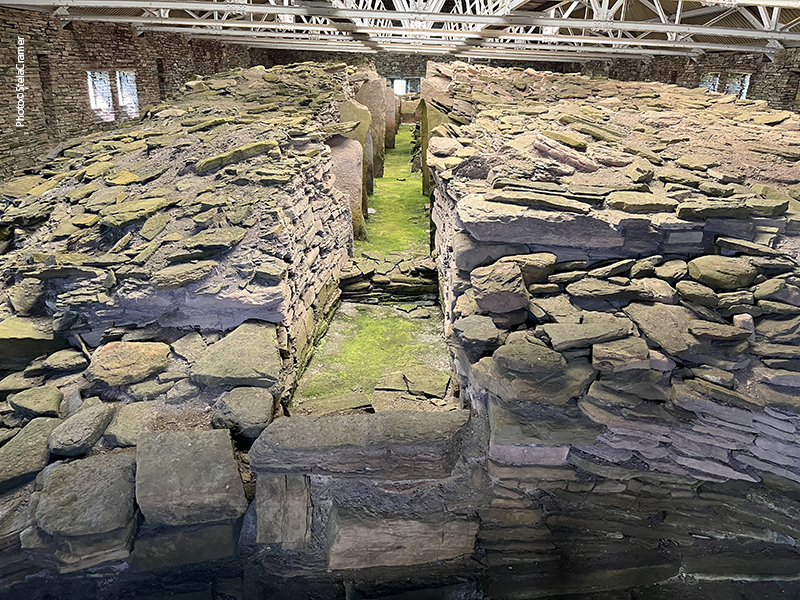
O túmulo fica dentro de um enorme galpão, construído para protegê-lo dos elementos em 1932 após a escavação. Ao entrar você vê uma pilha de pedras cujo formato se assemelha ao casco de um navio virado. Uma escada dá acesso a uma passarela suspensa, permitindo ao visitante andar ao longo de toda a estrutura, vendo os 24 compartimentos da câmara mortuária. Midhowe Cairn ganhou o apelido de “Navio dos Mortos” devido à semelhança com um navio viking, em formato e tamanho.

The massive structure is inside a large hangar, built after the excavation of the cairn in 1932 to protect it from the elements. Once inside it, you see a mound of stones that look like an upturned boat hull. You can then climb onto a gantry frame above it to walk the length of the cairn whilst looking down at the 24 “stalls” of burial chambers. It is easy to understand why it is known as the “Ship of the Dead”. It resembles a Viking galley ship in size and shape.

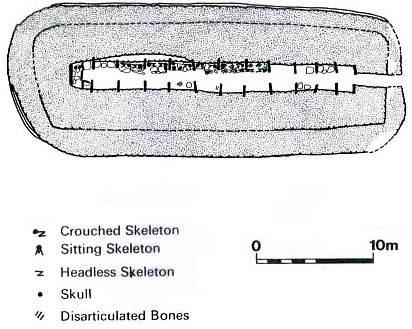
Diferente de muitas das câmaras mortuárias escavadas na região, aqui foram encontrados de fato 25 esqueletos humanos, nos diversos compartimentos, além de cerâmica, ferramentas de pedra, conchas, chifres e ossos de animais – ovelhas e gado. Arqueólogos acreditam que sejam vestígios de rituais, ou então objetos colocados junto aos corpos. Mais dois corpos foram encontrados enterrados em entulho, sugerindo que o lugar continuou sendo usado mesmo depois do colapso do telhado.

Unlike other similar cairns, here remains of at least 25 human skeletons were found in the stalls, plus stone tools, pottery, cattle and sheep bones as well as antlers, fish bones and shells. To the archaeologists, that suggests either ritual feasting or that these items were placed with the bodies. Two further bodies were found buried in the rubble of the cairn which would suggest that the use of the cairn continued for a while after the roof caved in.

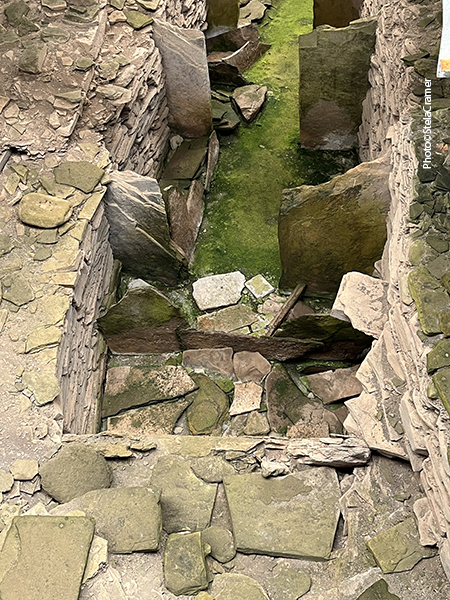
Enormes lascas de pedra dividem a câmara em compartimentos. Acredita-se que os mortos eram inicialmente postos perto da entrada e, uma vez a carne decomposta, os ossos eram movidos para a câmara central.
Large stone slabs create stalls within the large tomb. It is thought the dead were initially kept near the entrance and the bones later moved into the main body of the cairn once the flesh had rotted.

Mapa com a localização dos corpos encontrados / Map with the spots were bodies were found

Um modelo 3D pode ser acessado pelo link abaixo./ Link to a 3D model of the Cairn:

https://skfb.ly/6BzIG

Prosseguimos… / Moving on…

Read Full Post »


Midhowe, Isle of Rousay, Mainland in the background

O dia do tour em Rousay – 8 de junho de 2023 – amanheceu lindo e ensolarado; estava até quente! Aliás os póprios escoceses estavam surpresos com o calor. Meu guia, Patrick, brincou que eu havia trazido o sol do Brasil. A luz e o céu azul, não muito comuns no Reino Unido, propiciaram algumas fotos de paisagens desta ilha habitada por pouco mais de 200 pessoas.

June 8th / 2023, the day of the Rousay Tour, was a hot sunny day! Even the Scots were astonished with the heat. My guide, Patrick joked that I had brought the sun from Brazil. The bright blue sky, unusual in the UK, made possible some landscape photos of this isle inhabited by few more than 200 people.

Casas curiosas / Odd houses

Patrick Macguire, o guia / Patrick Macguire, the guide. Rousay Tours, phone +44 1856 821234

Verão na Escócia! Summertime in Scotland !

Após buscar alguns passageiros que chegaram de ferry, o tour seguiu a estreita estrada B9064, que contorna a ilha num total de 20 km, ao longo dos quais se encontram os sítios pré-históricos. Dos 100 já identificados, apenas alguns foram escavados e descritos.

After picking up some passengers that arrived with the ferry, the tour followed a single narrow lane, B9064, that makes a 13-mile circuit of the island, along which are the prehistoric sites. Over 100 have been identified but only a few have been excavated and characterized.

Yetnasteen Stone

Passamos por um megalito de 2m de altura, chamado Yetnasteen Stone (“pedra gigante” em nórdico antigo): diz a lenda que trata-se de um gigante que foi transformado em pedra pela exposição à luz do dia. Mas toda noite de Ano Novo, quando o relógio bate meia-noite, ele é liberado o tempo necessário para ir beber um gole de água fresca no lago próximo. Como a pedra fica dentro de uma propriedade privada, só pudemos avistá-la de passagem, pela janela da van.

Yetnasteen Stone: in Old Norse, Jotunna-steinn means “giant stone”; the legend says it’s a giant who’s been turned to stone when exposed to daylight, but at the stroke of midnight at New Year he’s released for just long enough to take a drink from the nearby freshwater loch. We could only see the 2m-tall slab from the van’s window, because it stands in private land.

A escultura “Deuses da Terra, Deuses do Mar”, de Ian Hamilton Finlay, no penhasco de onde se avista a Baía de Saviskaill, e a ilha de Westray ao longe. Foi esculpida numa pedra de 15 toneladas trazida da Cornualha! Me pergunto porque escolheram trazer uma pedra do outro extremo do Reino Unido, a 1.368 km de distância.

The sculpture ‘Gods of the Earth, Gods of the Sea’, by Ian Hamilton Finlay, overlooking Saviskaill Bay, and Isle of Westray in the distance. It’s carved out of 15 tonnes of Portland Stone… from Cornwall ! I wonder why they chose to bring a stone from the other extreme of UK…850 miles away.

A Baía de Saviskaill e, na foto abaixo, o Lago Wasbister. Pode-se ver uma ilhota ao longe no lago. Saviskaill Bay and Wasbister Lake (photo below). You can see an islet in the far side of the lake.

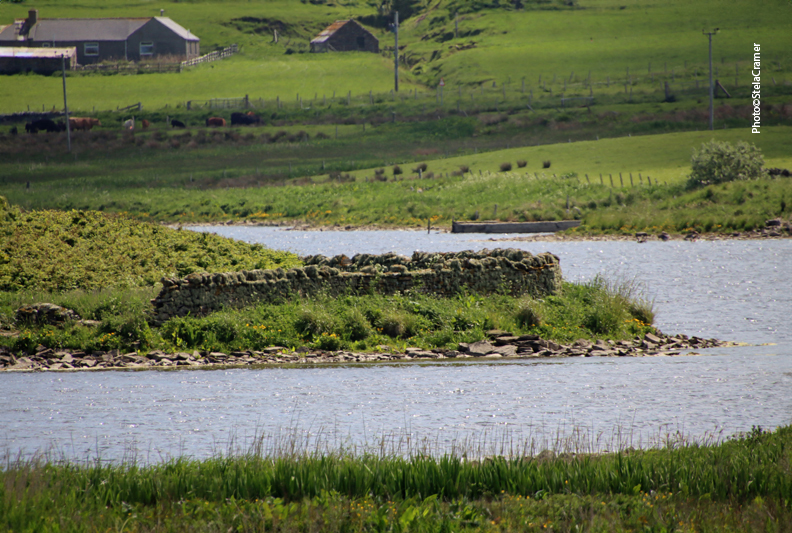
As ruínas que se vê na ilhota , segundo Patrick, são Vikings, mas ainda não foram escavadas.
In the islet there are viking ruins, non yet excavated, according to Patrick.

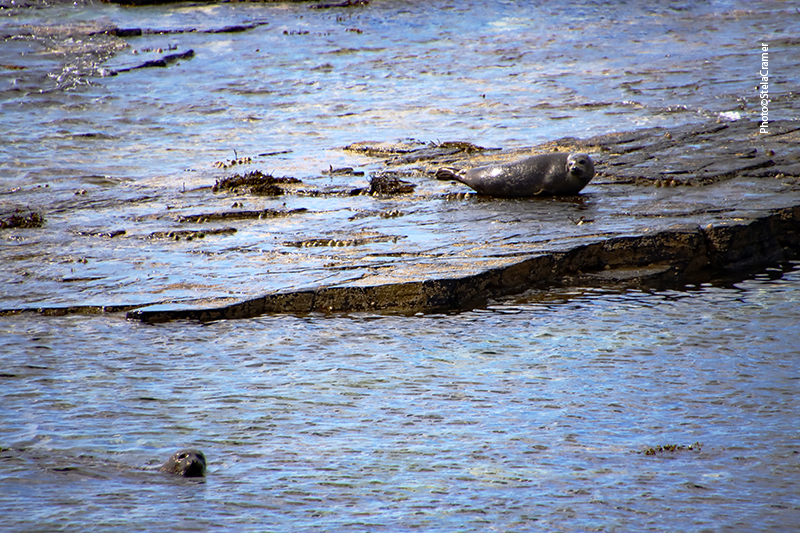
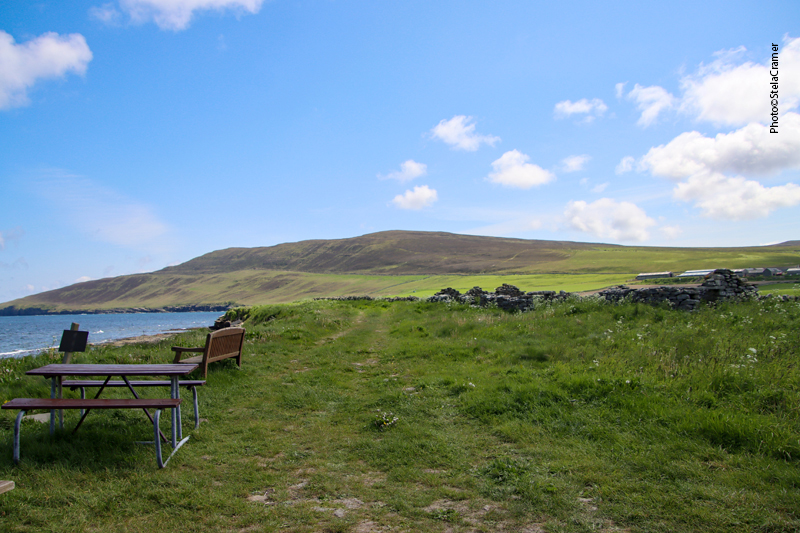
Seguimos para um picnic junto ao mar, em Saviskaill Bay, onde uma surpresa nos aguardava, além da bela paisagem. Rousay é um “Local de Interesse Científico Especial” devido à sua geologia, fauna e vida selvagem, colônias de pássaros e animais marinhos como lontras e focas. Elas estavam lá esperando por nós. Mas o melhor ainda estava por vir.

We stopped for a picnic by the sea, in Saviskaill Bay, where we had a surprise. Rousay is a Site of Special Scientific Interest because of its geology, wildflowers and bird life. Its wildlife includes otters and seals. And there they were, waiting for us. But the best was yet to come.

Seals / Focas em Saviskaill Bay

Read Full Post »


Broch de Gurness em Mainland visto de Rousay / Broch of Gurness in Mainland seen from Rousay

O Estreito de Eynhallow separa a ilha de Rousay de Mainland, a maior ilha das Orkneys, mas de uma se avista a outra. São apenas 3 km de distância. Dois Brochs ficam praticamente de frente um para o outro. Antes de visitar Midhowe vamos dar uma olhada em Rousay, apelidada de “Egito do Norte”, devido à quantidade e importância de sítios arqueológicos.

Eynhallow Sound divides the island of Rousay from Mainland, one in sight of the other, only 3 km apart. Two Brochs almost face each other across the water. Before visiting Midhowe, let’s take a look at Rousay. It has been nicknamed “Egypt of the North”, due to its archaeological diversity and importance.

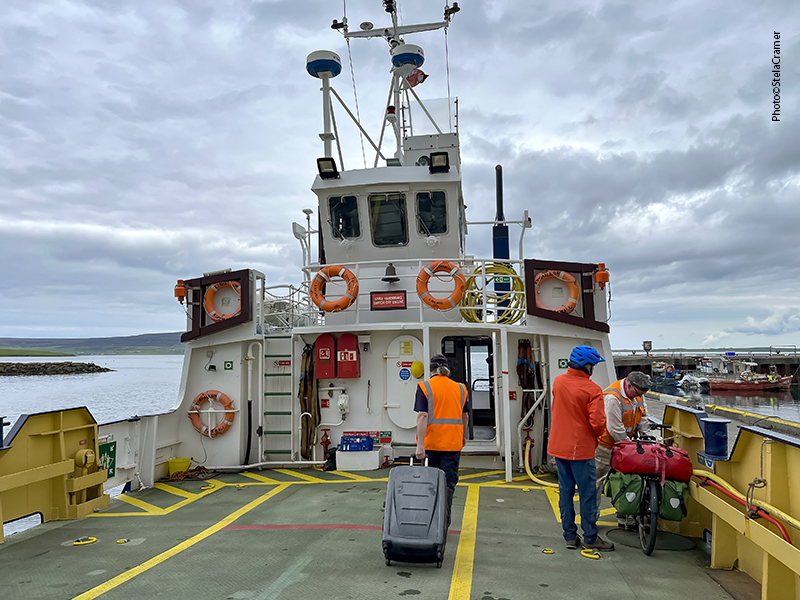
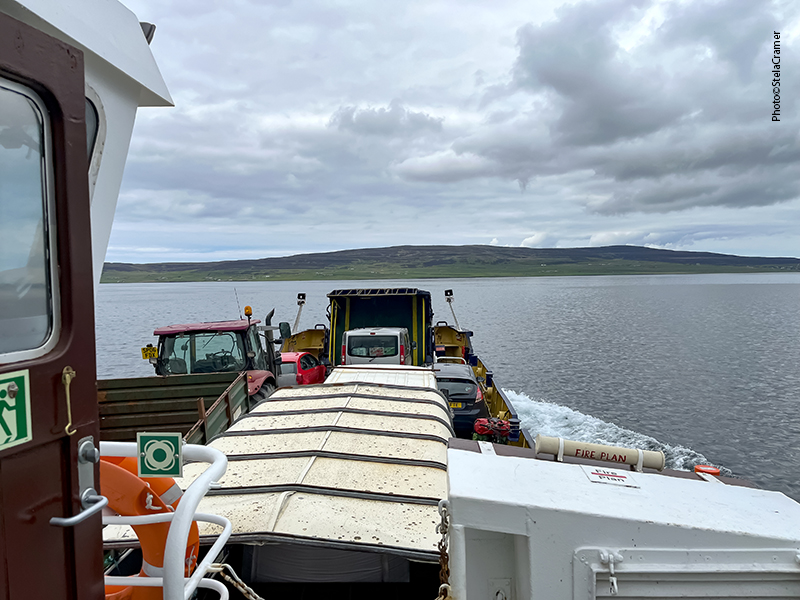
O ferry liga as ilhas de Rousay, Egilsay e Wyre entre si e com Orkney Mainland. Pode levar até 10 carros e 95 passageiros (no inverno apenas 50). / The ferry links the islands of Rousay, Egilsay, and Wyre with each other, and with the mainland of Orkney. It can take up to 95 passengers (reduced to 50 in winter), and 10 cars.

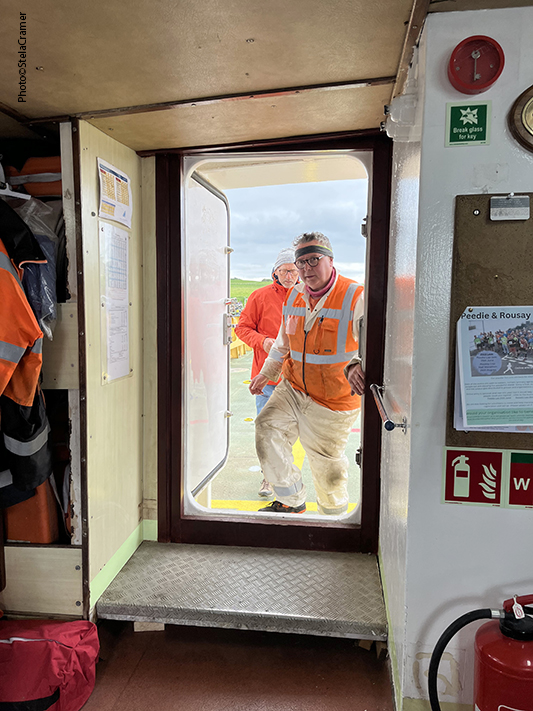
Depois de dois dias intensos em Westray e Papay (ver posts 167 a 170), peguei o ferry dia 6 de junho/2023 para Kirkwall apenas para pernoitar lá. Consegui um quarto no hotel Ayre, em frente ao terminal do ferry, e bem perto do terminal de ônibus de Kirkwall, assim pude ir andando até a condução para Tingwall, outro terminal de onde sai o ferry para Rousay. Os horários dos ônibus e dos ferrys são todos coordenados. Tinha planejado pegar o primeiro barco mas não foi possível porque precisei antes encontrar uma pessoa, que vinha de Westray trazendo o cartão de crédito que eu tinha perdido lá. O atraso acabou sendo fortuito: o guia Patrick, com quem eu tinha agendado um tour de Rousay, embarcou no mesmo horário. Foi o simpático marinheiro do ferryboat que nos apresentou. Ao me ver na prancha de embarque, correu para me ajudar com a mala e, na conversa que se seguiu, perguntei como chegar ao Taversoe, onde reservara duas noites. Ele respondeu que eu estava com sorte. Patrick era pai da dona do hotel, e me daria uma carona com o maior prazer!

A travessia leva de 20 a 25 minutos / The journey takes approximately 20-25 minutes.

After intense days in Westray and Papay ( see posts 167 to 170), I took the ferry to Kirkwall the 6thJune, just to spend the night there. Got a room at the Ayre hotel, in front of the ferry terminal and walking distance to Kirkwall Travel Centre, where I could take the bus to Tingwall, another ferry terminal that services the Rousay line. The buses and ferries’ schedules are all coordinated. My plan was to board the earliest one, but I couldn’t because I had to meet someone coming from Westray, bringing the Credicard I had lost there. The delay proved fortunate: the guide Patrick, with whom I had booked a Rousay tour, was in the same ferry I took. As I was walking aboard, a lovely sailor hurried to help me with my suitcase and, when I asked him how to get to The Taversoe (where I had booked two nights), he smiled and said that I was lucky. He introduced me to Patrick, who was the Inn owner’s father, and was happy to give me a ride.

Tingwall Terminal
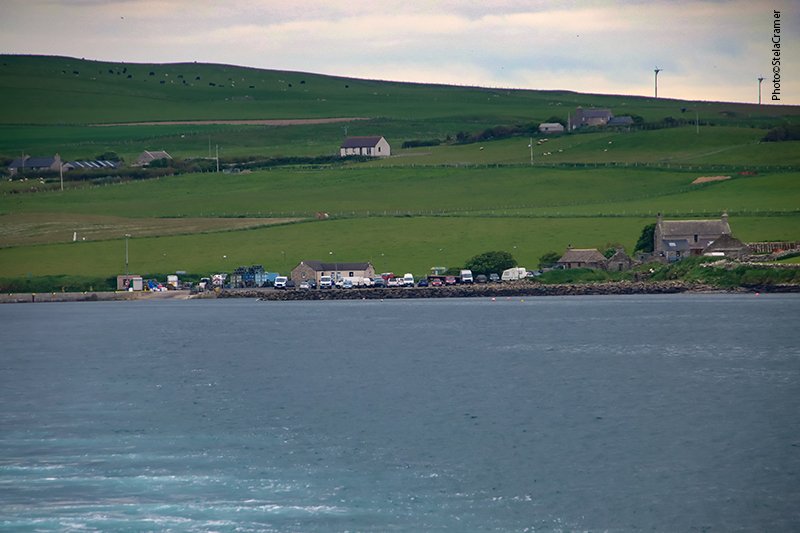
Rousay Ferry Terminal
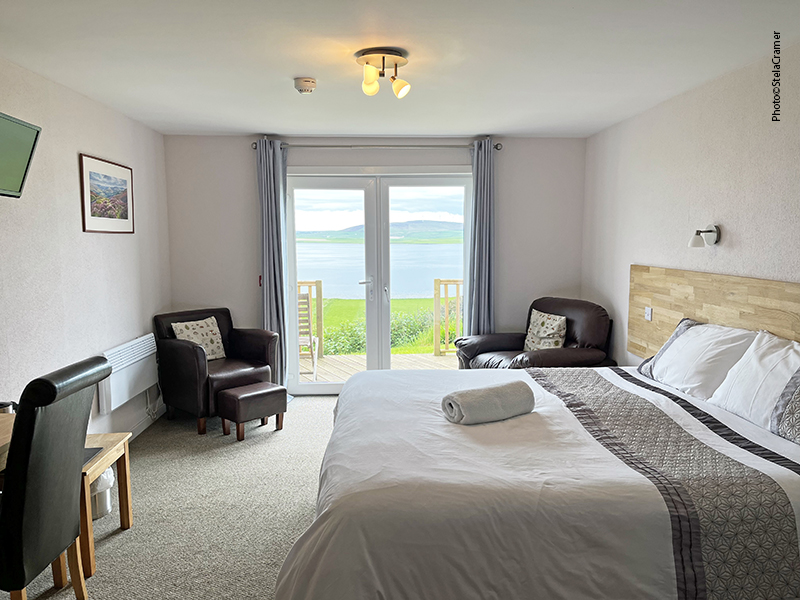
The Taversoe: o único hotel, bar e restaurante em Rousay, muito bom. / The Taversoe is the only Inn, Bar & Restaurant in Rousay, which I recommend.
Meu quarto era muito confortável, com um bom banheiro e varanda! Abaixo link para o site. / My room was very comfortable, with en-suite bathroom and a porch! Their website is:

https://www.taversoehotel.co.uk/

A impressionante vista da varanda: Mainland do outro lado do estreito /
The stunning view from the porch: Mainland across the water
O Broch de Gurness, que eu iria visitar em breve (ver Post 176), visível da varanda / Broch of Gurness, which I was going to visit soon (see Post 176), in sight from the porch

Foi uma sorte mesmo. Embora a distância fosse de apenas uns 2 a 3 km, consistia em subidas e descidas íngremes e estava chuviscando. Meu tour seria no dia seguinte, o que também foi uma sorte, pois abriu um lindo dia de sol. Aliás o sol apareceu naquele dia mesmo, um pouco mais tarde, apesar do mau tempo pela manhã. Eu já tinha tomado banho, uma pint e estava espichada na varanda do quarto apreciando a bela paisagem. À medida que caía a tarde pensei em dar uma volta, quem sabe capturar um belo por do sol! A mocinha na recepção me sugeriu subir uma trilha próxima, passando por uma pequena ponte, de onde eu teria uma linda vista. E lá fui eu toda contente.

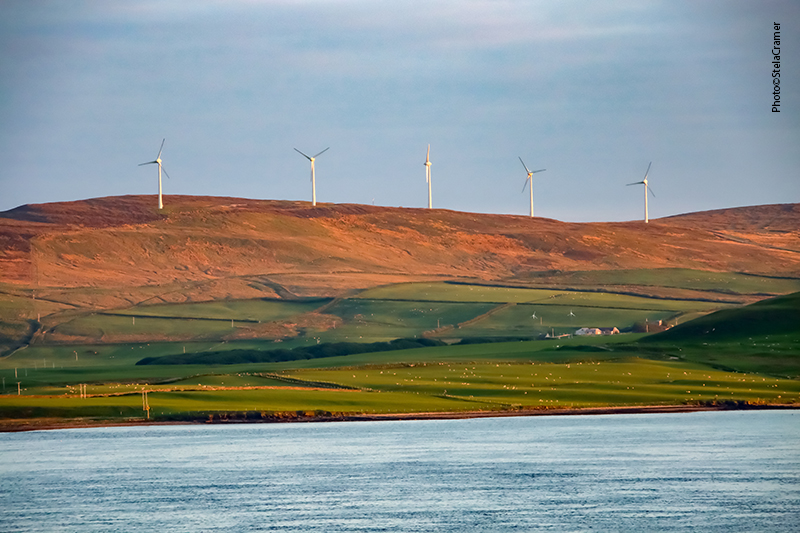
Sol poente, ovelhas e moinhos de vento / Sunset, sheep and wind farm turbines

I was lucky indeed. Although the Inn was just one mile away, the road was steep and a cold drizzle had started. My Island Tour would be the next day, lucky as well because it was a gorgeous sunny day. But the sun reappeared that same day, a bit later, despite the previous bad weather. I had already taken a shower, a pint and was lazying on the porch, reveling in the awesome landscape. As the afternoon approached dusk, I thought of going for a walk, perhaps capture a beautiful sunset. The clerk suggested a trail nearby, that crossed a small bridge, from where I’d have a stunning view. So there I happily went...

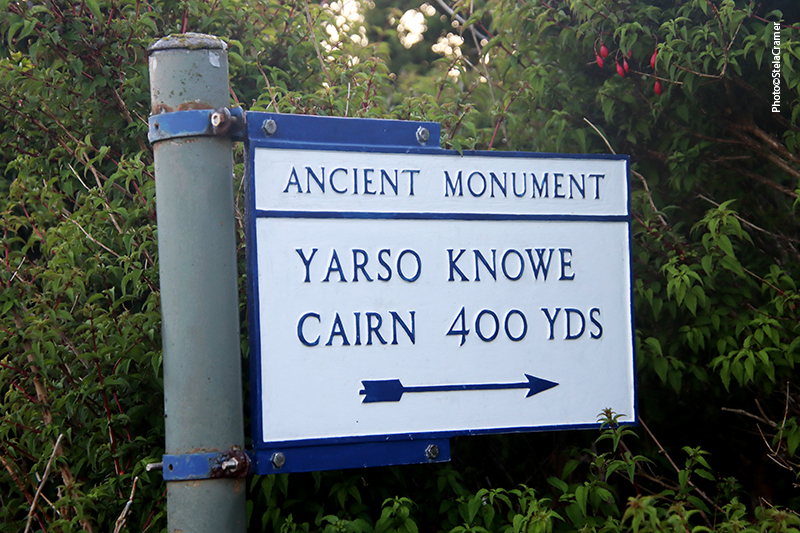
A trilha levava a um túmulo! Mais contente ainda, prossegui.
The trail led to a chambered cairn! Happier still, I went on.
A ponte indicada existia, mas não dava vista para nada além de mato / The little bridge was there but the view from it was just overgrown bushes
A trilha é quase invisível, mas a vista grandiosa/ The trail is almost invisible, but the view gorgeous

A trilha era praticamente inexistente, um caminho pedregoso no matagal, mais adequado para as ovelhas que por ali estavam do que para gente. Mesmo estas não me pareceram muito amistosas. Se afastaram quando passei, mas ficaram me encarando à distância. Levei quase meia hora para chegar à entrada do túmulo, quase suando apesar do vento frio.

The footpath was almost non-existant, steep, muddy and stony in the weeds, more appropriate to the sheep than to people. Even the sheep didn’t look very friendly. The got away as I went on, but kept staring at me from a distance. It took me around half an hour to reach the cairn. I was almost sweating despite the chilling wind.

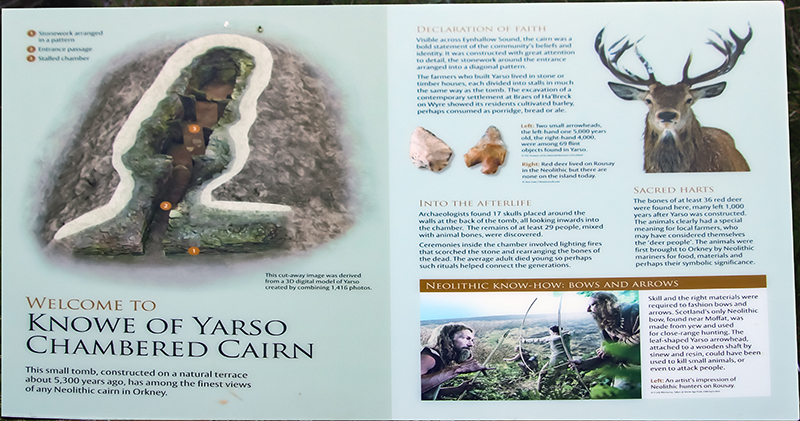
Knowe of Yarso data de 3500 a 2500 AC, mas cerâmica ali encontrada sugere que tenha permanecido em uso até 2000AC. O telhado não existe mais, mas as paredes permanecem mais ou menos da altura original. A câmara é dividida por lajes de pedra em compartimentos, semelhante a outras estruturas Neolíticas que visitamos.

Knowe of Yarso dates to between 3500 and 2500 BC, but pottery found inside the tomb suggests it remained in use until the late 2000s BC. Its roof is gone, but the walls still stand close to their original height. The chamber is divided into compartments by upright slabs, similar to other Neolithic structures we’ve seen before.

A entrada original ainda existe, embora o monumento tenha sido encapsulado numa estrutura de concreto com clarabóias e uma porta moderna. / The original entrance remains, although the monument is encapsulated in a sky-lit concrete cap with a modern door.
O fim da câmara / The chamber’s end

Knowe of Yarso é um entre pelo menos 15 outros túmulos semelhantes na pequena ilha. Arqueólogos acreditam que eram usados como cemitérios comunitários. Escavações na década de 30 encontraram os restos de pelo menos 29 esqueletos, e 17 crânios arrumados um ao lado do outro. Ossos de uns 36 cervos também foram desenterrados, assim como pederneiras, ferramentas de osso, pontas de flechas e pedaços de cerâmica.
Knowe of Yarso is one of at least 15 chambered tombs on the small island. Archaeologists believe these were used for communal burial. Excavations in the 1930s found the remains of at least 29 skeletons, with 17 skulls arranged side-by-side ; bones from at least 36 deer and also flint, bone tools, arrowheads, and shreds of pottery.

Assim, ali estava eu imersa em pensamentos, absorvendo a atmosfera e tentando bater umas fotos apesar da pouca luz, pois esta vinha por clarabóias cheias de sujeira acumulada, além disso estava escurecendo. Eis que escuto um barulho do lado de fora. As ovelhas tinham vindo até a porta de entrada. Imediatamente meu cérebro foi bombardeado por pensamentos assustadores: e se alguma delas esbarrasse na porta, fechando-a, e eu ficasse presa dentro da tumba? A tranca ficava pelo lado de fora. Meu celular estava com a carga no vermelho, tipo 10%, e ali não tinha sinal. Eu poderia gritar por socorro, mas não havia uma alma por perto para ouvir. Só iriam dar pela minha falta na manhã seguinte, na hora do tour, quando eu já teria com certeza morrido de fome (talvez) e de frio (certamente). Não trouxera mochila nem outro casaco. Rapidamente fiz mais um clique ou dois – inúteis, pois as fotos obviamente ficaram tremidas – e saí correndo.

So, there I was, deep in my thoughts, absorbing the atmosphere and trying to take some pictures in spite of the sparse light flowing through dirt covered skylights; besides, it was dusk. Then I heard a noise outside. The sheep had gathered next to the door. Horrible thoughts came to mind: what if one of them bumped the door closed and I got stuck inside the cairn? The lock was on the outside. My mobile was nearly dead – only 10% charge, and there was no signal. I could scream for help, but there was not a single soul around to hear me. I would only be missed in the morning, for the tour, and by then I’d be dead by starvation (maybe) or cold (definitely). I had no backpack or spare coat. So, I quickly took a couple more pictures – useless, obviously blurred – and ran away.

Run, Stela, run!

Demorei mais para descer a trilha do que para subir, pois já estava quase escuro. Não queria tropeçar e ir rolando os quase 400m até lá embaixo. Ou ir parar dentro do rio, que embora estreito devia ser gelado. As ovelhas ficaram lá de cima me olhando. Mas escapei.
It took me longer to get down the trail, because it was almost dark. I didn’t want to risk stumbling and rolling down 400 yards to the road. Or to the river, that was not broad but probably freezing. The sheep stood up there, still staring. But I had escaped.

A salvo, pousada à vista / Safe, the Inn within sight

Read Full Post »


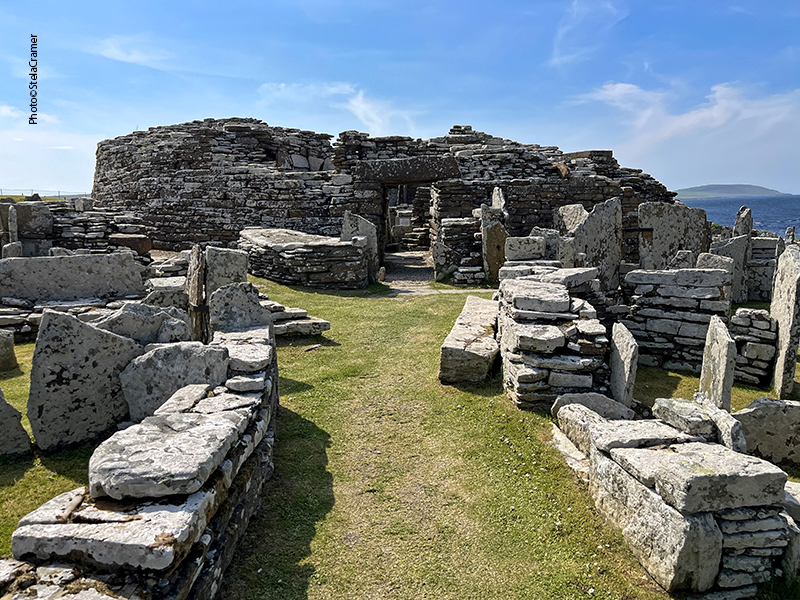
O Broch of Gurness é cercado por três fossos e plataformas escavados com paredes e plataformas de pedra, mostrando claramente três etapas de construção e reconstrução. A área total tem cerca de 45m de diâmetro. / The site is surrounded by three ditches cut out of the rock with stone ramparts, showing clearly three phases of construction and reconstruction. It encircles an area of around 45 metres diameter.
Como devia ser o Broch; vista da mesma posição que a foto acima / How the Broch should look like, from the same position of the picture above
O “Broch” é a torre redonda no meio, cuja altura provavelmente atingia 12 metros; as construções em volta eram as casas do povoado/ the Broch itself is the round tower in the middle, which once probably reached a height of around 12 metres; the buildings around it were the village houses.

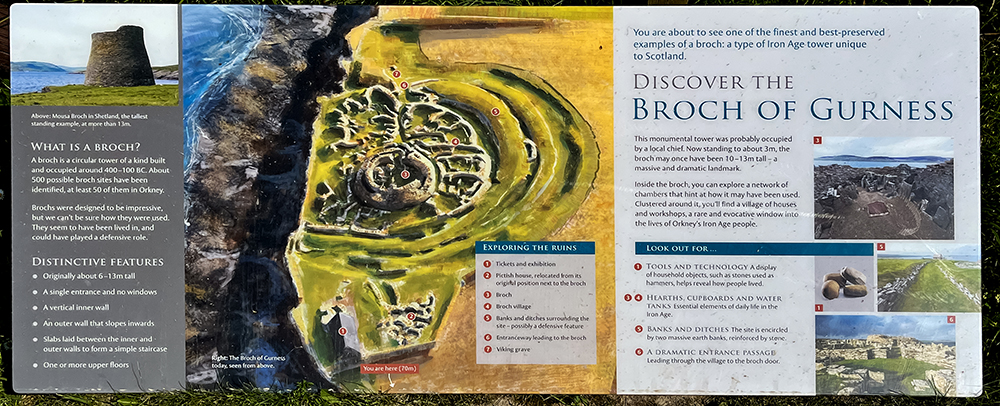
Brochs são construções redondas encontradas apenas na Escócia. Há mais de 500 deles, a maioria nas ilhas e nas Terras Altas. Alguns existem sozinhos, mas nas Orkneys a maioria aparece cercada por aldeias de tamanho razoável. Um dos exemplos mais impressionantes, e o mais bem preservado, é o de Gurness.

Brochs are roundhouse buildings unique to Scotland. There are more than 500 of them, mostly in the northern and western Highlands and the islands. Many stood alone, but sizeable villages often surrounded those in Orkney. The broch village at Gurness is one of the most impressive and the best-preserved examples.

Uma “avenida” principal conecta a entrada da aldeia à do Broch. / A “main street” connects the village outer entrance to the broch.
A foto anterior foi tirada na posição 6 deste mapa / The picture above was taken from the position number 6 in this map.
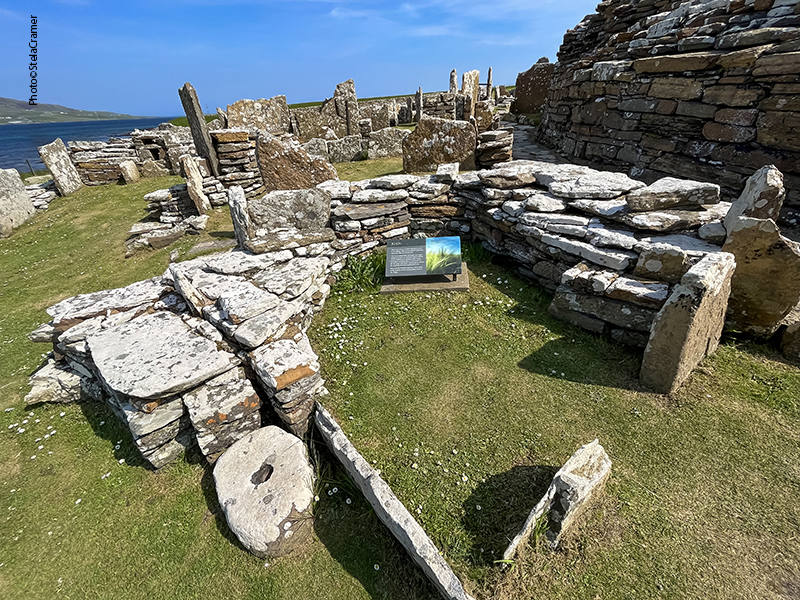
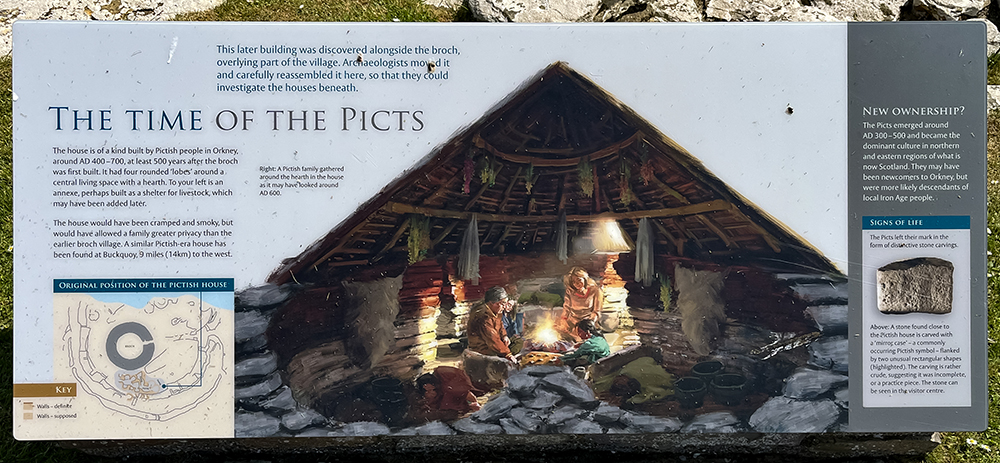
Vista da posição 2 : a casa dos Pictos, logo junto à entrada / View from position 2: the Pict House, right by the entrance

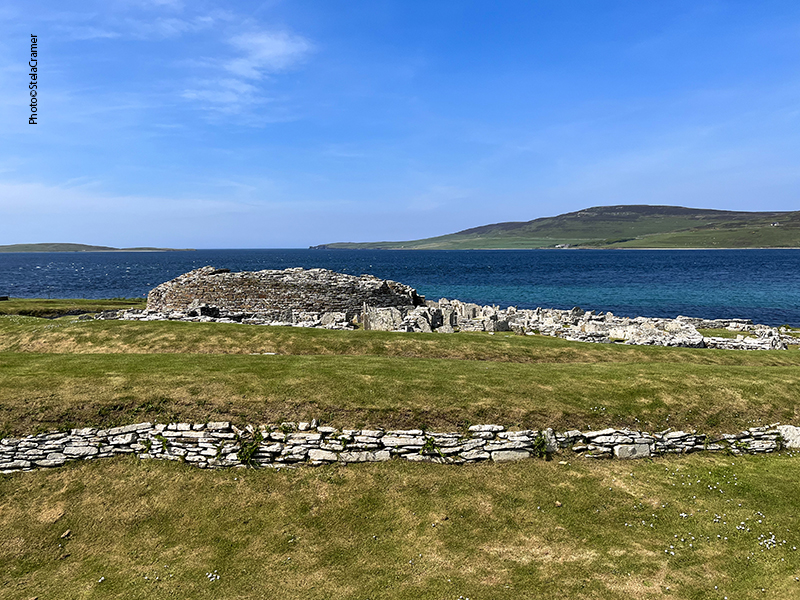
O Broch de Gurness tem cerca de 2000 anos. Construído no Neolítico, em algum momento depois de 100 A.C. parece ter sido abandonado e os fossos preenchidos. A aldeia em volta continuou existindo até cerca de 5 A.C., o chamado Período dos Pictos. Depois, construções Vikings ocuparam parte do lugar. Essa mesma sequência de ocupação se repete nos Brochs próximos, em Birsay e em Midhowe, este na Ilha de Rousay, que se vê ao fundo, na foto. Devia haver conexão entre os habitantes desses lugares. Imagino que, há milênios atrás, o nível do mar devia ser bem mais baixo e se pudesse atravessar a pé durante a maré baixa.

The Broch of Gurness is around 2000-years-old. Built by Neolithic people, at some point after 100 AD the broch was apparently abandoned and the ditches filled in. The settlement around it continued into the 5th century AD, the period known as Pictish times. Subsequently, Viking buildings occupied part of the site. This same sequence of occupation is seen in the nearby Brochs, Birsay and Midhowe, this last one in Rousay, the island seen in the background, in the picture above. There must have been connection between all these inhabitants. I guess that centuries ago the sea level was lower and people could cross on foot in the ebb.

Interior do Broch, cujo diâmetro tem cerca 20m / Inside the Broch, around 65ft in diameter

O Broch original tinha uma lareira central; armários construídos em pedra em volta das paredes; uma espécie de banheira – provavelmente um poço – e escadarias entre as paredes levando aos andares superiores. Este layout foi alterado quando o Broch começou a cair. O poço foi preenchido e o interior redividido.

The Broch originally had a single central hearth; stone-built cupboards around the wall; a sunken water basin – probably a well – and set of stairs between the broch walls, which led to the upper floors. This layout was altered when the broch began to collapse. The well was filled in and the interior refitted with new partitions.

Escadarias que levavam ao andar superior: uma “galeria” com piso em pedra, entre as duas camadas da parede externa, de cerca de 4m de largura / The tower features two skins of drystone walls, with stone-floored galleries in between, up to 4m thick, which were accessed by these steps.

O tanque apresenta o fundo e as laterais impermeabilizados com argila. Há outros semelhantes na aldeia em volta, muitos próximos às lareiras. Isto nos leva a crer que usavam a água para cozinhar, e que podiam aquecê-la pondo pedras da lareira dentro do tanque. / The water basin sides and bottom were made watertight using local clay. Similar tanks were found in the village, many placed near the hearths. This suggests using the water for cooking, and that water could be heated using stones from the hearth.

Havia um banheiro, com cisterna subterrânea / The broch features a “toilet” with a subterranean stone cistern
O forno poderia ser usado para secar grãos (repare a pedra de moer ali ao lado) e para queima de cerâmica / The kiln could have been used for drying crops ( notice the quern stone beside it) , and to fire pottery

Impressionante alvenaria num labirinto de compartimentos / Impressive stone masonry in a network of chambers

Vista da entrada e “avenida” principal por dentro do Broch (número 3 no mapa) / Inside view of the entrance and “main street” (number 3 in the map)
Na aldeia, a entrada de cada casa leva a um cômodo maior, como um sala e quarto conjugado, com a lareira ao centro, o tanque de água, armários e camas de alvenaria, assim como pequenas câmaras menores, divididas por blocos de pedra.
In the village, each house entrance leads to a large living and sleeping room, off which were smaller side rooms. The main room had a hearth, a large tank set into the floor, cupboards and sleeping spaces divided by stone slabs.

Escavações em 1920 revelaram que o Broch foi usado e reusado, demolido e reconstruído ao longo do tempo, assim como o povoado ao redor. Ou melhor dizendo, a série de povoados que foram se sobrepondo aos anteriores ( Pictos, Norsemen, etc). Estas casas nunca foram totalmente escavadas, pois seria preciso destruir esta camada para ter acesso ao que se encontra enterrado por baixo.
Excavations in the late 1920s revealed the broch was used and reused, demolished and rebuild, over a very long period, as well as the village around it. Or rather, several small villages of houses built one on top of the other (Pict, Norse, etc). These houses have not been fully excavated, as access to some of the lower levels would require destruction of the buildings at the upper levels.

Do outro lado do Estreito de Sound, existe outro Broch super bem preservado: Midhowe, na ilha de Rousay, ao fundo na foto. Chegaremos lá. / Across Eynhallow Sound you can see another well-preserved example at Midhowe in Rousay, seen in the background. We’re going there.

Aqui link para um vídeo tour: / Link to a video tour:

https://www.facebook.com/watch/?.mibextid=KsPBc6&rdid=eaGEcqJBYGdENiWE&v=2687884308026791

Read Full Post »