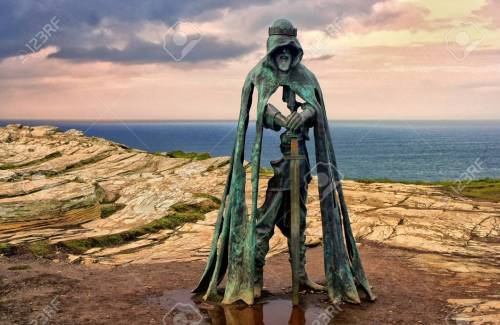
A escultura em bronze Gallos, de Rubin Eynon, inspirada no Rei Arthur, foi trazida para os penhascos de Tintagel em 2016 / Rubin Eynon’s 8-foot bronze sculpture Gallos, inspired by King Arthur, standing on the cliffs at Tintagel. The statue was placed in 2016.
Aqui se encerrava mais uma etapa dessa peregrinação que, agora percebo, não terá fim.
Here we got to the end of one more stage in this pilgrimage which, I now realize, will never end..
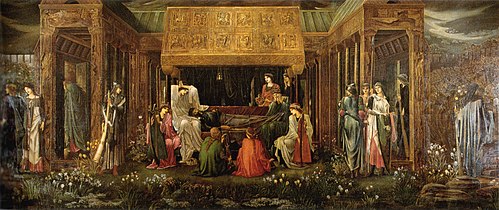
O repouso final de Arthur em Avalon (279 cm × 650 cm) , por Edward Burne-Jones. O pintor iniciou este trabalho em 1841 e levou a vida toda para terminá-lo. / The Last Sleep of Arthur in Avalon (279 cm × 650 cm), by Edward Burne-Jones. Started in 1881, it took the painter’s lifetime to finish.
A última música do álbum “The Myths and Legends…” do Rick Wakeman se chama The Last Battle. Quando escutei pela primeira vez, me pareceu a coisa mais triste que já ouvira. Ainda hoje me parece. Termina com um instrumental, cujo fim são os mesmos acordes do início da primeira música, fechando um ciclo. Eis o fim da letra, uma narrativa: “Sir Hector, Sir Bors, Sir Blamour e Sir Bleoboris, os únicos cavaleiros que sobreviveram, terminaram seus dias depois de uma peregrinação à Terra Santa. Pouco depois, os Saxões conquistaram toda a Grã-Bretanha e o reino de Logres* teve fim. Muitos acreditavam que Arthur retornaria para restabelecer to re-establish o sagrado reino de Logres e salvar a Grã-Bretanha na hora de seu perigo mais mortal.
* – Nome do reino de Arthur, correspondendo mais ou menos às atuais fronteiras da Inglaterra antes da ocupação por Anglo-Saxões.
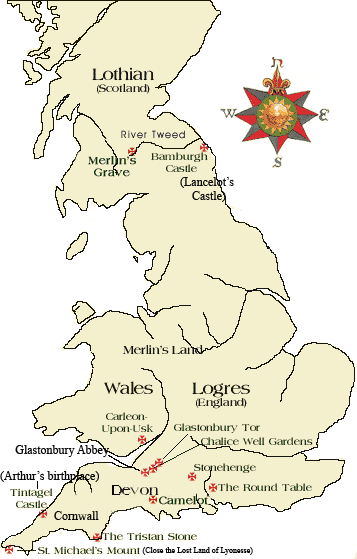
O reino sagrado de Logres/ The Holy Realm of Logres
Rick Wakeman’s “The Myths and Legends…” album’s last song is called The Last Battle. When I first listened to it, it sounded the saddest song I had ever heard. It ends instrumental, the last chords being the very first of the first song, closing a cycle. And the narrator ends with these lyrics: “Sir Hector, Sir Bors, Sir Blamour and Sir Bleoboris, the only surviving Knights of the Round Table, ended their days, after a pilgrimage to the Holy Land. Soon after, the Saxons conquered all of Britain and the realm of Logres* was over. Many believed that Arthur would return to re-establish the Holy realm of Logres and save Britain in the hour of its deadliest danger.”
- – King Arthur’s realm, the Brittonic territory roughly corresponding to the borders of England before the area was taken by the Anglo-Saxons.
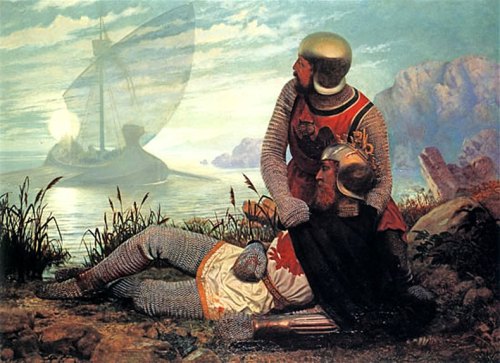
Morte do Rei Arthur / Death of King Arthur by John Garrick, 1862
No filme Excalibur, a barca de Avalon que leva o rei agonizante desaparece entre as brumas. Mesmo o autor Bernard Cornwell dá um fim fantástico à sua Trilogia Arthuriana: emboscados em um estreito e tendo resistido ao máximo, os sobreviventes da última batalha localizam um barqueiro (previamente instruído por Merlin para estar lá) e conseguem colocar Arthur na embarcação, que desaparece no nevoeiro, um segundo antes do ataque final dos inimigos. Dizem – e há pinturas inspiradas nesta cena – que, em Avalon, sob os cuidados de sua irmã Morgana, Arthur se recuperaria dos ferimentos e ficaria esperando ser chamado a atuar novamente no mundo dos vivos, quando a Britannia estivesse de novo em grande perigo – assim como os cristãos creem que Jesus irá voltar.
In the movie Excalibur, a barge from Avalon taking the dying king vanishes in the mist. The author Bernard Cornwell also chooses a fantastic end to his Warlord Trilogy: ambushed in a dead-end by a lake, at the end of their resistance, the last battle’s survivors meet a boatman in a barge (sent by Merlin) and manage to send the wounded Arthur away. The vessel vanishes in the mist one second before the last enemy stroke. The legend says – there are even paintings inspired by this scene – that, taken to Avalon, under his sister Morgan’s care, Arthur would heal from his wounds and there wait the call to return to the world of the living, and save Britain in the hour of its deadliest danger. Just like Christians believe in the return of Jesus.
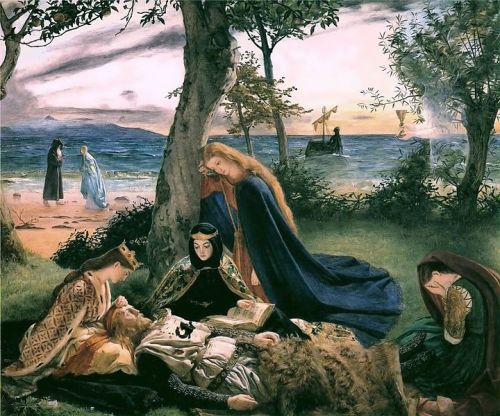
Morte do Rei Arthur / The Death of King Arthur by James Archer (1860)
Meu irmão, ao ver o poster “Land of Arthur” (um mapa que comprei em Glastonbury), começou a discorrer sobre a diferença entre lenda e religião. Uma lenda, segundo ele, tem aspectos nebulosos e cada um a interpreta como quer, ao passo que, na Bíblia, uma mesma história é contada por diversas pessoas, e pode ser comprovada, pois tudo está documentado. Eu não quis discutir, primeiro porque ele pode estar certo, mas principalmente porque pouco me importa a verdade textual. Se me apeguei às histórias de Arthur é porque, para mim, elas têm um significado, não religioso, mas psicológico. O livro “Mulheres que Correm Com os Lobos”, de Clarissa Pinkola Estés, mostra como cada narrativa lança luz sobre um aspecto da psique e, sendo assim, cada pessoa vai se identificar mais com uma ou com outra história. A Mulher-foca, Os Sapatinhos Vermelhos, A Pequena Vendedora de Fósforos, O Barba Azul… as histórias são inúmeras, mas o que importa é aquilo que o arquétipo desperta em você.
When my brother saw the poster “Land of Arthur” (a map that I’ve bought in Glastonbury), he started to discourse about the difference between myth and religion. A legend, according to him, has foggy aspects and each one interprets it at his own will, while in the Bible the same tale is told by many different people and can be proved, because it’s all substantiated. I didn’t want to discuss, first because he may be right, but particularly because the “real truth” doesn’t matter much to me. If King Arthur’s tale got a hold on me it’s because for me it has a meaning, not religious but psychological. The book “Women Who Run with the Wolves” by Clarissa Pinkola Estés, shows how each tale enlightens a different psyche aspect, therefore each person identifies her or himself more with one story than another. What matters is how that archetype touches you.
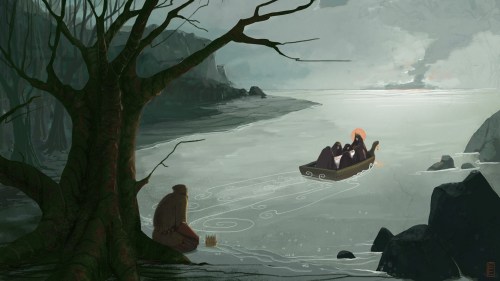
Sir Bedivere and the Death of King Arthur by Elinore Eaton
Viajei a princípio para entrar em contato com meus arquétipos, e criar imagens (fotografias). Tolkien criou um idioma élfico e, para lhe dar embasamento, criou toda a mitologia que ele queria dar à Inglaterra. Escreveu as sagas do Senhor dos Anéis, o Silmarillion e muito mais. Eu fui e voltei para o mesmo lugar inóspito de onde saíra; porém, quem voltou não foi a mesma pessoa. Aliás nem eu mesma sabia mais quem era, nem o que fazer com as fotografias e ideias – principalmente por não ser nenhum Tolkien. Comecei então a refazer meus passos aqui, por escrito para não esquecer.
The first reason for my trip was to get in touch with my archetypes, and to take photographs. Tolkien has created an Elfic language and, to give it a background, created all the mythology that he wanted to add to England. He wrote The Lord of The Rings, the Silmarillion sagas and much more. As for myself, I have left and came back to the same barren place where I’d been, although the person that returned was not the same that had left. Actually I felt lost, had no idea of who I was anymore nor what to do with those photos and ideas – specially because I am no Tolkien. So I’ve undertaken the task of retracing my steps here, writing it all down so I would not forget.
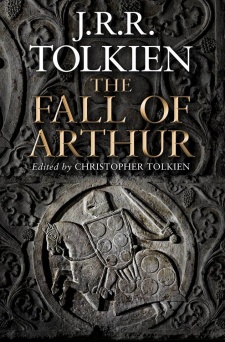
A Queda de Arthur / The Fall of Arthur by J.R.R.Tolkien
Os ideais do Rei Arthur e de seus cavaleiros- justiça, paz, prosperidade – até hoje permanecem inatingidos. E agora nem temos mais cavaleiros! Não sei se virá um tempo em que o espírito de Arthur irá ressurgir das brumas. Não tenho muita certeza se o ser humano quer mesmo se aperfeiçoar ou melhorar a sociedade em que vive. As pessoas falam em salvar o planeta, porém jogam lixo pela janela de casa e do carro. Alguns povos , eternamente em guerra, parecem querer apenas continuar se matando até não restar mais ninguém. Religiões duvidosas cultuam caricaturas nas quais as pessoas acreditam. A ignorância se alastra e o bom senso parece ter desaparecido. Apesar do avanço tecnológico, a humanidade, sob muitos aspectos, parece a mesma de séculos atrás, se é que não involuiu. Sinceramente, não consigo imaginar tempos mais obscuros do que estes e desejo que jamais existam. Querido Arthur, por gentileza, desperte.
King Arthur’s and his knights’ ideals – justice, peace , prosperity – remain unachieved so far. And knights don’t even exist anymore! I don’t know if there will come a time when Arthur’s spirit will rise from the mists. I doubt if mankind really aims to be better or create a better society. People talk about saving the planet, but throw their trash out of the car window. Some people, forever at war, just want to go on killing each other until there’s no one left. Dubious religions worship bizarre caricatures and people believe it. Ignorance spreads and reason has apparently disappeared. Despite technological progress, mankind remains the same of centuries ago in so many aspects… if it has not involuted. Honestly, I can’t imagine darker ages and wish there never come to be. Wake up, please, Arthur dear.
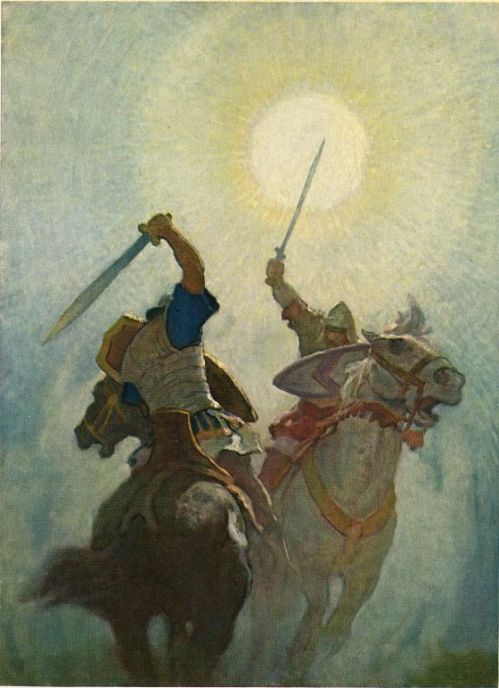
by N.C.Wyeth
A propósito, a jornada não acabou. Voltei ao Reino Unido em maio de 2015, dessa vez com minha amiga Vicky. Aguardem, vou contar tudo.
By the way, my journey is not over yet. I came back to the UK in May 2015, this time with my friend Vicky. Hold on, I’m going to tell you all about it.
Compartilhe meu blog se você gostou.Share my blog if you liked it!











































































 Avalon