
Pendragon presente / presence
O autor Gerald de Wales, em seu “Itinerarium Cambriae” de 1191, escrito sobre uma viagem de recrutamento para a terceira Cruzada no País de Gales em 1188, diz sobre Caerleon: “ Aqui os Embaixadores Romanos tiveram audiência na corte do grande Rei Arthur”.
In his 1191 Itinerarium Cambriae, written about a tour of Wales in 1188 to recruit for the Third Crusade, the author Gerald of Wales says of Caerleon, “the Roman ambassadors here received their audience at the court of the great king Arthur.”
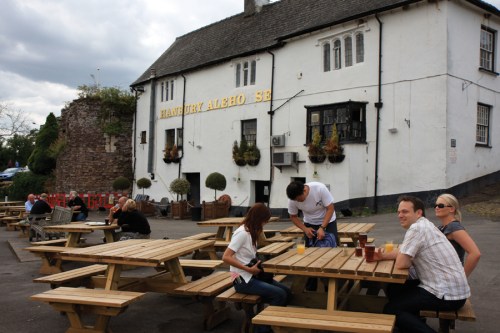
Lord Tennyson hospedou-se no Henbury Arms em 1856, quando trabalhava em seu longo poema “Idílios do Rei”, inspirado no Rei Arthur e Cavaleiros da Távola Redonda. Havia uma teoria de que a Távola Redonda se situava no Anfiteatro Romano em Caerleon. / In 1856, Lord Tennyson lodged at the Hanbury Arms while working on his long poem Idylls of the King. His inspiration was the legend of King Arthur and the knights of the round table. There was a theory that the round table was located at the remains of Caerleon’s Roman amphitheatre.
Geoffrey de Monmouth, o primeiro autor a escrever longamente sobre o Rei Arthur, considera Caerleon a capital de Arthur, e uma das mais importantes cidades britânicas em sua “História dos Reis da Grã-Bretanha”.
Geoffrey of Monmouth, the first author to write at length of King Arthur, makes Caerleon Arthur’s capital , one of the most important cities in Britain in his Historia Regum Britanniæ.
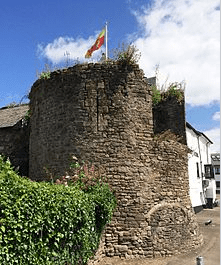
A Torre Redonda, ao lado do Hanbury Arms, é tudo que restou do Castelo de Caerleon./ The Round Tower, at the Hanbury Arms public house, last remnant of Caerleon Castle
Sir Thomas Malory considera Arthur coroado em Caerleon. O autor associa o ainda visível anfiteatro romano à Távola Redonda presente nas narrativas Arthurianas, sugerindo que a lenda possivelmente tenha se originado daí: “Porque se localizava num agradável lugar em Glamorgan, no Rio Usk, não longe do Canal de Bristol*. … pois o nobre rio que mencionei corre paralelo a este em uma das margens, onde os reis e príncipes que vinham de além mar podiam chegar de navio. Mas a outra margem, protegida por pradarias e florestas, destacava-se pelos palácios reais… Caerleon foi preparada para a anunciada festa”. ((Historia Regum Britanniae / História dos Reis da Grã-Bretanha)
*O Canal de Bristol até a época dos Tudors, e ainda hoje no País de Gales e na Cornualha, era conhecido como Mar de Severn.

Edifício do Priorado de Caerleon
Sir Thomas Malory has Arthur re-crowned there. The still-visible Roman amphitheatre at Caerleon has been associated with Arthur’s ‘Round-Table’s element of the tales; and has been suggested as a possible source for the legend: “For it was located in a delightful spot in Glamorgan, on the River Usk, not far from the Severn Sea*... For the noble river I have named flows along it on one side, upon which the kings and princes who would be coming from overseas could be carried by ship. But on the other side, protected by meadow and woods, it was remarkable for royal palaces… Caerleon was made ready for the announced feast.” (Historia Regum Britanniae /History of the Kings of Britain)
* – Until Tudor times the Bristol Channel was known as the Severn Sea, and it is still known as this in both Welsh and Cornish.
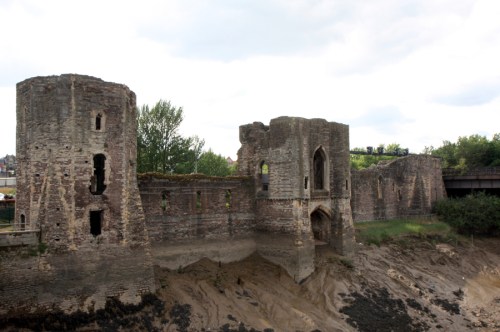
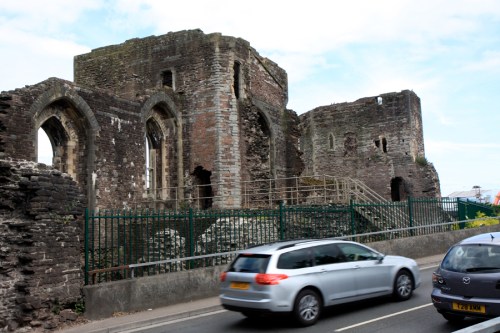
Ruínas do Castelo de Newport , também às margens do Rio Usk / Newport Castle ruins, also by the River Usk
Embora Geoffrey possa ter se inspirado na dimensão das ruínas, assim como na importância de Caerleon como centro urbano do Reino de Gwent, no inicio da Idade Média, a mais importante fonte histórica da ligação de Arthur com o “acampam ento da legião” é a lista das doze batalhas de Arthur na “Historia Brittonum” ( História Britânica) escrita por Nennius no século IX. Ele se refere à nona delas como a Batalha da Cidade da Legião. As hipóteses sobre o local desta batalha incluem Carlisle, Chester, York e Caerleon – também, segundo Geoffrey of Monmouth, local da corte de Arthur e do convento de Guinevere. Entretanto, é mais provável que a “urbs legionis” ( cidade da Legião) mencionada seja Chester, ou mesmo York. “Camelot” aparece pela primeira vez em Lancelot, escrito por Chrétien de Troyes, embora este autor também mencione Caerleon.
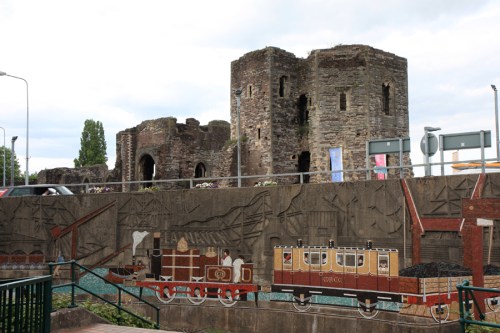
Em Newport, caminho para Caerleon, as ruínas dividem a paisagem com o espaço urbano / In Newport, on the way to Caerleon, the Castle ruins amongst urban landscape
Though the huge scale of the ruins along with Caerleon’s importance as an urban centre in early medieval Kingdom of Gwent may have inspired Geoffrey, the main historical source for Arthur’s link with “the city of the legion” is the list of the twelve battles of Arthur in the 9th century Historia Brittonum by Nennius.He refers to the Battle of the City of the Legion as 9th battle. Hypothesized sites for this battle include Carlisle, Chester, York and Caerleon – also, according to Geoffrey of Monmouth, the site of Arthur’s court and Guinevere’s convent. However the “urbs legionis” mentioned there may rather more probably be Chester , or even York. “Camelot” first appears in Chrétien de Troyes’ Lancelot, though Chrétien also mentions Caerleon.

Agora só resta o lado leste do castelo./ Now, only the east side of the castle remains
A escritora Mary Stewart, em sua narrativa das lendas Arthurianas, também menciona Carleon como sendo um lugar da corte de Arthur.
Mary Stewart’s account of the Arthurian legends also mentions Caerleon as a place where Arthur held court.
 Avalon