Feeds:
Posts
Comentários

Posts Tagged ‘roman site’


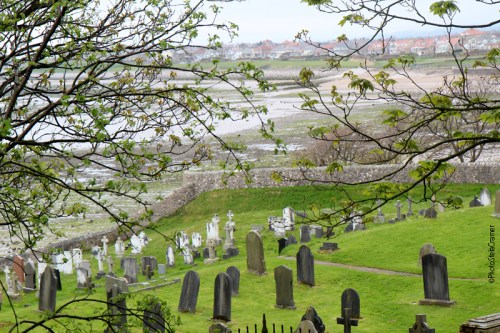
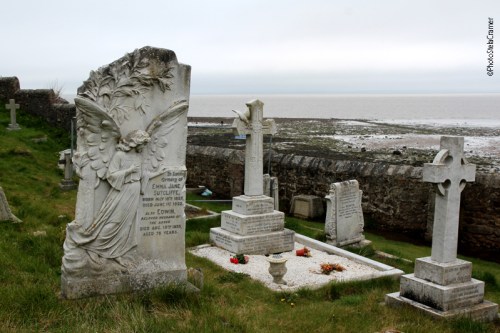
O cemitério, com Heysham e a Baía de Morecambe ao fundo / Graveyard, Heysham/Morecambe Bay in the background

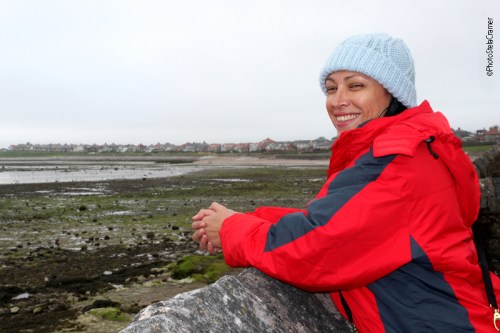
Vicky observa feliz a maré baixa na Baía de Morecambe / Vicky happily watching Morecambe Bay ebb

Túmulos antigos /Old graves

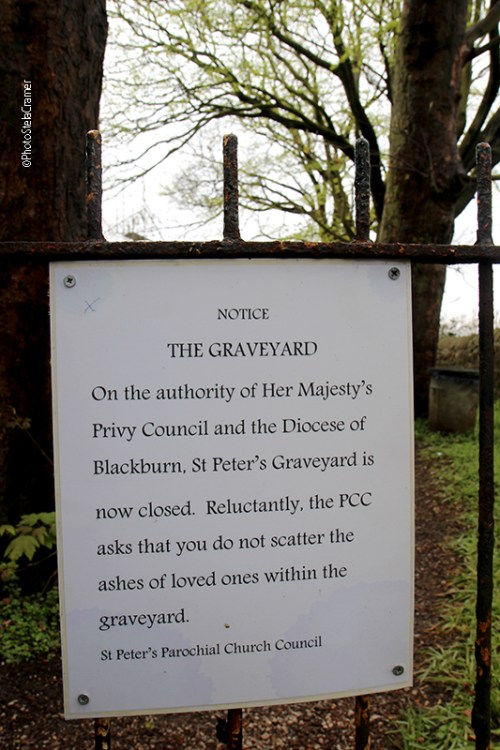
“O cemitério está fechado, pedimos que as pessoas não espalhem as cinzas dos entes queridos no cemitério”

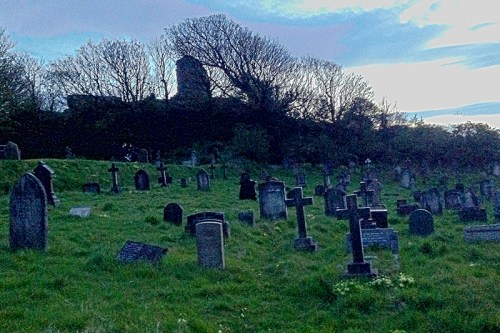
Foto batida pela Vicky: o cemitério e, ao fundo silhueta da Capela de St Patrick e das ruínas romanas. E ali estou eu batendo fotos./ Photo taken by Vicky: the graveyard and, on the background, St Patrick’s Chapel and roman ruins in sillouette. And there I am taking photos!

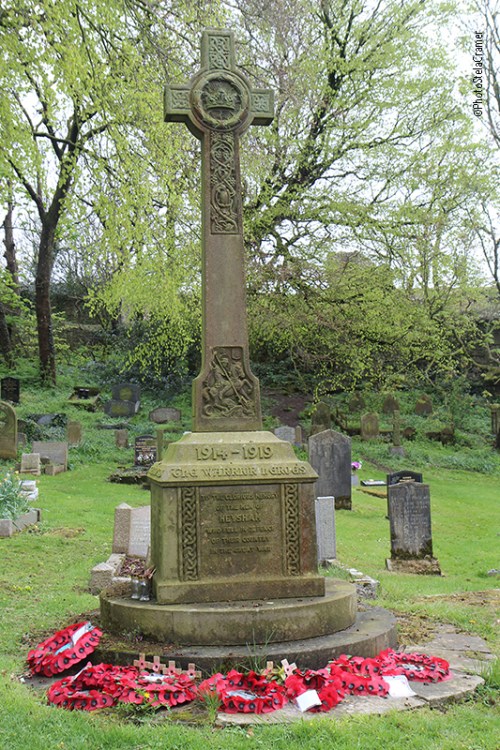
A cruz em homenagem aos soldados mortos na Primeira Guerra Mundial / The cross for the WWW1 dead soldiers

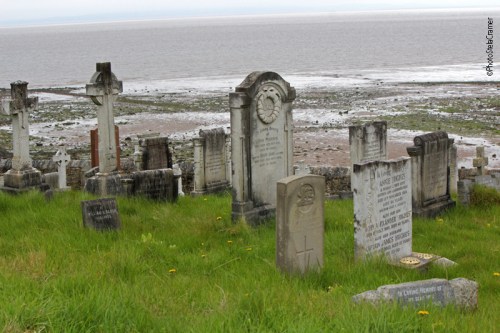
Túmulos antigos com a Baía de Morecambe ao fundo / Ancient graves, Morecambe Bay on the background

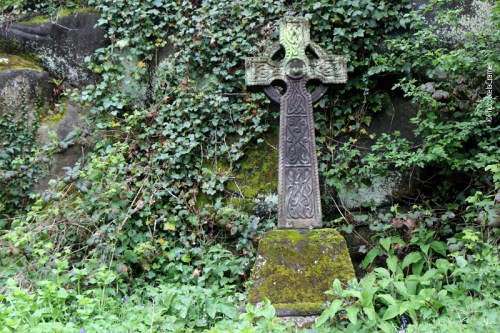
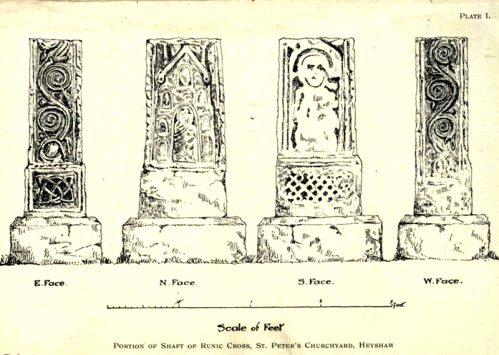
A Cruz Rúnica estava na área em obras fechada à visitação. Imagem tirada do livro de E.M. Grafton “Notas sobre a Igreja e a Paróquia de Heysham” .Esta Cruz Rúnica é um monumento de importância arqueológica nacional, protegido contra qualquer modificação sem autorização / The Runic Cross was in the restricted mainteinance area. This image was taken from the book “Some notes on Heysham Church and Parish” by E. M. Grafton. This Runic Cross is a scheduled monument :a nationally important archaeological site or historic building, given protection against unauthorised change.

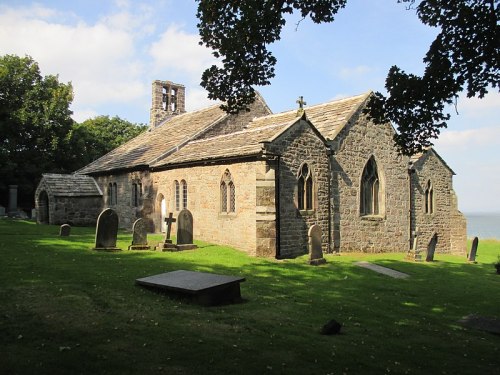
St.Peter’s Church; foto da Wikipedia, pois a Igreja estava em manutenção, coberta por andaimes e tapumes / St. Peter’s Church, a Wikipedia photo because I couldn’t see it, covered by scaffolding

Read Full Post »


Pendragon presente / presence

O autor Gerald de Wales, em seu “Itinerarium Cambriae” de 1191, escrito sobre uma viagem de recrutamento para a terceira Cruzada no País de Gales em 1188, diz sobre Caerleon: “ Aqui os Embaixadores Romanos tiveram audiência na corte do grande Rei Arthur”.

In his 1191 Itinerarium Cambriae, written about a tour of Wales in 1188 to recruit for the Third Crusade, the author Gerald of Wales says of Caerleon, “the Roman ambassadors here received their audience at the court of the great king Arthur.”

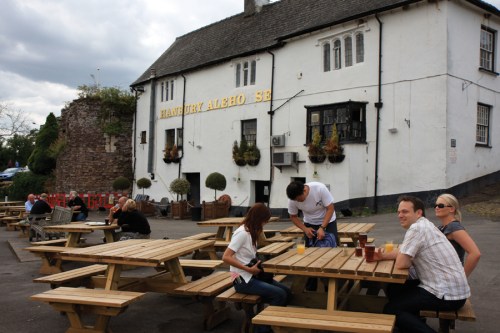
Lord Tennyson hospedou-se no Henbury Arms em 1856, quando trabalhava em seu longo poema “Idílios do Rei”, inspirado no Rei Arthur e Cavaleiros da Távola Redonda. Havia uma teoria de que a Távola Redonda se situava no Anfiteatro Romano em Caerleon. / In 1856, Lord Tennyson lodged at the Hanbury Arms while working on his long poem Idylls of the King. His inspiration was the legend of King Arthur and the knights of the round table. There was a theory that the round table was located at the remains of Caerleon’s Roman amphitheatre.

Geoffrey de Monmouth, o primeiro autor a escrever longamente sobre o Rei Arthur, considera Caerleon a capital de Arthur, e uma das mais importantes cidades britânicas em sua “História dos Reis da Grã-Bretanha”.

Geoffrey of Monmouth, the first author to write at length of King Arthur, makes Caerleon Arthur’s capital , one of the most important cities in Britain in his Historia Regum Britanniæ.

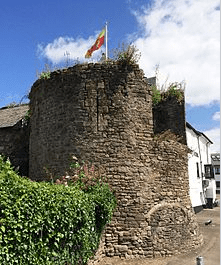
A Torre Redonda, ao lado do Hanbury Arms, é tudo que restou do Castelo de Caerleon./ The Round Tower, at the Hanbury Arms public house, last remnant of Caerleon Castle

Sir Thomas Malory considera Arthur coroado em Caerleon. O autor associa o ainda visível anfiteatro romano à Távola Redonda presente nas narrativas Arthurianas, sugerindo que a lenda possivelmente tenha se originado daí: “Porque se localizava num agradável lugar em Glamorgan, no Rio Usk, não longe do Canal de Bristol*. … pois o nobre rio que mencionei corre paralelo a este em uma das margens, onde os reis e príncipes que vinham de além mar podiam chegar de navio. Mas a outra margem, protegida por pradarias e florestas, destacava-se pelos palácios reais… Caerleon foi preparada para a anunciada festa”. ((Historia Regum Britanniae / História dos Reis da Grã-Bretanha)
*O Canal de Bristol até a época dos Tudors, e ainda hoje no País de Gales e na Cornualha, era conhecido como Mar de Severn.

Edifício do Priorado de Caerleon

Sir Thomas Malory has Arthur re-crowned there. The still-visible Roman amphitheatre at Caerleon has been associated with Arthur’s ‘Round-Table’s element of the tales; and has been suggested as a possible source for the legend: “For it was located in a delightful spot in Glamorgan, on the River Usk, not far from the Severn Sea*... For the noble river I have named flows along it on one side, upon which the kings and princes who would be coming from overseas could be carried by ship. But on the other side, protected by meadow and woods, it was remarkable for royal palaces… Caerleon was made ready for the announced feast.” (Historia Regum Britanniae /History of the Kings of Britain)
* – Until Tudor times the Bristol Channel was known as the Severn Sea, and it is still known as this in both Welsh and Cornish.

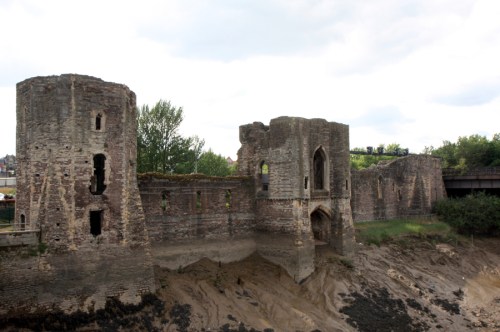
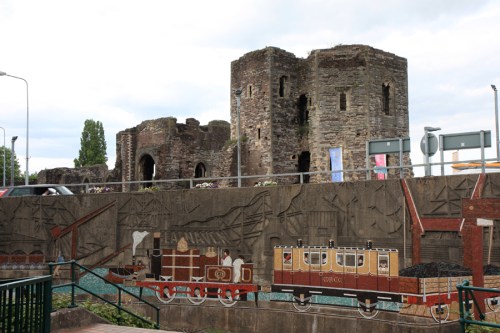
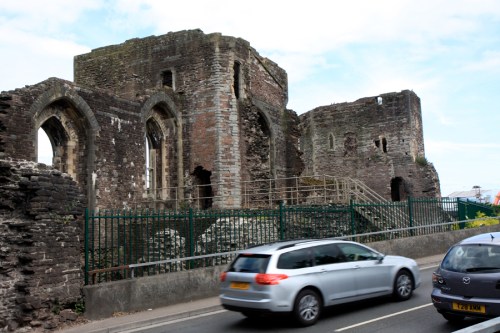
Ruínas do Castelo de Newport , também às margens do Rio Usk / Newport Castle ruins, also by the River Usk

Embora Geoffrey possa ter se inspirado na dimensão das ruínas, assim como na importância de Caerleon como centro urbano do Reino de Gwent, no inicio da Idade Média, a mais importante fonte histórica da ligação de Arthur com o “acampam ento da legião” é a lista das doze batalhas de Arthur na “Historia Brittonum” ( História Britânica) escrita por Nennius no século IX. Ele se refere à nona delas como a Batalha da Cidade da Legião. As hipóteses sobre o local desta batalha incluem Carlisle, Chester, York e Caerleon – também, segundo Geoffrey of Monmouth, local da corte de Arthur e do convento de Guinevere. Entretanto, é mais provável que a “urbs legionis” ( cidade da Legião) mencionada seja Chester, ou mesmo York. “Camelot” aparece pela primeira vez em Lancelot, escrito por Chrétien de Troyes, embora este autor também mencione Caerleon.

Em Newport, caminho para Caerleon, as ruínas dividem a paisagem com o espaço urbano / In Newport, on the way to Caerleon, the Castle ruins amongst urban landscape

Though the huge scale of the ruins along with Caerleon’s importance as an urban centre in early medieval Kingdom of Gwent may have inspired Geoffrey, the main historical source for Arthur’s link with “the city of the legion” is the list of the twelve battles of Arthur in the 9th century Historia Brittonum by Nennius.He refers to the Battle of the City of the Legion as 9th battle. Hypothesized sites for this battle include Carlisle, Chester, York and Caerleon – also, according to Geoffrey of Monmouth, the site of Arthur’s court and Guinevere’s convent. However the “urbs legionis” mentioned there may rather more probably be Chester , or even York.  “Camelot” first appears in Chrétien de Troyes’ Lancelot, though Chrétien also mentions Caerleon.

Agora só resta o lado leste do castelo./ Now, only the east side of the castle remains

A escritora Mary Stewart, em sua narrativa das lendas Arthurianas, também menciona Carleon como sendo um lugar da corte de Arthur.

Mary Stewart’s account of the Arthurian legends also mentions Caerleon as a place where Arthur held court.

Read Full Post »


Se esta era a Távola Redonda, deveria haver centenas de cavaleiros! / If this was the Round Table, there must have been hundreds of Knights!

Dizem que o túmulo de Arthur em Glastonbury é falso, uma invenção dos monges para atrair peregrinos e dinheiro. A história prova que os focos de resistência britânica contra todas as invasões se concentraram na fronteira com a Escócia, na Cornualha e País de Gales – onde fica Caerleon. Isso pode confirmar a teoria de que ali se encontravam os melhores guerreiros e generais, e entre eles podiam estar Arthur e seus cavaleiros. O autor Stephen E. Lawhead atribui a Aurelianus Ambrosius a paternidade de Arthur.

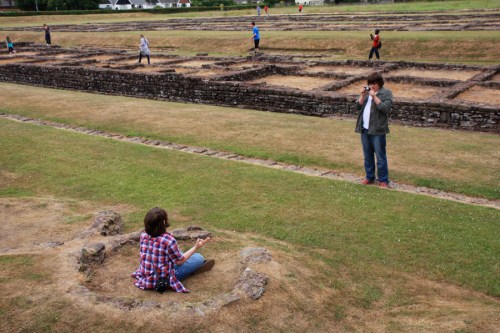
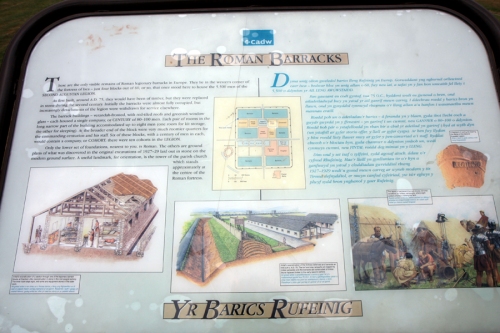
Sítio arqueológico da fortaleza romana de Isca Augusta / Archaeological site of Isca Augusta Roman barracks

Some say that Arthur’s grave at Glastonbury is fake, priests’ fabrication to attract pilgrims and their money. History shows that the main spots of British resistance against all invasions were concentrated in the Scottish borders, Cornwall and Wales – where Caerleon is located. That may confirm a theory of these places having counted on the best warriors and generals, Arthur and his Knights among these. The author Stephen E. Lawhead imputes Arthur’s fatherhood to Aurelianus Ambrosius.

Murais nas ruas sugerindo que Caerleon era a Camelot de Arthur / Street boards suggesting that Caerleon was Arthur’s Camelot

Assim, o País de Gales também reclama a origem de Arthur. De toda forma, é significativo que o Pendragon, título de Uther, seja o símbolo do país. A lenda também conecta o mago Merlin a Gales. A estória é a seguinte: o rei Vortigern* decidiu construir uma fortaleza em Snowdonia (uma região de Gales) e escolheu um local estratégico. Porém, uma coisa estranha ocorreu quando os trabalhadores começaram a lançar as fundações e paredes de pedra do castelo. Tudo que era construído durante o dia desabava misteriosamente durante a noite.

Vista do sítio arqueológico da fortaleza romana de Isca Augusta / View of the archaeological site of Isca Augusta Roman barracks

So, Wales claims  Arthur’s origins too. Anyway, it’s meaningful that the Pendragon, Uther’s title, is the symbol of Wales. The legend also links the wizard Merlin to Wales. It goes like this: King Vortigern* had decided to build a stronghold in Snowdonia ( a region in Wales) and had chosen a proper place, strategically located. But the weirdest thing happened when the building began. The foundations, the stone walls, everything that was built in the daytime collapsed mysteriously by night.

Painéis explicativos nas ruínas / Explanatory panels in the ruins

Os magos da corte de Vortigern recomendaram que o sacrifício de uma criança que não tivesse pai fosse feito no local, para que o sangue derramado fortalecesse a terra. Tal criança foi localizada e trazida à presença do rei. Tratava-se, entretanto, de Merlin, que seria reconhecido como o maior druida de todos os tempos.

* Vortigern foi um general do sec. V, um rei dos britânicos, ou pelo menos assim considerado pelo escritor Bede. Diz-se que ele contratou os mercenários saxões Hengist e Horsa para lutar contra os Pictos e os Escoceses. Porém estes acabaram por se voltar contra ele, e mataram seu filho. Hengist conquistou Kent, tornando-se o primeiro de uma linhagem de reis. Por este erro, atribui-se a Vortigern a perda da Grã- Bretanha para os saxões.

Outra vista das ruínas do quartel de Isca Augusta / Another view of Isca Augusta’s barracks ruins

Vortigern’s magicians consulted their oracles and recommended a blood sacrifice to strengthen the soil. The victim should be a fatherless child, and such a kid was eventually found and brought to the King’s presence. But the child happened to be Merlin, who would be renowned as the greatest Druid ever.

* Vortigern was a 5th-century warlord, a king of the Britons, at least connoted as such in the writings of Bede. He’s said to have hired the saxon mercenaries Hengist and Horsa to fight the Picts and the Scots. But they eventually betrayed him, killing his son and Hengist successfully conquered Kent, becoming the forefather of its kings. So, Vortigern is blamed for his misjudgement and the loss of Britain to the saxons.

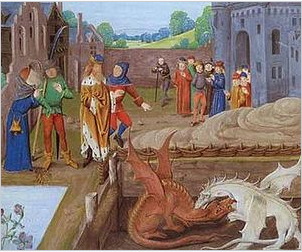
O encontro de Vortigern e Merlin, de acordo com Geoffrey de Monmouth em sua História dos Reis Britânicos / Vortigern meeting the young Merlin, as related in Geoffrey of Monmouth’s Historia Regum Britanniae

Merlin se dirigiu ao rei afirmando que aqueles magos ignoravam que, sob o lugar escolhido para a construção, havia um lago subterrâneo, onde habitavam dois dragões, um vermelho e um branco, que lutavam durante a noite e dormiam de dia. A construção desabava em consequência da luta.

Merlin told Vortigern that his magicians ignored that under the exact building ground, there was an underground pond, home to two dragons, one red and the other white, who would sleep the day and wake up at night to fight each other. Their fierce battle caused the building to collapse.

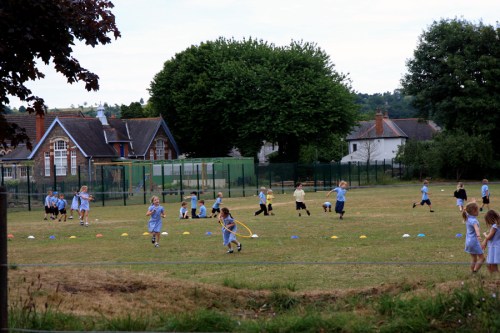
Há escolas em volta das ruínas. Aqui, estudantes no intervalo de aula / The ruins are surrounded by schools. Here, students during class break

Vortigern ordenou que os servos cavassem; o lençol d’água foi localizado e, à noite, escondidos, os nobres presenciaram o surgimento das criaturas. O dragão branco parecia vencer o vermelho, mas, no último instante, este revidava e derrotava seu oponente que, ao se retirar para as profundezas, derrubava toda a estrutura da fortaleza. Intrigado, o rei pediu ao garoto que interpretasse o significado daquela visão.

Vortigern ordered his subjects to dig in the spot; the pond was found and, at night, the noblemen, hidden in the bushes, witnessed the dragons show up. The white one at first appeared to beat the red but, in the last moment, the red would fight back and defeat his opponent. The white dragon’s retreat to the depths made the whole built structure fall to the ground. The king, puzzled, asked the boy to interpret the meaning of such vision.

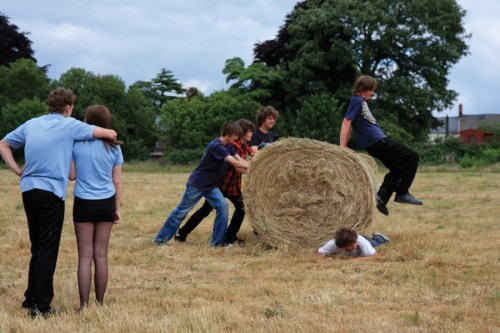
Turistas se divertem / Tourists having fun

Estudantes se divertem / Students having fun

Merlin explicou que o dragão branco representava o povo invasor que quase chegaria a dominar a ilha de uma ponta à outra, enquanto que o vermelho representava o povo bretão que se levantaria e viria a expulsar os invasores. Impressionado, Vortigern libertou Merlin e o elevou à categoria de seu conselheiro. Daí o dragão vermelho ser o emblema dos galeses.

Merlin explained that the white dragon impersonated the invaders, who would almost succeed to conquer the isle from one end to the other. The red dragon was the British people, who would raise to defeat and kick out the invaders. Impressed, Vortigern freed Merlin and made him his counsellor. And this is why the red dragon is the Welsh symbol.

Outra escola – primária – junto às ruínas / Other school – elementary – neighbor to the barracks

Eu tinha comprado, na loja de souvenirs do Cardiff Castle, um irresistível dragãozinho vermelho de pelúcia. Nem lembrei que teria de carregá-lo na mochila todo o resto da viagem.
I had bought an irresistible stuffed red dragon at Cardiff Castle’s souvenir shop. It hadn’t crossed my mind that I’d have to carry it in my backpack all along the trip.


Read Full Post »


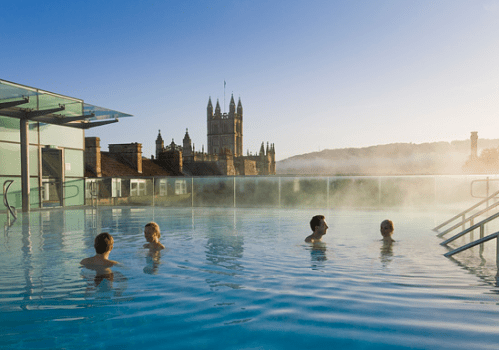
Foto do site /Photo from the Thermae Bath Spa website: https://www.thermaebathspa.com/

Foto do site /Photo from the Thermae Bath Spa website

No segundo dia em Bath, depois de visitar o Museu da Moda, o de Jane Austen e de bater perna o dia inteiro, entrei no Thermal SPA, uma versão high-tech dos banhos romanos, alimentado pela mesma fonte que estes, localizados bem em frente. O ingresso do SPA é caro, porém, vi um pacote promocional na Internet – Twilight Package – que custava dez libras a menos e compreendia três horas no SPA, uma refeição com bebida e o uso de armário, toalha, robe e chinelos, normalmente cobrados à parte, totalizando mais doze libras. Na recepção não ofereciam esse pacote, mas eu disse à moça que tinha visto no site e ela imediatamente identificou. Paguei e entrei.

My second day in Bath consisted in visiting the Fashion Museum, Jane Austen’s Museum, strolling around the town and relaxing in the Thermal SPA, a high-tech version of the Roman Baths, right in front of these and fed by the same waters. The Spa ticket is expensive, but I had seen in the website a promotional package – the Twilight Package – which costed 10 pounds less, comprising 3 hours in the Spa, a meal with drink included and free locker, towels, robe and slippers (usually charged extra, around 12 pounds). This package is not offered at the front desk, but I told the receptionist that I had seen it in the website and she agreed immediately. I paid and entered.
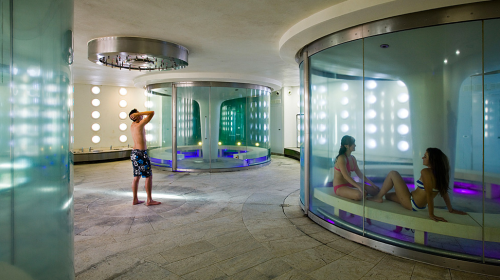
Outra foto do site: Saunas perfumadas / Aromatic Steam Rooms. Also from the website.

Outra foto do site: Saunas perfumadas / Aromatic Steam Rooms. Also from the website.

Link para o site do Thermal Spa em Bath, UK / Link to Thermal Spa website

O local tem três andares. No terceiro, o terraço, há uma piscina ao ar livre com vista para a cidade e água morna que começa a borbulhar a cada quinze minutos! Então ali estava eu, em Acquae Sulis, me banhando na mesma fonte que os Celtas de 2000 anos atrás! Comecei a rir sozinha, dar cambalhotas dentro d’água, dando guinchos do mais puro prazer. Desnecessário dizer que todo mundo olhou para mim… na verdade, já estavam olhando para meu biquíni brasileiro; não que fosse indecente, mas os maiôs das outras pessoas eram feios e surrados. Na verdade ali só tinha idosos e casais. Apenas eu era mais jovem e estava sozinha. E dei graças à deusa Sulis por não haver crianças pulando e gritando na piscina.

The place has 3 floors. On the third, there’s an open-air rooftop pool, with naturally warm, mineral-rich waters, that start bubbling each 15 minutes! So, there I was in Acquae Sulis, bathing in the same spring the Celts did over 2000 years ago! I started to laugh, cartwheel underwater and winch of pure joy. No need to say that all other customers were staring at me… actually, they were surely staring at my brazilian bikini. It wasn’t indecorous, but everyone else’s were ugly and shabby. There were only seniors in the pool, and a few couples. I was the only young and alone. And I thanked the goddess Sulis for there were no kids screaming and jumping on the pool.
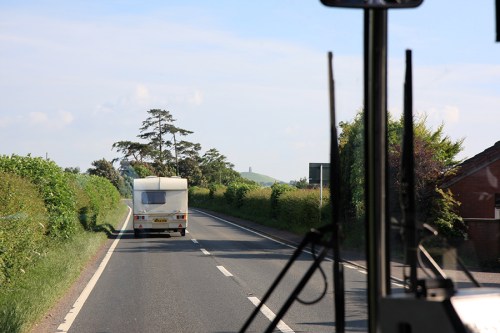
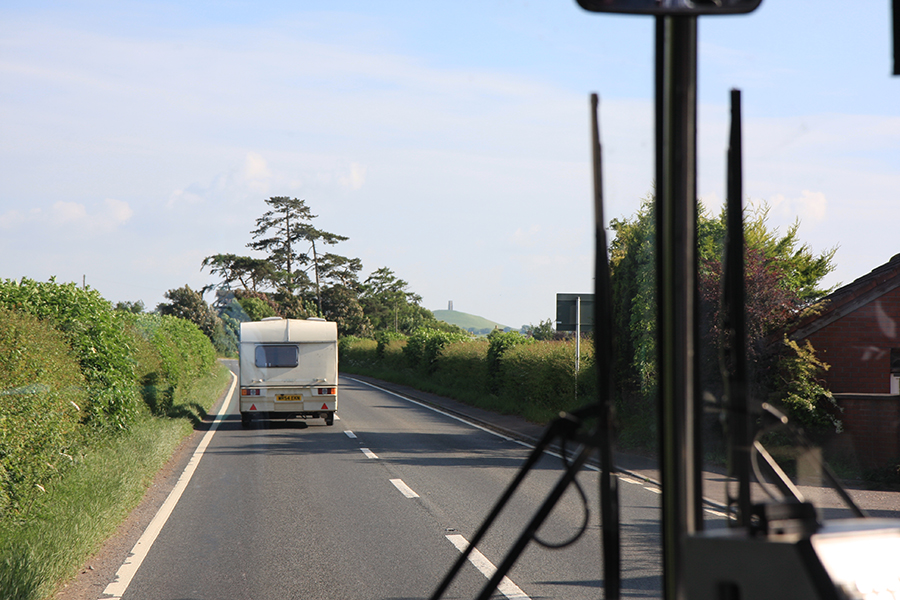
A caminho de Glastonbury, o Tor já à vista / On the way to Glasto, Tor in sight

A caminho de Glastonbury, o Tor já à vista / On the way to Glasto, Tor in sight

O segundo andar tinha uma enorme ducha no meio e quatro cilindros gigantes de vidro em volta. Eram as saunas a vapor, cada uma com um perfume (lavanda, hortelã, alecrim e incenso). Ao longo de uma parede, várias bacias para escalda pés. Escolhi a sauna de lavanda para me espichar, esvaziar a mente e obrigar meus olhos a descansar, já que era proibido bater fotos no local. Refleti sobre o que estava fazendo ali, cinco anos depois do início do projeto. Logo estaria em Glastonbury para o encontro dos druidas, curiosíssima.

The second floor had a big shower surrounded by four steam rooms, massive glass cilinders, each infused with a different aromatic essence (lavender, mint, rosemary and frankincense). Along a wall, many basins for foot baths. I chose the lavender steam room to lie down, empty my mind and force my eyes to rest, because it was forbidden to take photos there. I thought over what I was doing there, five years after the beginning of this project. Soon I’d be in Glastonbury, to attend the druid’s meeting, so curious I was!!!!
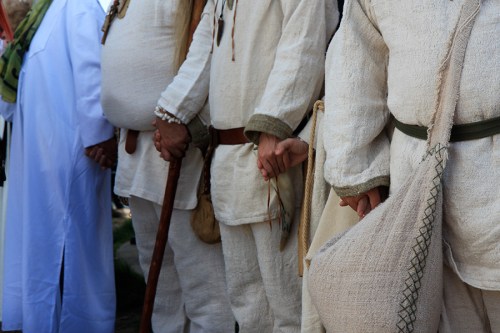
Encontro de Druidas / Druid meeting

Encontro de Druidas / Druid meeting

Em outubro de 2010, o druidismo foi reconhecido como religião no Reino Unido. Séculos depois de ter sido banido! Na verdade, trata-se de uma releitura do druidismo, mais adequada aos dias de hoje. O personagem Panoramix (das histórias de Asterix o Gaulês, criado pelos geniais Goscinny e Uderzo) reflete bem a importância dessas figuras na antiga sociedade celta.

In October 2010 Druidism was acknowledged as a religion in UK. Centuries after it had been banished! Actually, it’s a new druidism, more suitable to the present days. The character Panoramix (from Asterix the Gaul, by the brilliant Uderzo and Goscinny) shows how important druids were in Celtic ancient society.
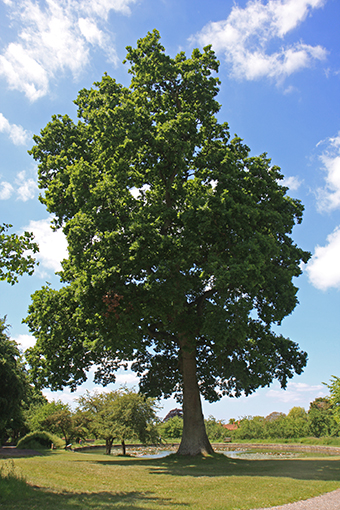
Carvalho, a árvore sagrada dos druidas/ Oak is the Druids' sacred tree

Carvalho, a árvore sagrada dos druidas/ Oak is the Druids’ sacred tree

Druidas eram líderes espirituais de elevado status social, xamãs, vistos como feiticeiros com poderes sobrenaturais, especialmente pela sua capacidade divinatória; acreditva-se que podiam entrar em contato com os deuses e trazer a orientação destes para o restante da tribo. Reuniam o conhecimento de música, poesia, tradições orais e genealogia; dos reinos animal e vegetal, da medicina e das leis naturais e cósmicas. O treinamento de um druida podia levar vinte anos – isto é, uma vida dedicada ao estudo. Eles precisavam saber de cor histórias, lendas e canções. Deviam sintonizar-se com as estações do ano e a respiração da terra. Eram sacerdotes, juízes, sábios. Merlin, conselheiro de Arthur, era um druida – daí meu interesse.

Druids were spiritual leaders of high social status, shamans, seen as sorcerers with supernatural powers, particularly for their ability to perform divination; supposed to contact the Gods and bring their messages to guide the tribe. They had the knowledge of music, poetry, folk lore; of  plants and animals, physics, cosmic and natural laws. Druidic lore consisted of a large number of verses, songs and legends learned by heart. It could take up to twenty years to complete the course of study. That means, a whole life dedicated to study. A Druid should be in tune with the seasons, with the Earth’s breath. Druids were priests, judges, wisemen. Merlin, Arthur’s mentor, was a Druid. That’s where my interest come from.
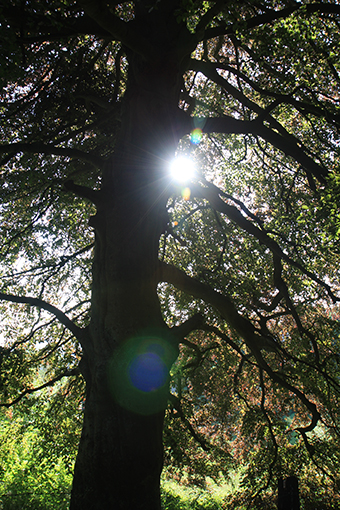
A natureza é o templo. / Nature is the temple.

A natureza é o templo. / Nature is the temple.

Muita gente menciona apavorada que os druidas faziam sacrifícios humanos, mas obviamente isso hoje não faz parte dos seus rituais. Antigamente, sacrifícios eram comuns em diversas culturas. E digo mais, nenhuma foi tão atuante quanto a Igreja Católica durante o período de Inquisição, quando morreu mais gente na fogueira do que de Peste Negra. O Druidismo, como a Wicca, são cultos pagãos que se caracterizam atualmente pela consciência ecológica. A natureza é seu templo.

Many state, terrified, that Druids performed human sacrifices, but obviously in present times that isn’t part of their rituals anymore. In ancient times, human sacrifices were indeed common in many cultures. I add that none has been so effective as Catholic Church: in Inquisition times, more people were killed in the bonfires than by plague – the “Black Death”. Nowadays, Druidism, as Wicca, are pagan worships featured by ecological consciousness. Nature is their temple.
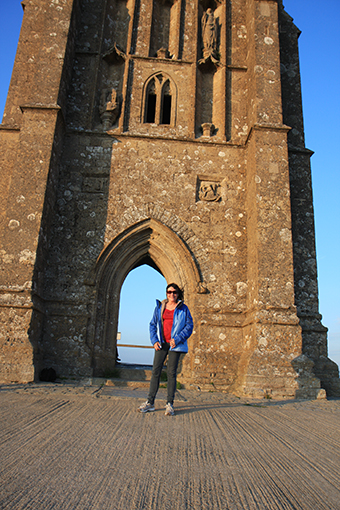
No alto do Tor, aguardando o encontro / Up the Tor, waiting for the meeting

No alto do Tor, aguardando o encontro / Up the Tor, waiting for the meeting

O livro As Brumas de Avalon mostra bem o avanço do cristianismo sobre o paganismo dos povos antigos da Bretanha. Mostra como a convivência pacífica entre estas crenças descambou para dominação cultural com padres, bispos e arcebispos taxando todo o conhecimento secular celta de bruxaria e feitiçaria. O motivo foi o mesmo que ainda hoje instiga o conflito entre religiões: cobiça por riquezas e poder.

The Mists of Avalon depicts the Christianity overpowering British people’s ancient Paganism. It shows how these two faiths’ former peaceful coexistence changed into cultural domination, with priests, bishops and archbishops calling “witchcraft” and “sorcery” the ancient Celtic knowledge. The reason was the same that nowadays still instigates religious conflicts: greed for riches and power.

Read Full Post »


Muitos lugares para visitar / Several places to visit

Muitos lugares para visitar / Several places to visit

O primeiro santuário no local das fontes de água quente foi construído pelos Celtas. A água que brota do solo em Bath caiu sob forma de chuva nas colinas Mendip próximas. Ela se infiltra através de aquíferos de calcário a uma profundidade entre 2.700 e 4.300 metros, onde energia geotermal eleva a temperatura da água para algo entre 64 e 96ºC. Sob pressão, a água aquecida sobe à superfície através de fissuras e falhas no calcário.

The first shrine at the site of the hot springs was built by Celts. The water which bubbles up from the ground at Bath falls as rain on the nearby Mendip Hills. It percolates down through limestone aquifers to a depth of between 2,700 and 4,300 metres (8,900 and 14,100 ft) where geothermal energy raises the water temperature to between 64 and 96 °C (147.2 and 204.8 °F). Under pressure, the heated water rises to the surface along fissures and faults in the limestone.

Fachada do Museu / Museum forefront

Fachada do “Pump Room”  / Pump Room forefront

Roman Baths / Banhos Romanos, interior

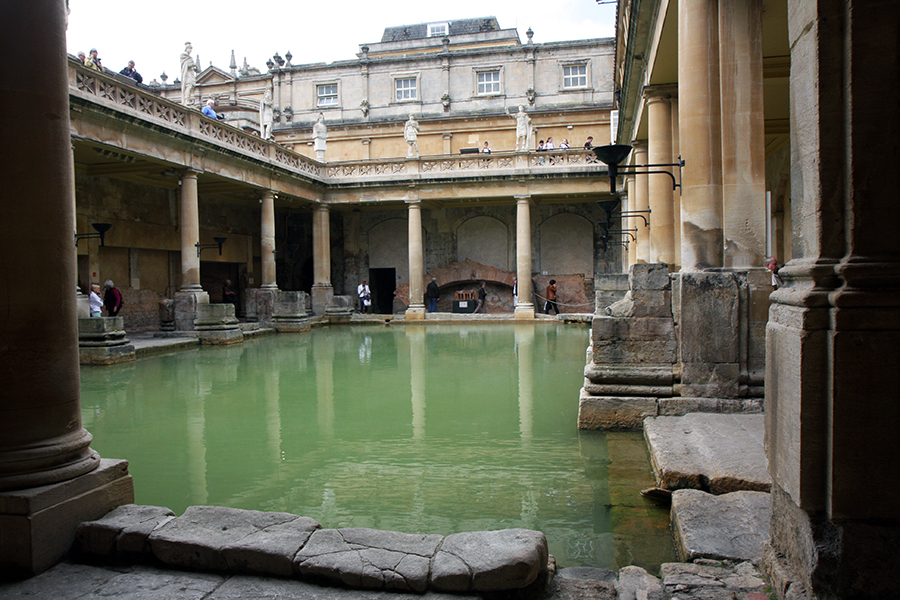
Os Banhos Romanos originais se localizam abaixo do nível da rua. Há quatro atrações: a Fonte Sagrada, o Templo Romano, a casa de banhos romana e o Museu. Toda construção acima do nível da rua data do século XIX. / The Roman Baths themselves are below the modern street level. There are four main features: the Sacred Spring, the Roman Temple, the Roman Bath House and the Museum holding finds from Roman Bath. The buildings above street level date from the 19th century.

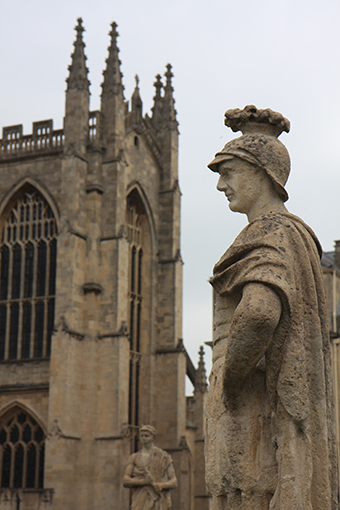
Andar superior, vista da Catedral ao fundo / upper level, with Cathedral in the background

Andar superior, vista da Abadia ao fundo / Upper level, Abbey in the background

Vista da Catedral / Cathedral View

Toda a estrutura superior acima das colunas foi edificada posteriormente, não data do tempo dos romanos./ The entire structure above the level of the pillar bases is a later construction, and was not a feature of the building in Roman days.

Deuses Romanos / Roman Gods

Deuses Romanos / Roman Gods

Confronto de religiões / Confrontation of religions

Confronto de religiões / Confrontation of religions

A deusa Sulis, a quem a fonte era consagrada / The goddess Sulis,  to whom the water spring was consacrated

A deusa Sulis, a quem a fonte era consagrada / The goddess Sulis, to whom the water spring was consacrated

Vista da Banheira Real no térreo / The Royal Bath, ground level

Vista do Grande Banho no térreo / The Great Bath, ground level

Esta funcionária, vestida de romana, mostra aos visitantes as ervas e óleos que eram usados nos banhos. / This lady in Roman garments shows the visitors the oils and herbs used by bathers in Roman times

Esta funcionária, vestida de romana, mostra aos visitantes as ervas, utensílios e óleos que eram usados nos banhos. / This lady in Roman garments shows the visitors the tools, oils and herbs used by bathers in Roman times

Acesso ao Museu / Museum access

Acesso ao Museu / Museum access

Interior do Museu / Museum Interior

Interior do Museu / Museum Interior

Além das peças encontradas nas escavações, o visitante pode assistir diversos curtas sobre o funcionamento dos banhos e costumes romanos. / Besides the archaeological findings, the museum presents short movies about Roman life and the Baths running

Além das peças encontradas nas escavações, o visitante pode assistir diversos curtas sobre o funcionamento dos banhos e costumes romanos. / Besides the archaeological findings, the museum presents short movies about Roman life and the Baths operation

Cabeça da deusa romana Minerva / Roman goddess Minerva's head

“Na Britannia há fontes quentes adornadas com suntuoso esplendor para o uso dos mortais. Sua deusa padroeira é Minerva.” / “In Britain are hot springs adorned with sumptuous splendor for the use of mortals. Minerva is patron goddess of these…” (Solinus, 3rd Century AD)

Visitantes passeiam entre as ruínas / Visitors stroll around the ruins

Visitantes passeiam entre as ruínas / Visitors stroll around the ruins

Entrada para o jardim do templo / Entrance to the Temple's gardens

Entrada para o jardim do templo / Entrance to the Temple’s gardens

Jardins do Templo. Temple's gardens.

Jardins do Templo. Temple’s gardens.

Maquete dos Banhos no tempo dos Romanos. No lugar do Templo foi erguida a Abadia. / Model of the original Roman Baths. The Abbey was built where the Temple once was.

Maquete dos Banhos no tempo dos Romanos. No lugar do Templo foi erguida a Abadia. /
Model of the original Roman Baths. The Abbey was built where the Temple once was.

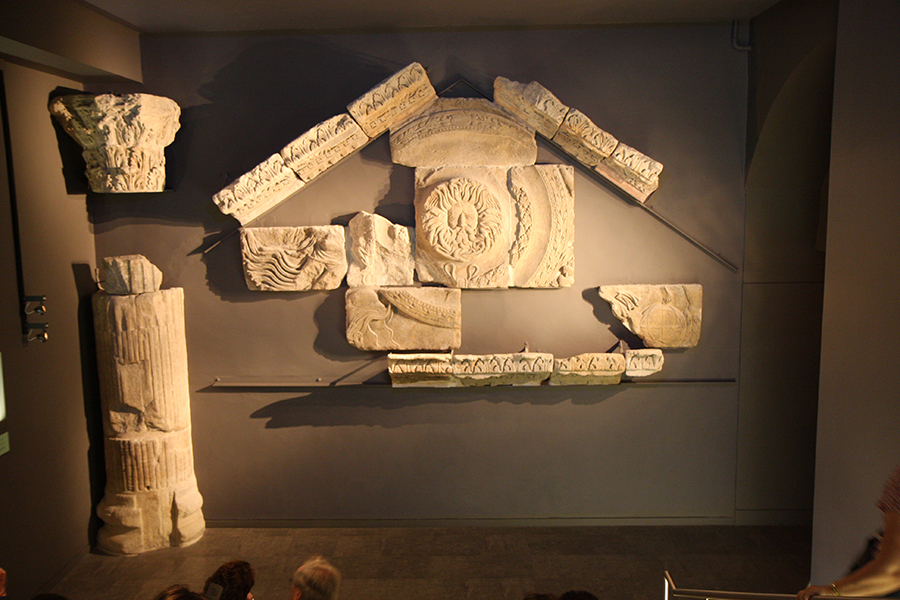
O que restou do Templo / What was left of the Temple

O que restou do Templo / What was left of the Temple

Show de luzes no frontão do Templo / Light changing show in the Temple's pediment

Show de luzes no frontão do Templo / Light changing show in the Temple’s pediment

Show de luzes no frontão do Templo / Light changing show in the Temple's pediment

Show de luzes no frontão do Templo / Light changing show in the Temple’s pediment

Mapa do lugar / Site map

Mapa do lugar / Site map

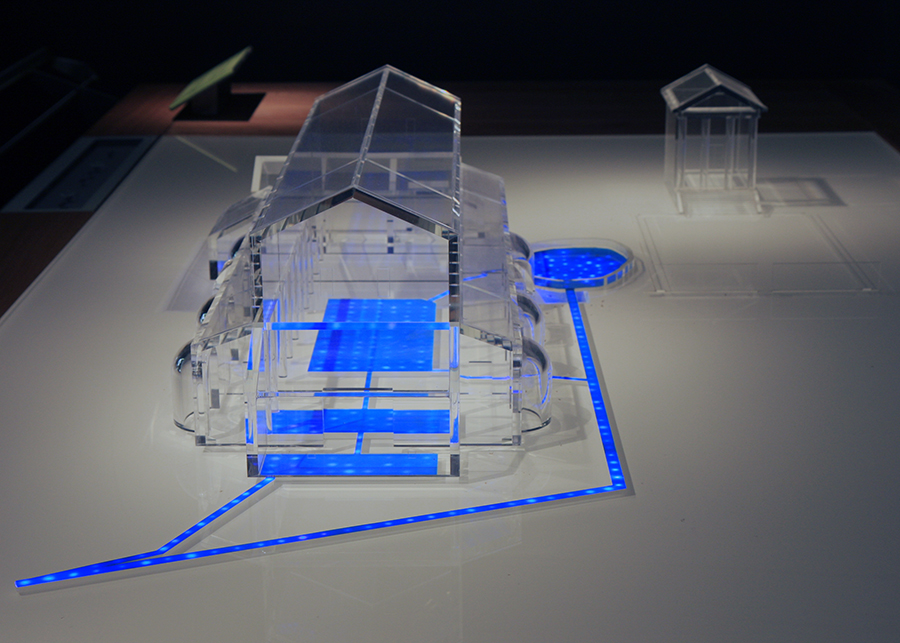
Linda maquete do percurso da água / Beautiful model of the water path

Linda maquete do percurso da água. / Beautiful model of the water path

Manutenção no lugar da fonte sagrada, visitantes não tem acesso à essa área./ Sacred Spring surroundings in maintenance. Visitors are not allowed inside.

Manutenção no lugar da fonte sagrada, visitantes não tem acesso à essa área./
Sacred Spring surroundings in maintenance. Visitors are not allowed inside.

Stela Cramer amando tudo / Stela Cramer loving the trip

Stela Cramer amando tudo / Stela Cramer loving the trip

Read Full Post »


Bath, Somerset, England

Bath, Somerset, England

Haveria um encontro de druidas em Glastonbury.
Em 2005 descobri que existia uma “Ordem dos Bardos, Ovates e Druidas” sediada na Inglaterra, e oferecia curso por correspondência. Interessada, me inscrevi para aprofundar meu conhecimento sobre o assunto. Recebi um pacote de apostilas com lições, textos e exercícios, basicamente meditações e visualizações. Tenho vergonha em reconhecer que, cinco anos depois, ainda estava na lição vinte e não conseguira fazer uma meditação completa sem dormir no meio. Mas aprendia coisas interessantes e recebia uma revista mensal , Touchstone, onde vários participantes postavam artigos, textos, poemas… e calendário de eventos, cursos e celebrações como solstícios e equinócios. Decidi comparecer ao Solstício de Verão de 2010, e para lá me dirigia. Faria um pit stop em Bath, cidade dos banhos romanos.

River Avon

The 18th-century Pulteney Bridge, River Avon – Ponte Pulteney, do século 18, no Rio Avon

A Druid meeting was going to take place in Glastonbury.
In 2005 I discovered that an “Order of Bards, Ovates and Druids” existed based in England, and offered a correspondence course. To dig deeper in the subject, I enrolled in it and got by mail a package with booklets of lessons, texts and exercises in meditation and visualization. I’m ashamed to admit that five years later I was still in lesson 20 and wasn’t able to meditate without falling asleep before the end. Anyway, I learned interesting things. I also subscribed to Touchstone, a monthly journal of members’ articles, texts, poetry and events such as retreats, workshops and gatherings, including Solstice and Equinox ceremonies. I decided to attend 2010 Summer Solstice celebration, and was heading for it. On the way, I’d stop in Bath, city where the Romans built Baths in the hot springs.

"The Crescent" , a massive building encircling a park - Enorme prédio em forma de lua crescente em volta de um parque

“Royal Crescent” , a massive building encircling a park – Enorme prédio em forma de lua crescente em volta de um parque

Eu agendara três noites num albergue próximo à estação de trem, em Bath. Durante a viagem, a moça sentada ao meu lado foi multada porque estava sem passagem. Disse ao fiscal que tinha comprado, mas não achava na bolsa. Ela ficou meia hora tentando convencê-lo a vender a passagem ali na hora, mas ele só repetia “These are the rules”. Aquelas eram as regras: não era permitido comprar a passagem no trem depois de embarcar. Assim a moça levou uma multa pesada – o dobro do valor do ticket ou mais.

Bath Abbey - Abadia de Bath

Bath Abbey – Abadia de Bath

I had booked three nights in a hostel near Bath train station. During the journey, a girl sitting next to me was fined because she didn’t have the ticket. She told the inspector that she actually had bought a ticket but just couldn’t find it in her purse. She tried to buy the ticket from him and spent half an hour trying to talk him into it, but he kept on saying “these are the rules”: Nobody was allowed to buy the ticket in the train, after boarding. So the girl got a heavy fine, twice the ticket’s price or more.

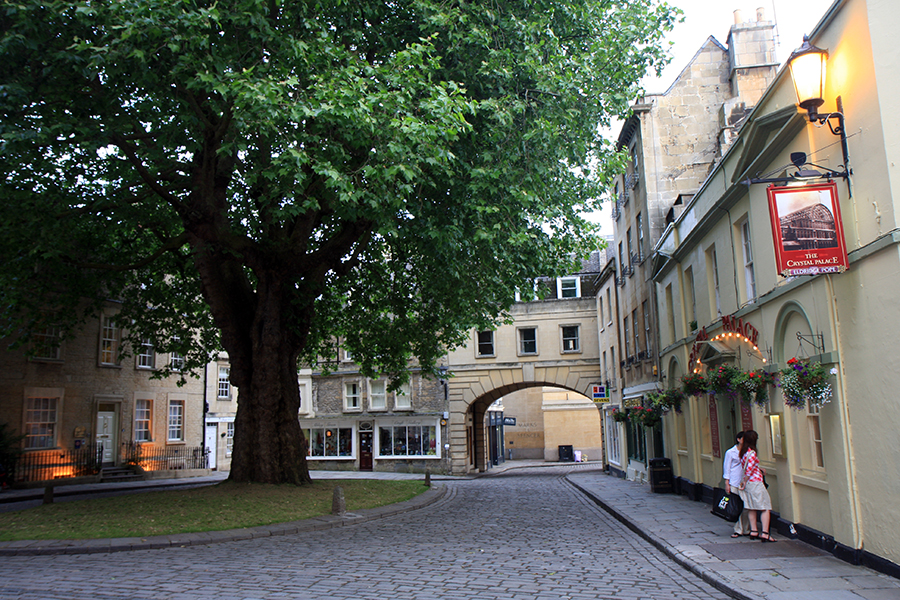
Árvores gigantescas embelezam as praças - Giant trees embelish the squares

Árvores gigantescas embelezam as praças – Giant trees embelish the squares

Apesar da previsão de chuva, abriu um sol lindo quando cheguei. A bela cidade, às margens do rio Avon, foi ocupada pelos romanos no século 43 d.C. em função da situação geográfica e das águas termais que já serviam à população desde tempos imemoriais. O local da nascente era um templo dedicado à deusa local Sulis, que os romanos identificaram como Minerva e o nome se manteve: Acquae Sulis, “as águas de Sulis”.

Another square - Outra praça

Another square – Outra praça

Despite the rain forecast, a glorious sun was shining when I arrived. The beautiful city, on River Avon, was occupied by the Romans around 43 AD for its strategic location and the thermal springs that served the people ever since. The site of the main spring was treated as a shrine by the Britons and was dedicated to the goddess Sulis, whom the Romans identified with Minerva. So the name continued to be used: Aquae Sulis (“the waters of Sulis”).

Feirinha sob uma árvore - Street market under a tree

Feirinha sob uma árvore – Street market under a tree

Me interessava visitar ruínas romanas, pois Bernard Cornwell na sua Trilogia Arthuriana considera que a formação de Arthur foi de soldado romano. O filme “King Arthur” (com Clive Owen e Keira Knightley) é fraco e cheio de clichês, mas tem essa abordagem: apresenta Arthur como um líder que combatia com estratégia e disciplina graças à educação romana. Embora as legiões tivessem sido chamadas de volta a Roma, seu legado permaneceu. De fato, a história menciona um líder na Britannia, nessa época dividida por conflitos entre os reinos, que procurou uni-los contra os invasores. Tudo fazia sentido.

River Avon, com o parque Parade Garden ao fundo - River Avon, Parade Garden in the background

River Avon, com o parque Parade Garden e a torre da Abadia ao fundo – River Avon, Parade Garden and Abbey Tower in the background

I was interested in Roman ruins because Bernard Cornwell, in his Arthurian Trilogy, considers Arthur being raised a roman soldier. “King Arthur”, a movie starring Clive Owen and Keira Knightley is poor and commonplace, but has this approach. Arthur’s character is a clever leader that combined strategy and discipline, thanks to his Roman education. Although the Legions had been called back to Rome by that time, their legacy remained. Indeed, History remarks a Briton leader who tried to unite the conflicting British kingdoms against a common enemy. It made perfect sense to me.

Parade Garden

Parade Garden

Bath foi alçada a Patrimônio da Humanidade pela UNESCO em 1987. A cidade é praticamente toda construída com uma pedra cor de mel característica da região. Havia locais tão parecidos no centro que toda hora eu me perdia. Pubs, restaurantes e lojas, a maioria de grife. Uma Apple Store estava em obras para abrir em poucos dias. Hordas de chineses cheios de sacolas de compras tiravam fotos em frente às lojas, por toda a parte. Minhas roommates no albergue eram três chinesas que passavam o dia fazendo compras. Dali iam para Bristol: “Good shopping”, segundo elas.

Avenida movimentada - Crowded Avenue

Avenida movimentada – Crowded Avenue

Bath became a World Heritage Site in 1987. Most buildings are made from the local, golden-coloured Bath Stone. Some downtown streets looked so alike, I got lost several times. Pubs, restaurants and plenty of fashion shops. An Apple store was about to open. Everywhere, bunches of Chinese tourists carrying lots of tote bags took selfies in front of the shops. My hostel roommates were three Chinese girls who spent their days shopping. From Bath they were going to Bristol: “Good shopping”, according to them.

Street fashion: school uniform - Foto de moda: uniforme escolar

Street fashion: school uniform – Foto de moda: uniforme escolar

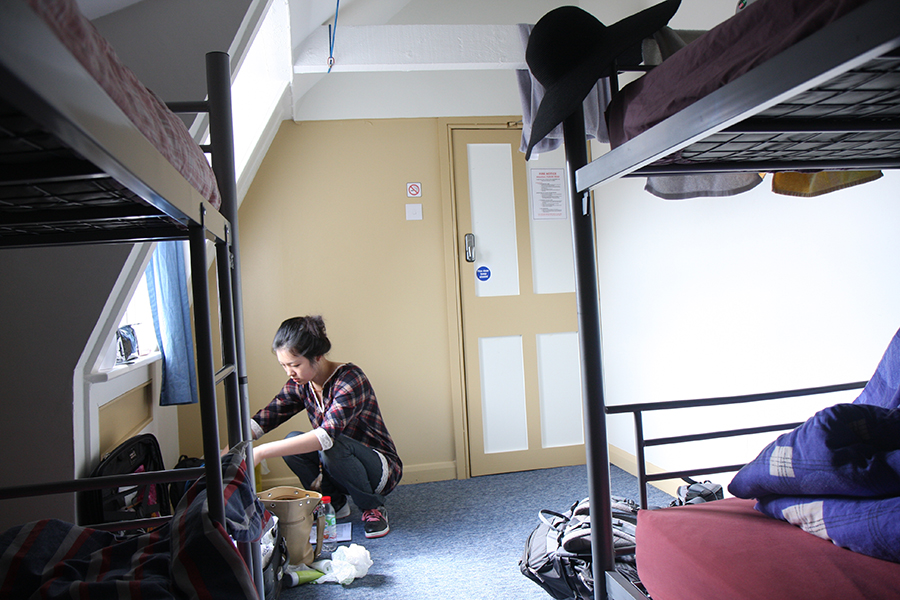
Tinha outra roommate, finlandesa que estava ali estudando inglês. Saía muito cedo para a aula, vestida como se fosse à boite, com maquiagem pesada. Observei que todas as meninas carregavam na maquiagem, ainda que fossem seis da manhã. Fiquei me sentindo uma anciã, com minha cara lavada coberta apenas por protetor solar. Havia mais uma pessoa no quarto, um indiano de Londres que, segundo as moças, roncava feito um porco. Nenhuma delas tinha dormido por causa dos roncos. Eu, curiosamente, não ouvi nada – tenho o dom de virar pedra quando durmo cansada.

Interior do albergue - Inside my hostel

Interior do albergue – Inside my hostel

There was also a Finnish roommate. She left early everyday for her English classes dressed as if she was going to a nightclub, with heavy make up. I noticed that all girls wore heavy make up, even at 6 a.m. I felt like a crone, with my washed face, using sunblock only. There was someone else in the room, an Indian guy from London who, according to the girls, snored like a pig. They couldn’t sleep with him snoring all night. Oddly enough, I never heard it at all. I have the power to turn into stone when I go to sleep very tired.

Meu quarto, no terceiro andar - My room, 3rd floor

Meu quarto, no terceiro andar – My room, 3rd floor

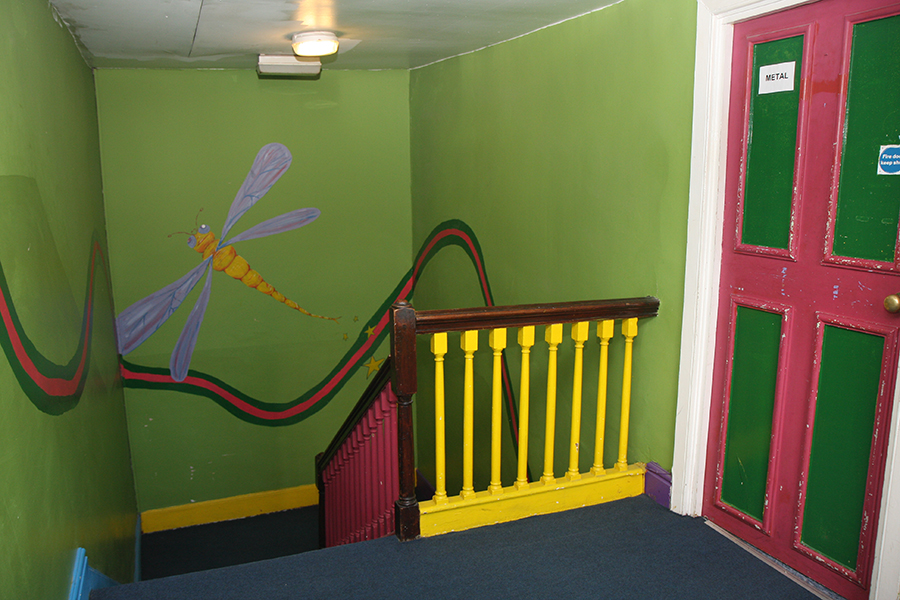
Escada do albergue - Hostel stairs

Escada do albergue – Hostel stairs

Roommate chinesa guardando suas compras - Chinese roommate packing up her shopping

Roommate chinesa guardando suas compras – Chinese roommate packing up her shopping

Read Full Post »
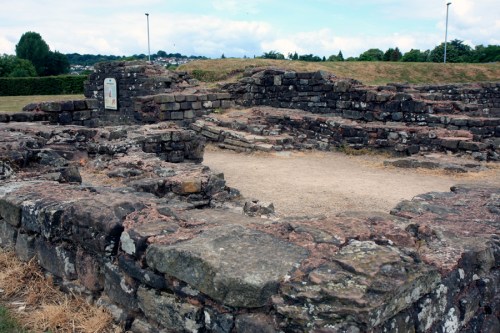

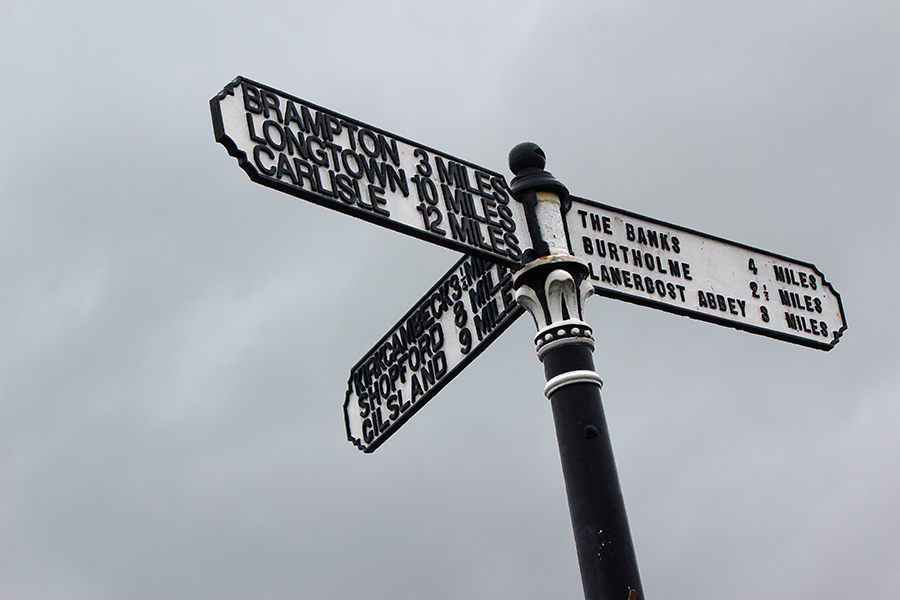
Longo caminho pela frente, debaixo de chuva forte / Long road ahead, under heavy rain Long way to go under hard rain

Longo caminho pela frente, debaixo de chuva forte / Long road ahead, under heavy rain

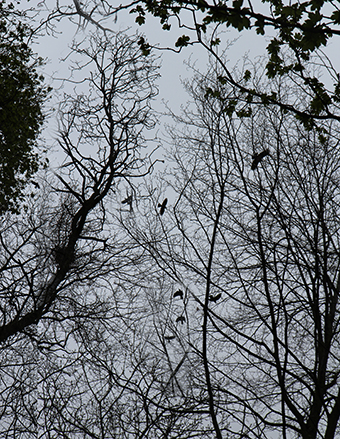
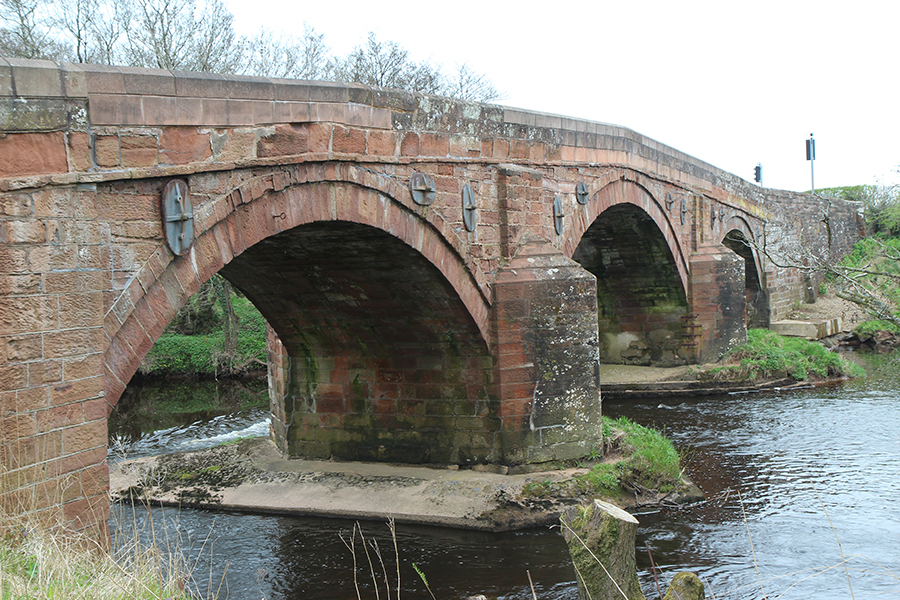
O fato é que o dia amanhecera fechado. Até aí normal, e na primavera muitas vezes as nuvens vão embora, mas não naquele dia. Me demorei muito mais do que devia tentando fotografar uns corvos cujo chamado me fez parar. Eram dezenas, pousados em árvores desfolhadas, voando de um galho para outro, e começaram a grasnar alto quando passei. Não pude ignorar, e quando me dei conta a chuva já caía fina. Guardei a câmera na mochila e prossegui na direção da cidade mais próxima, cruzando uma ponte. Dez minutos depois a chuva apertara bastante e parei um instante para pensar se devia pedir carona, pois faltavam doze milhas (uns 25 km) para Carlisle. Quase instantaneamente passou um carro… e parou.

Morning had broken heavy and grey, what is no news. In springtime, often by noon the clouds are gone, but not that day. I took my time trying to picture some crows, whose call I couldn’t just ignore, since they started to croak loud as I was passing by. They were dozens, flying around or perched in bare tree branches. When I took notice, a thin rain was already falling, so I kept my camera in the backpack and moved on towards the nearest village, crossing a bridge. After ten minutes it was raining hard and I stopped for a moment to decide if hitch a ride was a good idea, because Carlisle was twelve miles away. That very moment a car appeared on the road… and stopped.

Voo do corvo / Raven's Fly

Voo do corvo / Raven’s Fly

Quase me atirei dentro do veículo, onde já havia um carrinho de mão, diversas ferramentas, caixas e todo tipo de tranqueira amontoada. O motorista era um senhor simpático, cabelo já branco rumando para a calvície, olhos muito azuis e aquele sutil senso de humor britânico que tanto aprecio: “Lovely day for a walk, hã?” (Lindo dia para uma caminhada)…
Seguiu-se a conversa de praxe – quem somos, para onde vamos, de onde viemos; a surpresa por eu ser brasileira e estar ali sozinha no meio do nada trilhando uma rota não muito comum. Mr. Ian estava a caminho de Carlisle, mas antes ia buscar um amigo que morava ali perto. Ao ver o tanto de chuva que escorria pelos vidros do carro e praticamente obscurecia a paisagem, não tive vergonha de perguntar se podia ir com eles. Além do mais era domingo e eu sabia que ficaria pastando horas sozinha e encharcada em algum ponto descoberto até surgir um ônibus para Carlisle. Portanto respondi que não me importava em absoluto pelo desvio, se não fosse inconveniente para ele.

I jumped into the vehicle, where were crammed tools, a wheelbarrow, boxes, all kind of stuff. The driver was a middle-aged man, white-hair on the way to baldness, eyes very blue and that delicious british wit that pleases me so much: “Lovely day for a walk, hnn?” The usual talk followed: who we are, where are we going and where do we come from, then the surprise for me be a Brazilian, alone in the middle of nowhere, trailing such an unusual track. Mr. Ian was actually going to Carlisle, but first he had to pick up a friend who lived nearby. I wasn’t ashamed to ask if I could take the ride, given the hard rain that poured in the windowpanes, turning the landscape into a grey mist. I was aware that, being a Sunday, the option would be to stand somewhere under the rain, waiting hours for a bus to Carlisle. So I didn’t care about the detour, as long as I was not intrusive.

Entrei pelo mato, embaixo da ponte, atrás dos corvos. / I went after the ravens into the thicket by the bridge

Entrei pelo mato, embaixo da ponte, atrás dos corvos. / I went after the ravens into the thicket by this bridge.

Quando chegamos à casa do amigo eu não fazia mais idéia de onde estava. Havíamos saído da rodovia num vilarejo, Brampton talvez, e entrado em diversas estradas, entre casas e propriedades rurais, ou seja entre o nada e coisa nenhuma. Mas todas bem asfaltadas, em ótimo estado de conservação.  Não pude dizer o mesmo da casa onde paramos. O quintal parecia um depósito de ferro velho. Mas o amigo do Sr. Ian foi muito gentil, nos serviu uma xícara de chá e pareceu encantado quando abri o maior sorriso ao ver um cinzeiro abarrotado de guimbas. Que maravilha encontrar outro fumante! Meu último Camel fora fumado na véspera, ninguém fumava em Sandysike e não havia onde comprar outro maço, pois o comércio nessas cidadezinhas é praticamente inexistente. Os dois iam a Carlisle justamente fazer compras no supermercado.

Lar dos corvos / Ravens' home

Lar dos corvos / Ravens’ home

I still have no idea where exactly was the friend’s home. We left the main road in a little village  – maybe Brampton – and took several lesser roads through houses and farmyards, that means between nothing and nowhere, but all paved and in good conditions. I couldn’t say the same about the house where we stopped, it looked like a junkyard. But Mr. Ian’s friend was very kind, made us a cup of tea and was delighted when I opened a large smile in the sight of an ashtray overflowing cigarette ends. What a bliss, to meet another smoker! My last Camel had been consumed in the eve, all people in Sandysike were non-smokers and there was nowhere to buy a new pack. There are no shops in these villages; indeed both men were going to Carlisle for shopping.

Nesta ponte consegui carona. / In this bridge I got a ride.

Nesta ponte consegui carona. / In this bridge I got a ride.

Ele enrolou dois cigarros para mim. Quando entramos no carro vinte minutos depois parecia que éramos amigos de longa data. Conversando sobre a caminhada, contei que na véspera tinha visto e batido fotos da placa junto ao rio, assinada pelo Duende Chefe, e os dois começaram a rir. Esta foi a maior surpresa do dia. O sr. Ian tinha feito a placa! Estava revoltado porque sempre que as crianças faziam seus castelos de pedras empilhadas alguém ia lá e derrubava todos. As crianças ficavam tristes quando voltavam no dia seguinte para brincar na beira do rio e encontravam tudo destruído.
Quando desci do carro, em frente ao Sands Sports Centre em Carlisle, deixei meu contato do Facebook e e-mail, com a promessa de enviar as fotos, que cumpri algumas semanas depois. Um ano já se passou. Fica aqui a história, minha gratidão e o sincero desejo de que o Duende Chefe tenha atingido seu objetivo.

Ninhos dos corvos / Ravens' Nests

Ninhos dos corvos / Ravens’ Nests

The man rolled a couple of cigarettes for me. Twenty minutes later, when we were on the road, it seemed we were longtime friends. Talking about Hadrian’s Wall footpath, I told them about the Chief Pixie sign I had seen and photographed the day before, and both started to laugh. That was the big surprise. Mr. Ian was the one who wrote the sign! He was angry because everytime children built their fairycastles, somebody would come and knock them all down. Children were sad when they came back to play by the riverside and found it all ruined.
So when I got off the car in Sands Sports Centre in Carlisle I left my e-mail, Facebook contact and the promise to send him the pictures, which I fullfilled a couple of weeks later. One year is gone by now. The tale is told, and here I state my gratitude and the sincere wish that the Chief Pixie has achieved his goal.

tulips

Read Full Post »


Castelos de Fadas / Fairy Castles

Castelos de Fadas / Fairy Castles

Distraída, saí de Lanercost na direção errada e tinha andado uns dez minutos quando senti que algo estava errado. Explico: minha primeira aventura como andarilha foi o Caminho de Santiago de Compostela, e ali não existe possibilidade de erro. Além das setas amarelas pintadas a cada dois metros, tinha sempre uma dezena de peregrinos passando, bastava segui-los. Então jamais me preocupei em ter um mapa. Mas aqui era diferente. Existe uma sinalização, porém mais esparsa. Várias vezes me vi no meio de pastagens sem saber ao certo para que lado ir. Na dúvida, seguia em frente, e acabou dando certo. Nessa tarde porém eu não podia errar. Me demorara mais do que o previsto entre os lindos túmulos ancestrais, e prolongara ao máximo o prazer de tomar uma tigela de sopa quentinha no restaurante, pois estava frio do lado de fora.

Chuva chegando / Rain is coming

Chuva chegando / Rain is coming

I left Lanercost unheeding and took the wrong direction, but ten minutes later realized there was something amiss. Let me explain, my first footpath adventure was in St. James’  Way, where such mistake is impossible. There are yellow arrows painted every inch along the footpath and pilgrims, always a bunch of them, so I could just follow someone else, and never cared about having a map. But here things were different. There are wooden arrows pointing the way, but sparse. Many times I found myself kind of lost in the midst of pastures. In doubt, I would keep on straight ahead and that was working so far, but this day I could not make any mistakes. I had lingered too long in the ancient graveyard, and taken my time enjoying a steamy bowl of soup in the restaurant, because it was cold outside.

Vilarejo à vista / Tiny village comes into sight: Walton

Vilarejo à vista / Tiny village comes into sight: Walton

Já eram quase quatro da tarde quando refiz meus passos de volta ao Priorado para examinar com mais atenção o mapa afixado no ponto do ônibus, que indicava uma ruazinha de terra quase invisível. Eu tinha visto antes mas não acreditara ser o caminho certo… enfim apareceu a plaquinha do caminho, e outra pessoa caminhando. Veio me perguntar se a trilha era aquela. A moça tinha vindo de outra cidade para ver a filha se apresentar num concurso de canto coral, ali naquele povoado entre o nada e lugar nenhum! Viva a Inglaterra. Fomos conversando uns quinze minutos, então ela voltou para onde estava hospedada e eu prossegui mais animada, apesar do tempo fechado com pancadas de chuva.

Ponte de Walton , campanário da igreja ao fundo / Walton Bridge with the church spire in the background

Ponte de Walton , campanário da igreja ao fundo . Ali uma surpresa me aguardava/
Walton Bridge with the church spire in the background. There was a surprise for me.

It was around 4 p.m. when I retraced my steps back to the Priory to check more closely Hadrian’s Footpath map by the bus stop. It indicated an almost invisible gravel road, which I had actually seen before, but didn’t believe that was the right way! Soon the wooden arrow  sign appeared AND another walker approached me to ask if that was the footpath. This lady had come from another town to watch her daughter’s performance in a choir contest. There was such an event going on , in that tiny village between nothing and nowhere! Gods save England.
We walked together for a while, talking, before she went back to her hotel and I kept walking happier, in spite of the bad weather with rain showers.

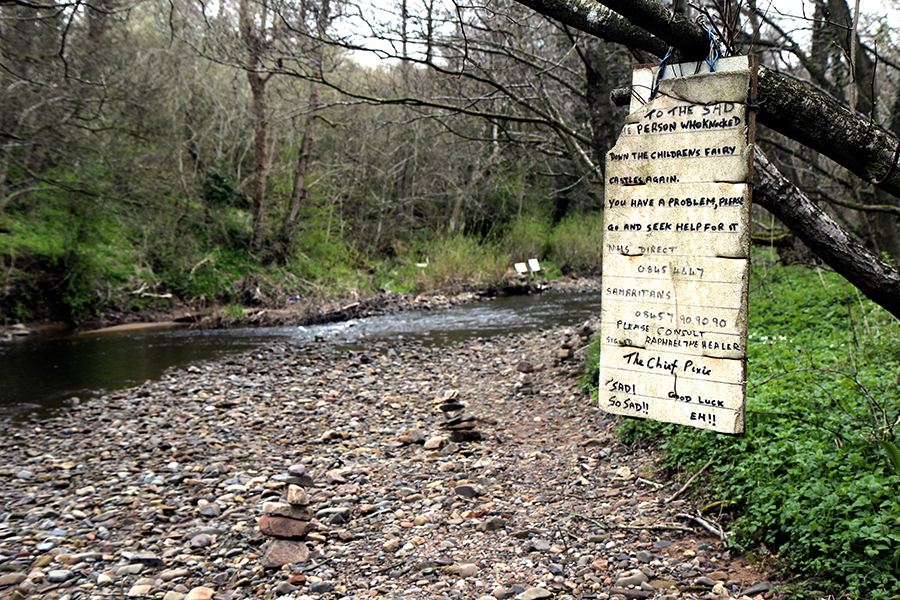
Recado do Duende Chefe / Message from the Pixie Chief

Recado do Duende Chefe / Message from the Chief Pixie

A fazenda Sandysike nem era tão longe, o caminho não era íngreme, atravessava pastos e mais pastos, felizmente sobre todos os portões havia indicação. A trilha leva a cruzar a ponte Dovecote, de onde se avista a torre da igreja de Walton. Mas o que me chamou a atenção foi uma quantidade de pilhas de pedras no leito. Quando desci para bater uma foto, me deparei com um enorme cartaz, pendurado numa árvore, com os seguintes dizeres:
“Para o infeliz que derrubou novamente os Castelos de Fadas das crianças. Você tem problemas, por favor procure ajuda.  (Número da linha direta dos Samaritanos). Por favor consulte Rafael, o Curandeiro. Boa sorte! Assinado: o Duende-Chefe”. Ainda dizia “Triste, muito triste”.
Aquilo me intrigou. Os Castelos de Fadas eram as pilhas de pedras, já tinha visto semelhantes em St. Nectan’s Glen e outros lugares, mas quem seria o Duende-Chefe, e por que razão um maluco se daria ao trabalho de derrubar os castelos, estragando a brincadeira das crianças? Eu não sabia, mas teria a resposta no dia seguinte.

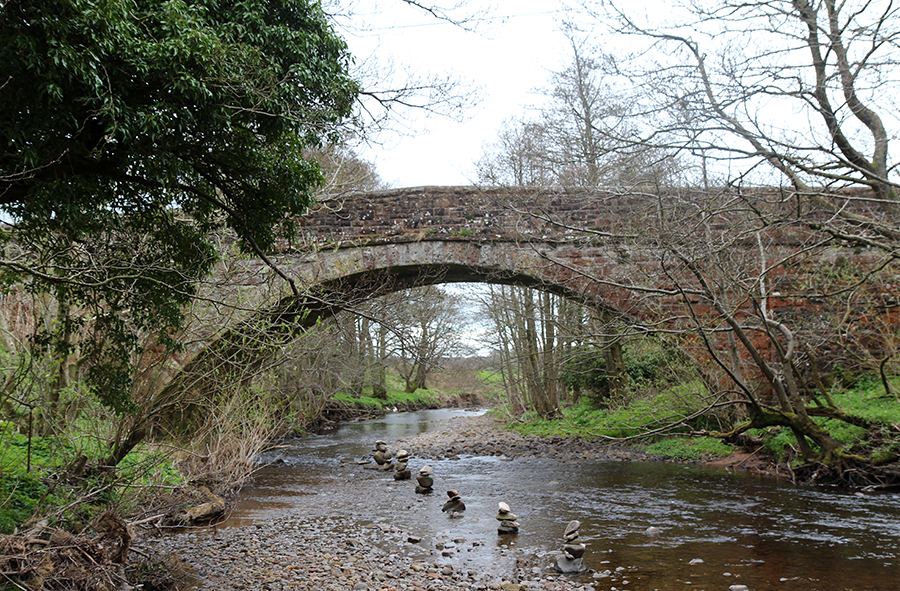
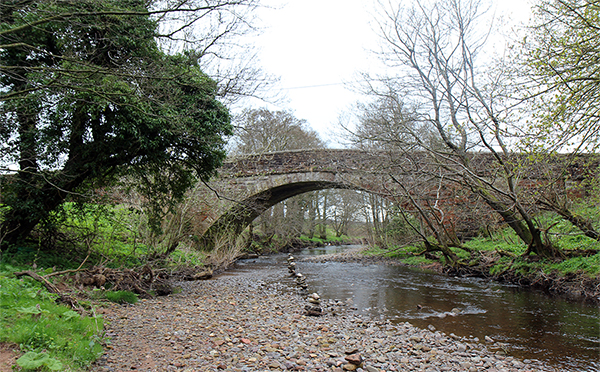
Castelos de Fadas sob a ponte Dovecote / Fairy Castles under Dovecote Bridge

Castelos de Fadas sob a ponte Dovecote / Fairy Castles under Dovecote Bridge

Sandysike Farm was not so far, but there was no Wall to follow, just crossing pastures and more pastures. Luckily, next to every stile and hand gate there’s a Hadrian’s Footpath sign. The road leads down to cross Dovecote Bridge, where the spire of Walton church comes into view. But I had my attention drawn by a number of stacked stones in the riverbed – the fairy castles. As I approached them to take a picture, I ran into a large showbill hanging in a tree, which said: “ To the sad person who knocked down the children’s Fairy Castles again. You have a problem, please go and seek help for it. NHS direct: 08457909090 Samaritans. Please consult Raphael the Healer . Good Luck! Signed , The Chief Pixie.” It added: “Sad! So sad!”.
I was intrigued. I had seen plenty of Fairy Castles  before, in St Nectan’s Glen and other places, but who was the Chief Pixie and why would some freak destroy the children’s work? Next day would bring me the answer.

Sandysike

Sandysike

Cheguei a Sandysike pouco depois, ao por-do-sol.  O proprietário me recebeu dizendo: “Você é a brasileira? Oh! Você me deve dinheiro!” Comecei a rir. A vendedora de Lanercost já devia ter telefonado lembrando-o de me cobrar a caneca. A cozinha estava uma bagunça mas assim mesmo fui convidada a tomar chá. Chá é tão revigorante, de volta ao Brasil nunca mais parei de tomar pelo menos duas xícaras por dia. Por fim surgiu a esposa do simpático proprietário, que me encaminhou a um quarto fofo onde por um momento tive vontade de ficar para sempre. Pertencia à filha do casal, que não morava mais com eles. Havia um alojamento coletivo mais em conta, porém todos os leitos estavam reservados. Havia ainda meia dúzia de barracas no terreno, ocupadas por um grupo de veteranos de guerra, todos com perna mecânica. Após tomar um bom banho de banheira – tinha uma no quarto! – desci para jantar com os demais hóspedes, do quarto coletivo. O cardápio consistia em comida congelada: sopa e Torta do Pastor, um prato típico britânico. O pessoal das barracas fazia sua própria comida.

Sandysike Farm

Sandysike Farm

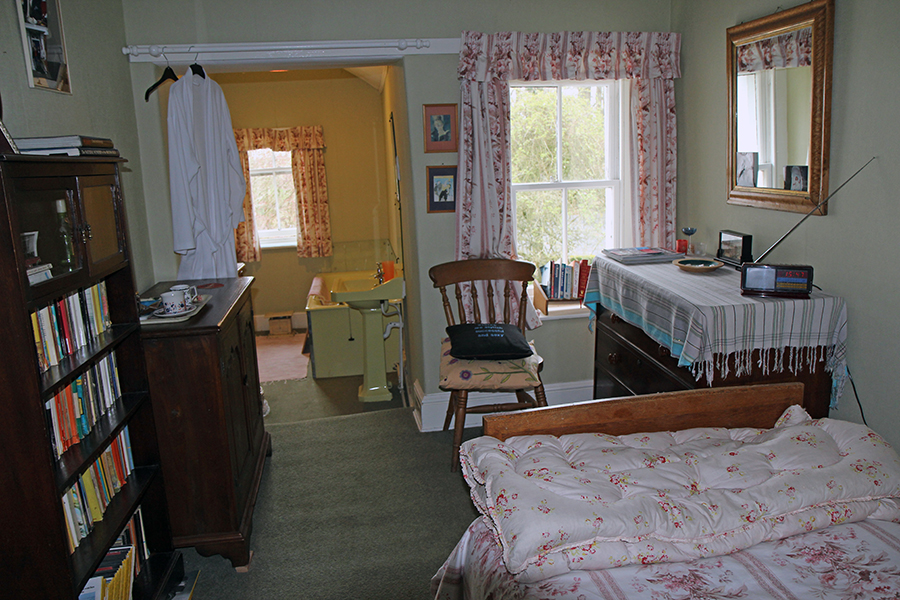
Meu quarto aconchegante / My cosy room

Meu quarto aconchegante / My cosy room

By sunset I reached Sandysike. The owner welcomed me: “So you’re the Brazilian lady? Oh, you owe me money!” I laughed a lot. The saleswoman from Lanercost should already had called to warn him about the money concerning the mug . The kitchen was a mess but anyway I was invited to have some tea. How restorative is tea! Back in Brazil I still have a couple of cups daily. At last the farmer’s wife came and showed me to a cosy room where, for a while I felt like staying forever. It belonged to their daughter, who lived now somewhere else. There was a bigger room for backpackers but all beds were already taken. In the yard there were six tents occupied by a group of ex combatants, all with prosthetic legs. The room had a bathtub so I enjoyed it before going down for dinner with the other guests. The menu was frozen food: soup and Shepherd’s Pie. People in the tents made their own food.

Camping in Sandysike

Camping in Sandysike

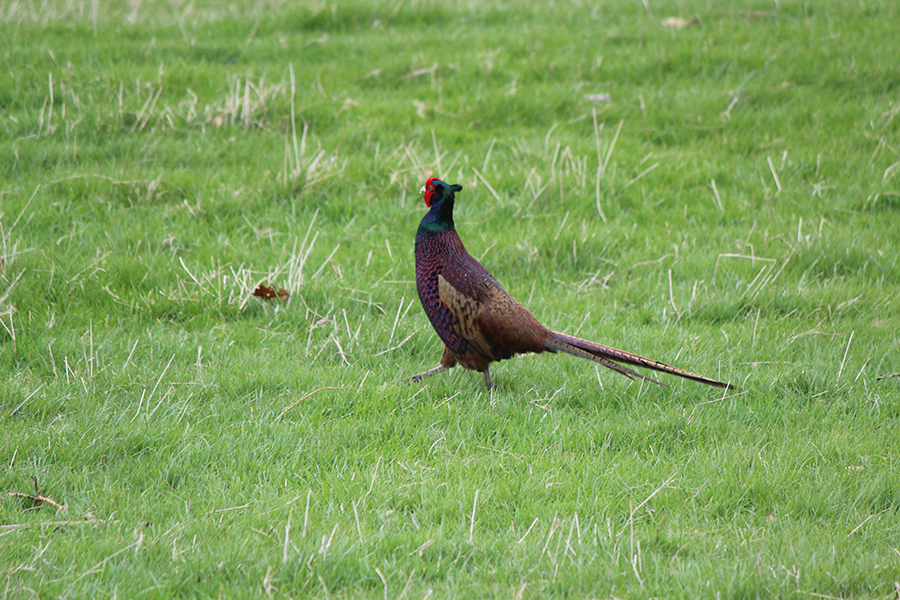
Um faisão avistado pela janela / Pheasant seen from my window

Um faisão avistado pela janela / Pheasant seen from my window

Esqueci de combinar com as pessoas para prosseguirmos juntos porque achei que isso aconteceria naturalmente. Entretanto já tinham partido na manhã seguinte quando terminei de tomar café e paguei a conta, incluindo o valor da caneca. Por isso tomei a direção errada novamente. Já estava voltando quando encontrei o fazendeiro descendo o caminho de triciclo. Era um sessentão, mas ainda bonito e forte, e insistiu em me dar uma carona até a estrada para Carlisle, o único caminho, segundo ele. Assim sendo não discuti e me empoleirei no banco do triciclo atrás do homem, de mochila e tudo. Muito emocionante mas durou apenas dez minutos. Chegando à rodovia o fazendeiro desejou-me sorte e disse que não era todo dia que tinha oportunidade de dar carona a uma linda brasileira. Agradeci e nos despedimos. Ele tinha algumas dezenas de ovelhas para tratar e eu doze milhas para caminhar até Carlisle. Porém logo percebi que realmente saíra da trilha, que seguia pela floresta e só cruzava a estrada mais adiante. Na verdade não fazia muita diferença, não havia ruínas nesse trecho, apenas pesadas nuvens negras que logo se desfizeram em grossas gotas de chuva. Foi quando encontrei o Duende Chefe em pessoa.

Sala de jantar / Dining room

Sala de jantar / Dining room

Jardim dos fundos / Backyard

Jardim dos fundos / Backyard

I forgot to talk about joining the others for next day’s walk, because I thought that would naturally happen. However, they were gone when I finished breakfast and checked out next morning… so again I took the wrong way, and was half way back when the farmer appeared driving a tricycle. The man was in his sixties but still handsome and strong. He insisted in giving me a ride to the road, the only way to Carlisle, according to him. So I didn’t discuss any further, just rode the tricycle behind him, backpack and all. It was thrilling to cross a couple of miles through the fields, but that ended ten minutes later. By the road the farmer wished me luck and said it was not everyday he had the chance to give a ride to a beautiful Brazilian. I thanked him and said goodbye. He had a flock of sheep to tend to and I had twelve miles to walk towards Carlisle. But soon I realized I wasn’t indeed in the footpath, that coiled through the woods to join the road a couple of miles ahead. Anyway it didn’t matter, there were no ruins in the stretch, only heavy dark clouds that soon melted in thick raindrops pouring over my head. And that was when I met the Chief Pixie himself.

No jardim / Sandysike garden

No jardim / Sandysike garden

Sandysike Garden (2)

Sandysike Garden (2)

Read Full Post »

birdoswaldPanorama1

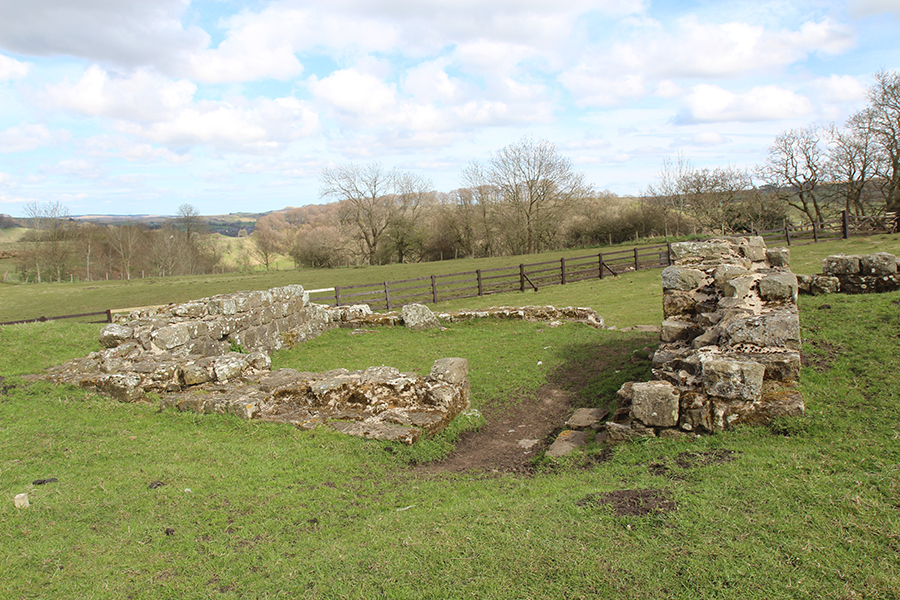
Muralha de adriano junto a Birdoswald (à esquerda, entre as árvores)./ Hadrian’s wall next to Birdoswald (among the trees, to the left)

Arthur foi vitorioso nas doze batalhas que travou contra invasores, porém pouco se sabe sobre a Última Batalha, na qual o Rei enfrentou seu próprio filho Mordred, a quem abateu mas foi mortalmente ferido. Isto aconteceu num lugar chamado Camlan. Para resumir, segundo Norma Goodrich, Camlan seria “Camboglanna Roman Fort”, hoje conhecido como Birdoswald, o último forte antes de Carlisle na Muralha de Adriano.
Exatamente o lugar para onde eu estava me encaminhando, e retrato nas fotos abaixo.

Quase lá / Almost there

Quase lá / Almost there

birdoswald034

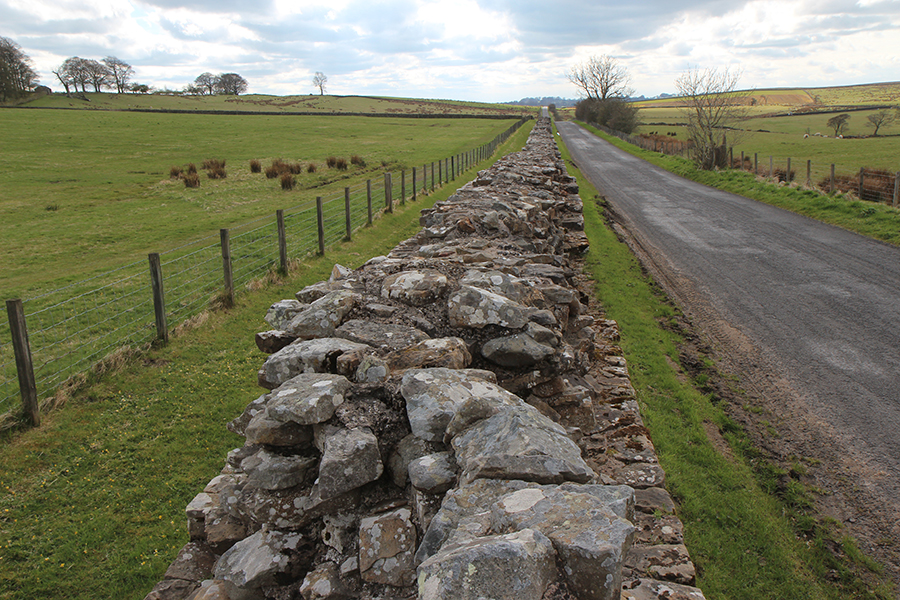
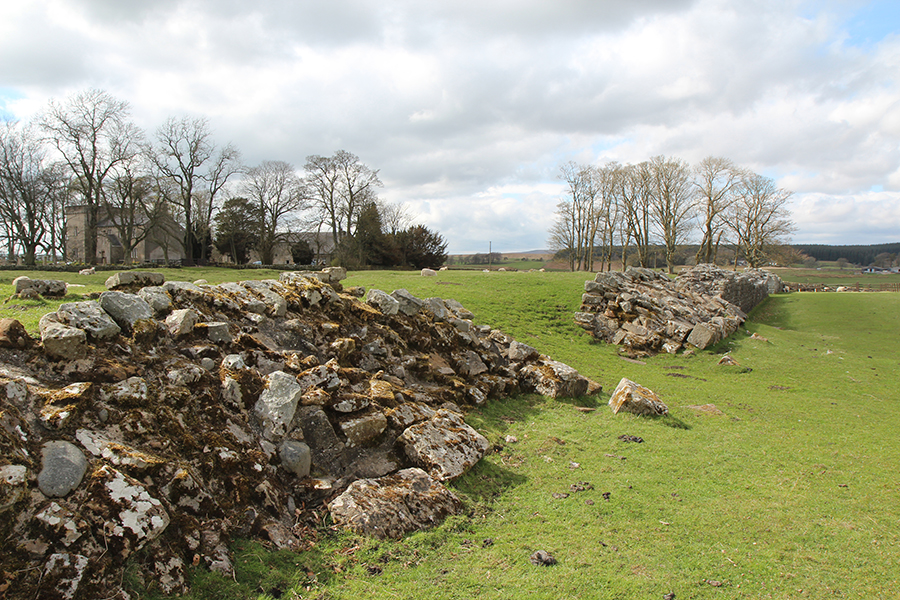
O mais longo trecho de muralha ininterrupta passa por Birdoswald / The longest steady stretch of continuous Wall pervades Birdoswald

birdoswald032

A passagem de uma nuvem muda toda a cor do lugar/ The landscape colors change as clouds go by

A passagem de uma nuvem muda toda a cor do lugar/ The landscape colors change as clouds go by

Arthur succeeded to defeat his enemies in twelve battles. But no one knew for certain where was or is his last battleground, somewhere called Camlan, where the King faced his own son Mordred, whom he did kill but got deadly wounded himself. To cut it short, according to Norma Goodrich, Camlan is translated “Camboglanna Roman Fort”, nowadays called Birdoswald, the last fort in Hadrian’s Wall before Carlisle.
That happened to be exactly the place I was heading to, shown in the photographs below.

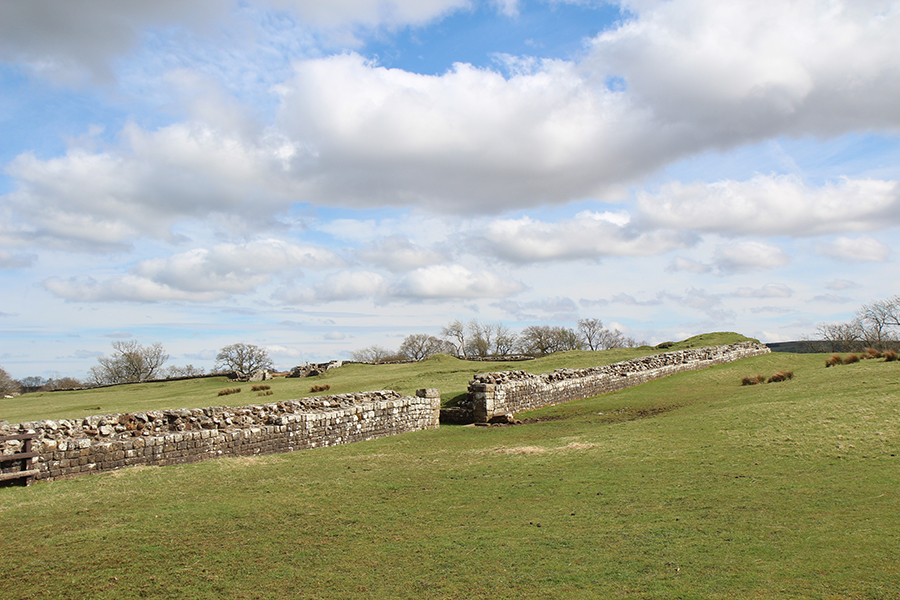
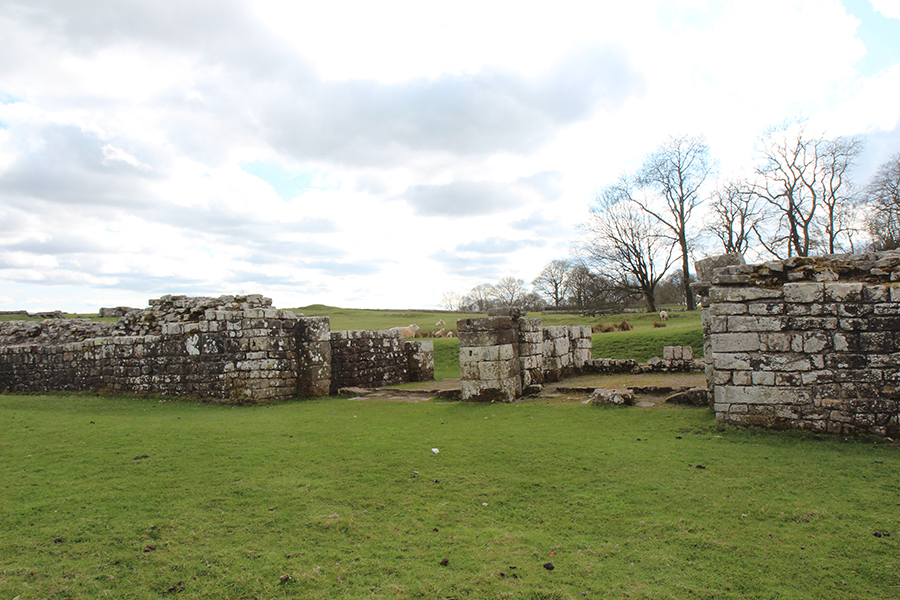
Birdoswald East Gate / Portão Leste

Birdoswald East Gate / Portão Leste

birdoswald031

Portão Norte / North Gate

Porém, no Cicerone Guide escrito por Mark Richards, Camboglanna aparece em outro lugar: em Castlesteads, numa propriedade privada sem acesso ao público, onde um mercador da Cia das Índias Ocidentais construiu sua mansão e jardins no século 18, sobre as ruínas do forte. A Wikipedia esclarece que durante muito tempo acreditou-se que Camboglanna fosse Birdoswald, mas era um erro. O nome romano de Birdoswald é Banna. Camboglanna parece significar “vale em curva” pois dali se vê uma curva no rio Irthing, e fica 11km a oeste de Birdoswald.

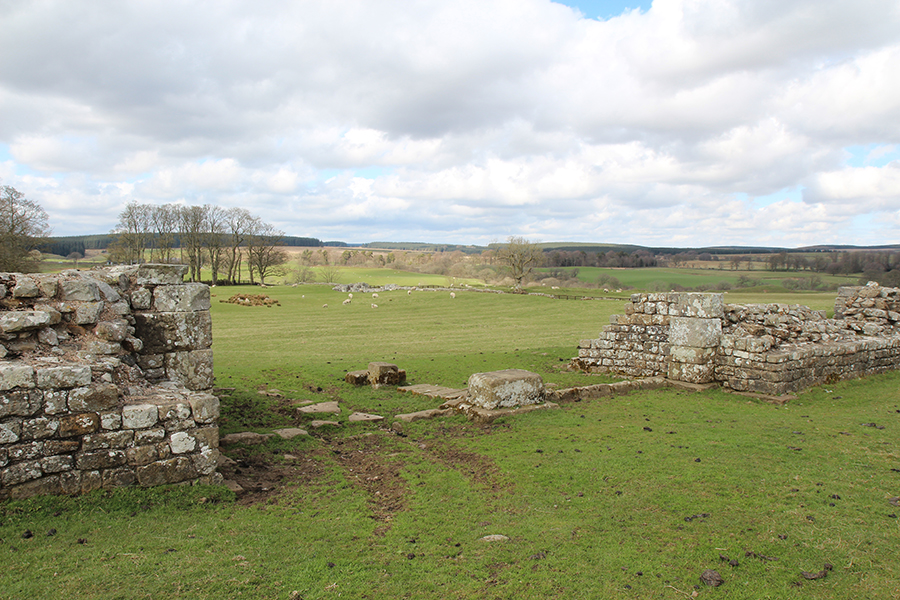
Birdoswald West Gate / Portão Oeste

Birdoswald West Gate / Portão Oeste

Birdoswald panorama from West Gate

Birdoswald panorama from West Gate

But in the Cicerone Guide by Mark Richards, Camboglanna appears somewhere else: in Castlesteads, inside private property with no access for the public. It’s nowadays a great house built by a wealthy merchant from the East India Company in the 18th century. The house and its walled gardens rest upon the Roman fort ruins, destroyed when the house was built. According to the Wikipedia, there was some confusion over the Roman name for the fort. At one time Camboglanna was the accepted name for Birdoswald, but this is now believed to be an error. The Roman name for Birdoswald is now thought to be Banna. The name “Camboglana” is believed to mean “Crook Bank”, or “Bent Valley” because it overlooks a bend in the river Irthing, almost 7 miles west of Birdoswald.

Eu não era a única visitante / I was not the only visitor

Eu não era a única visitante / I was not the only visitor

Roman ruins

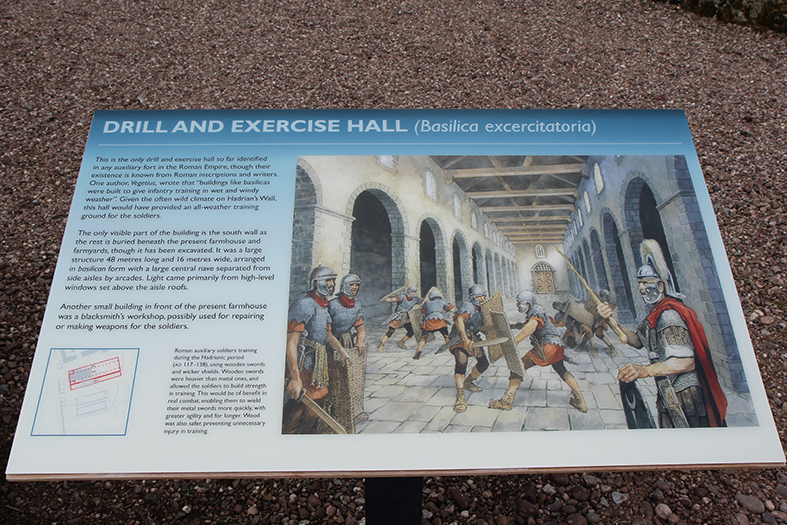
Sala de treinamento e exercício / Drill and exercise halls

birdoswald008

Aqui entramos na região de Cumbria, depois de Northumberland.

Here we’re no longer in Northumberland, but in Cumbria.

Pasto a leste, direção de onde vim / Pastures to the East, where I had come from

Pasto a leste, direção de onde vim / Pastures to the East, where I had come from

East Gate from inside

Vista de dentro do Portão Leste / East Gate from inside

birdoswald028

birdoswald024

Mesmo lugar, com nuvem / Same place, cloudy

birdoswald026

Os novos habitantes / New inhabitants

birdoswald004

A casa de fazenda é um exemplo de utilização agrícola das estruturas romanas ao longo da Muralha/ The farm house is an example of the agricultural use of Roman structures along the Wall

Ali funciona atualmente o pequeno museu e um café /  Nowadays it houses a small museum and café

Ali funciona atualmente o pequeno museu e um café /Nowadays it houses a small museum and café

birdoswald002

birdoswald010

Há acomodação na casa da fazenda para visitantes que queiram ficar neste lugar histórico. / Birdoswald offers farmhouse-style accommodation for those wishing to stay within this historic site.

birdoswald011

Roman halls


birdoswald009

birdoswald022

Horário de visitação / Opening time from 1 April – 30 September: 10:00 – 18:00

birdoswald023

Ingresso/ Price: Adult £5.60; Child (5-15 years) £3.40 ; Concession £5.00 (estudantes e pessoas acima de 60 anos)

birdoswald025

3 November 2014 – 15 February: Abre apenas sábado e domingo / Only weekends, 10:00 – 16:00

birdoswald027

Endereço/ Address: Gilsland, Brampton, Cumbria – CA8 7DD Telephone: 016977 47602

birdoswald020

Portão Sul / South Gate

birdoswald021

Read Full Post »


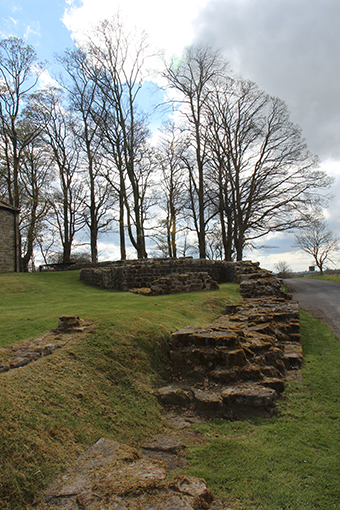
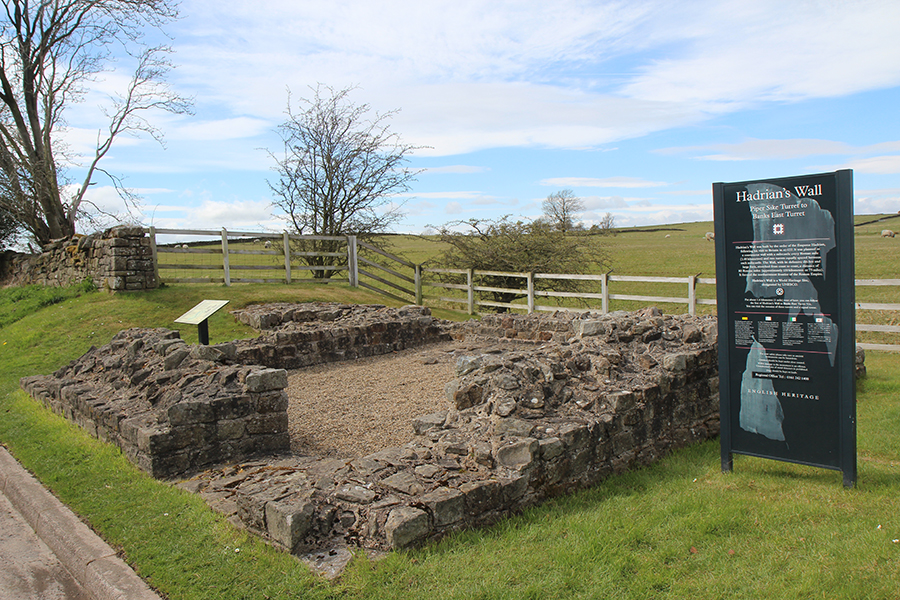
Turret 51

Turret 51A, Hadrian’s Wall

Continuamos com King Arthur, de Norma L. Goodrich: “Delimitamos o reino de Arthur nos quatro cantos: Dumbarton (NW), Carlisle (SW), Stirling (NE) e Berwick (SE). Estas cidades hoje são importantes centros, à exceção do porto de Berwick, que foi em grande parte destruído durante as guerras entre Inglaterra e Escócia que se seguiram.”

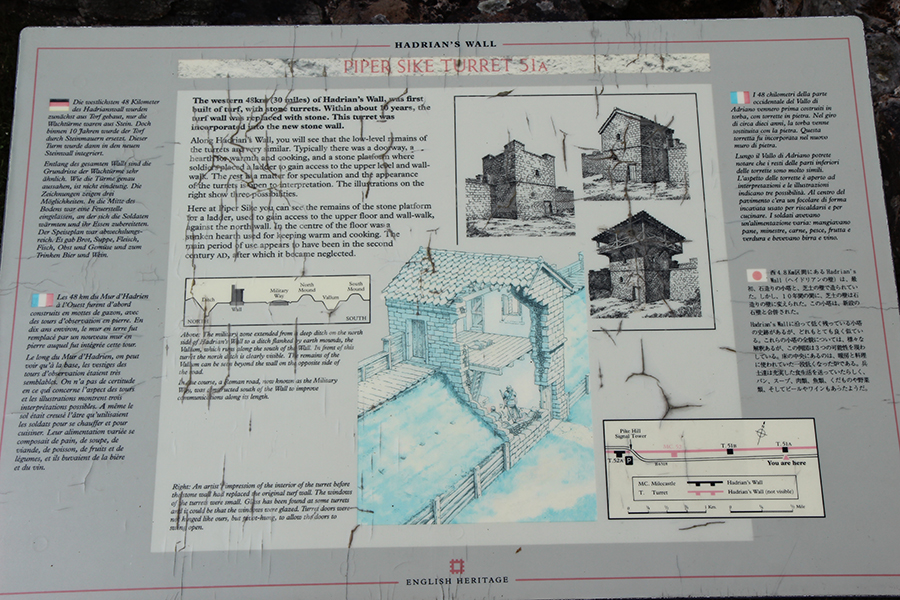
Placa informativa da Turret 51 / Signpost

Placa informativa da Turret 51A / Signpost

Piper Sike Turret 51

Piper Sike Turret 51A

Let’s keep reading King Arthur by Norma L. Goodrich:
“ We delimited King Arthur’s kingdom at its four corners: Dumbarton (NW), Carlisle (SW), Stirling (NE) and Berwick (SE).  These are key centers today, with the possible exception of the seaport of Berwick, which was largely destroyed during the subsequent wars between Scotland and England.”

Turret 51B

Turret 51B

“Para quem acredita no Arthur histórico, o principal problema é a localização dos seus castelos. Camelot permanece o mais importante de todos, onde provavelmente estariam abrigados os tesouros do Rei. Estes foram citados pelo enciclopedista Lambert de Saint-Omer em seu livro “Liber floridus”, que precedeu Geoffrey of Monmouth em mais de uma década: “Existe um palácio na Grã Bretanha, na terra dos Pictos, do guerreiro Arthur, construído com arte maravilhosa e diversa, no qual todos os feitos épicos de suas conquistas e guerras podem ser vistos esculpidos”.”

Hadrian's Wall Turret 51B

Hadrian’s Wall Turret 51B

Placa informativa, Turret 51B/ Signpost

Placa informativa, Turret 51B/ Signpost

Turret 51B, à beira da estrada

Turret 51B, à beira da estrada / By the highway

“For those who think of King Arthur as historical, the chief problem must be the emplacements of King Arthur’s castles. Camelot must remain most important of all, and it is likely that it housed the king’s treasures. These were reported by the encyclopedist Lambert de Saint-Omer in his book “Liber floridus”, which antedated Geoffrey of Monmouth by more than a decade: “There is a palace in Britain, in the land of the Picts, of the warrior Arthur, built with marvelous art and variety, in which all the epic deeds of his conquests and of his wars are to be seen sculpted”.”

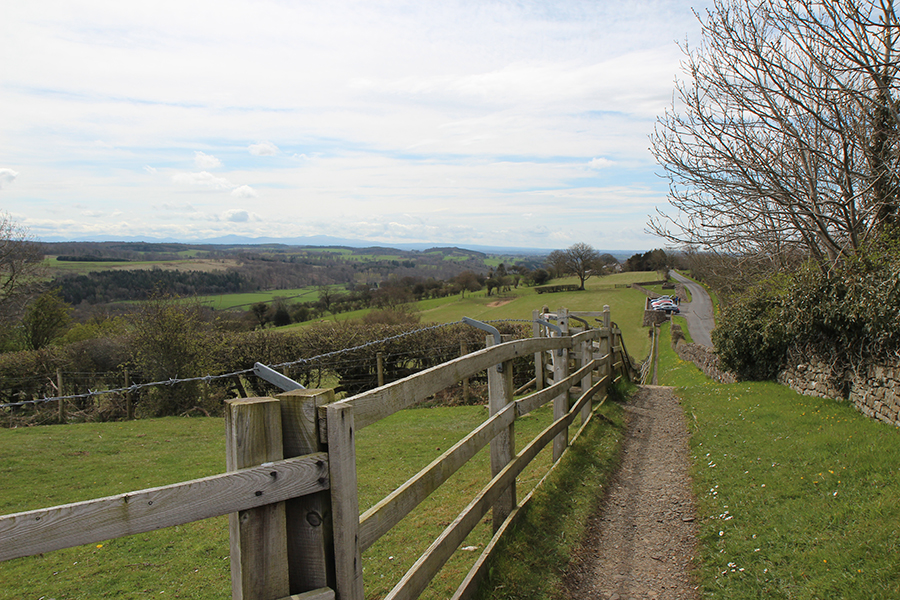
Trilha segue paralela à estrada

Trilha segue paralela à estrada/ Footpath parallel to the road

“Camelot, como sabemos, por muito tempo foi considerado fictício. Já foi identificado como sendo Colchester, Cadbury e Winchester, mas estudiosos por fim concluíram que não era o nome de nenhum lugar na Grã -Bretanha. Sir Thomas Malory parecia inclinado a acreditar que Camelot era o nome dado ao castelo onde e enquanto o Rei ali estivesse residindo, qualquer que fosse o lugar. O livro “Perlesvaus” * afirma que havia dois Camelots.”
NOTA: * significa Percival – o cavaleiro que por fim encontrou o Santo Graal. Este livro também é chamado Li Hauz Livres du Graal, A Nobre História do Santo Graal, trata-se de um antigo romance Arthuriano francês da primeira década do século XIII, do qual sobreviveram três manuscritos, dois fragmentos e duas gravuras do século XVI. Nada se sabe sobre o autor.

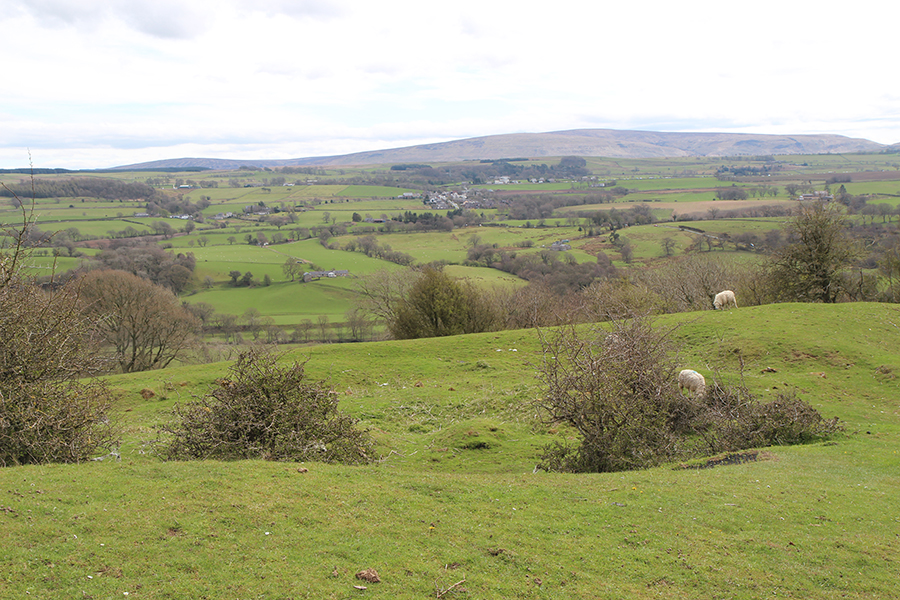
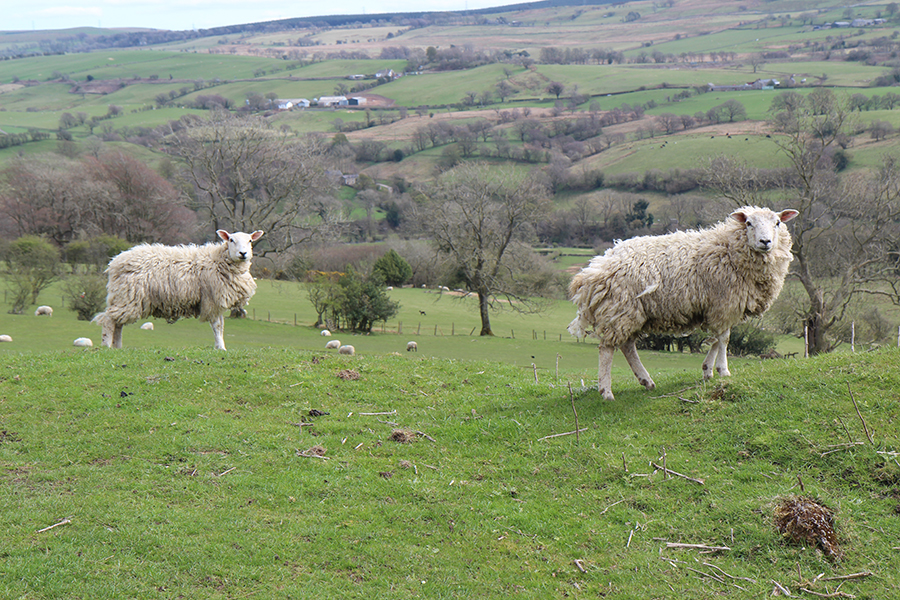
Linda região de pastagens/ Lovely pasture landscape

Linda região de pastagens/ Lovely pasture landscape

“Camelot, we know, has long been considered fictitious. It has been identified as Colchester, Cadbury and Winchester, but scholars finally concluded that it was not the name of any place in Britain. Sir Thomas Malory seems to have been inclined to believe that Camelot was King Arthur’s castle when the king was in residence there, at whatever site that may have been. The book “ Perlesvaus * ” states that there were two Camelots.”
 NOTE: *means Percival – the knight who eventually found the Holy Grail. This book is also called Li Hauz Livres du Graal , The High History of the Holy Grail, is an old French Arthurian romance dating to the first decade of the 13th century. It survives in three manuscripts, two fragments, and two 16th-century printings. Nothing is known of the author.

Ovelhas

Ovelhas / Sheep

“Claramente Carlisle é apontado como sendo o principal castelo de Arthur, portanto seria um deles, e o outro foi identificado por O.G.S. Crawford:  Castelo de Stirling, chamada “chave para a Escócia”. William of Worcester também escreveu que “Rei Arthur presidia a Távola Redonda na fortaleza militar de Stirling, também conhecida como Snowdon West Castle.”
Norma Goodrich afirma que Camelot  se situava em King’s Knot, abaixo da face norte do penhasco em Stirling: “ A topografia é inconfundível, de acordo com todas as descrições feitas por diversos autores.”

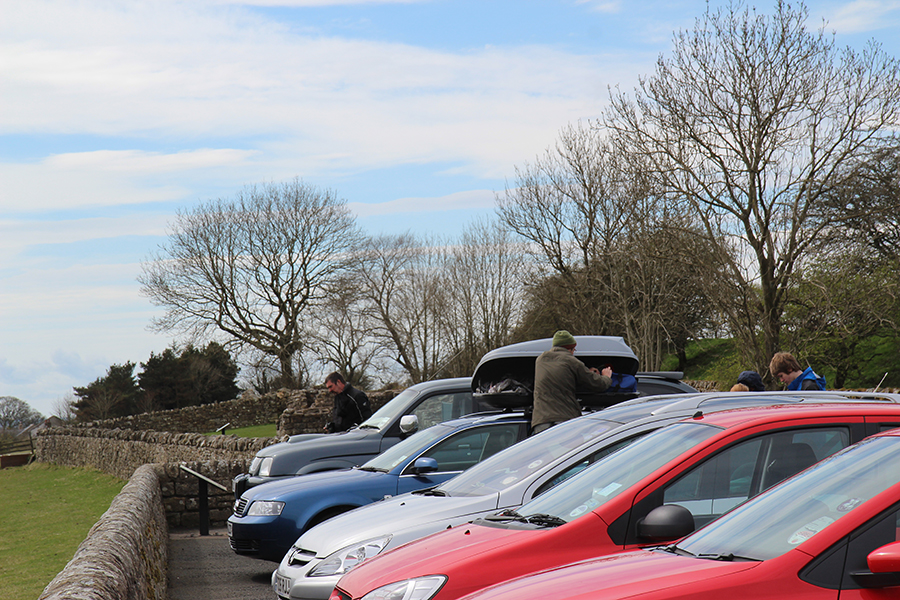
Estacionamento próximo às ruínas / Parking lot beside the ruins

Estacionamento próximo às ruínas / Parking lot beside the ruins

“Clearly Carlisle is indicated as King Arthur’s principal castle, so it was probably one, and the other has been identified by O.G.S. Crawford as Stirling Castle, called the “key to Scotland”. William of Worcester also wrote that “King Arthur presided over the Round Table in the military fort of Stirling, otherwise known as Snowdon West Castle. “
Norma Goodrich states that Camelot was located at King’s Knot, below the western-facing cliff at Stirling: “ The topography is unmistakable, fitting all descriptions by several authors.”

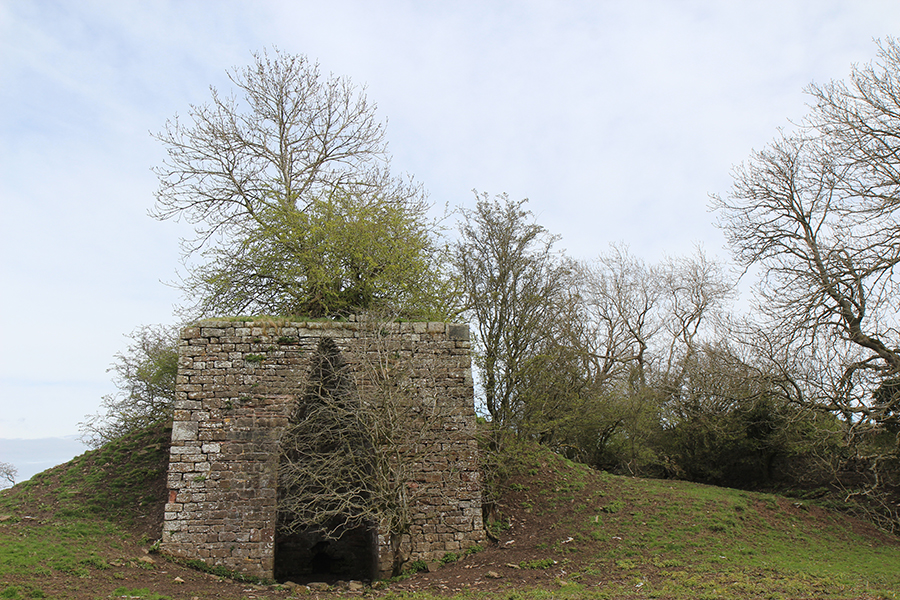
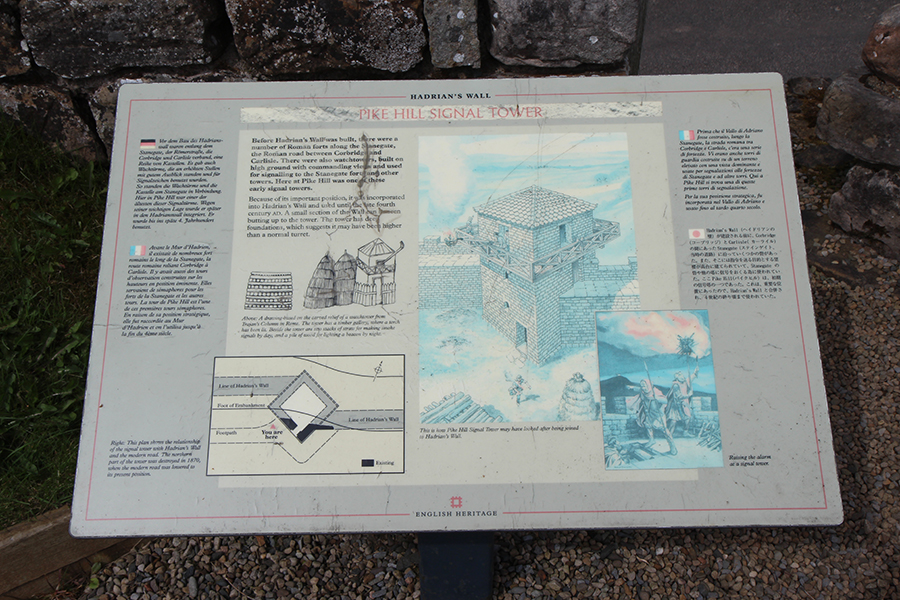
Pike Hill Signal Tower

Pike Hill Signal Tower

“Tanto na Idade das Trevas como hoje, pode-se chegar à garganta de Stirling, entre os imponentes montes Campsie-Gargunnock a oeste e o estuário do Rio Forth a leste. O corredor norte-sul, conhecido por muitas batalhas, tem dez milhas de comprimento e quatro de largura. O forte pré-histórico ficava, como a fortaleza moderna e os quartéis ainda em uso hoje, sobre a enorme parede inexpugnável, avistando do alto dos íngremes penhascos a cidade de Dumbarton a oeste. Praticamente a única montanha em toda a extensão de planícies. Stirling, visto da Muralha de Antonino, é ainda mais impressionante. O Castelo de Stirling dominava a única e estreita travessia do estuário do Rio Forth que, durante a cheia, atingia a largura de uma milha. Junto ao castelo, olhando para baixo dos penhascos a oeste, pode-se ver claramente a planície abaixo do King’s Knot. Trata-se de um monte octogonal cujo nome significa “castelo do monte”, do tipo sobre o qual eram construídos castelos com paliçadas de madeira nos tempos ancestrais. Sobre este monte outrora ergueu-se Camelot, de onde o Rei Arthur presidia a Távola Redonda.”

Pike Hill Signal Tower Signpost

Pike Hill Signal Tower Signpost

“Whether in the Dark Ages or today, one can stand at the Stirling Gap, beside the lofty Campsie-Gargunnock Hills to the west and the Forth estuary to the East. The north-south corridor, famous for many battles, is ten miles long and four miles wide. The prehistoric fort sat, like the modern fortress and barracks still in use today, upon the great impregnable wall, looking down its precipitious cliffs toward Dumbarton on the west.
One mountain almost alone in the expanse of flatlands. Stirling seen from the Antonine Wall is an even more impressive mass. Stirling Castle commanded the only and very narrow crossing of the flooded Forth River estuary. At peak flood the Forth stretched one mile wide across flatlands. Standing beside the castle and looking down the west cliffs of Stirling, one can plainly see on the meadowland below the King’s Knot. This is an octogonal mound, whose name means  “castle mound”, upon which the wooden palisaded castles were built in ancient times. Upon this mound once stood King Arthur’s Camelot. At his castle he chaired the Round Table.”

footpath

footpath

Assim, enquanto eu trilhava a Muralha de Adriano a caminho do Forte Romano de Birdoswald, estav muito mais perto de Arthur do que podia imaginar.
So, as I treaded along Hadrian’s Wall, approaching Birdoswald Roman Fort, I was much closer to Arthur than I could imagine.

mais turrets

mais turrets

Vista da região de Stirling no Google Maps / Stirling overview


Read Full Post »

Older Posts »