
Se esta era a Távola Redonda, deveria haver centenas de cavaleiros! / If this was the Round Table, there must have been hundreds of Knights!
Dizem que o túmulo de Arthur em Glastonbury é falso, uma invenção dos monges para atrair peregrinos e dinheiro. A história prova que os focos de resistência britânica contra todas as invasões se concentraram na fronteira com a Escócia, na Cornualha e País de Gales – onde fica Caerleon. Isso pode confirmar a teoria de que ali se encontravam os melhores guerreiros e generais, e entre eles podiam estar Arthur e seus cavaleiros. O autor Stephen E. Lawhead atribui a Aurelianus Ambrosius a paternidade de Arthur.

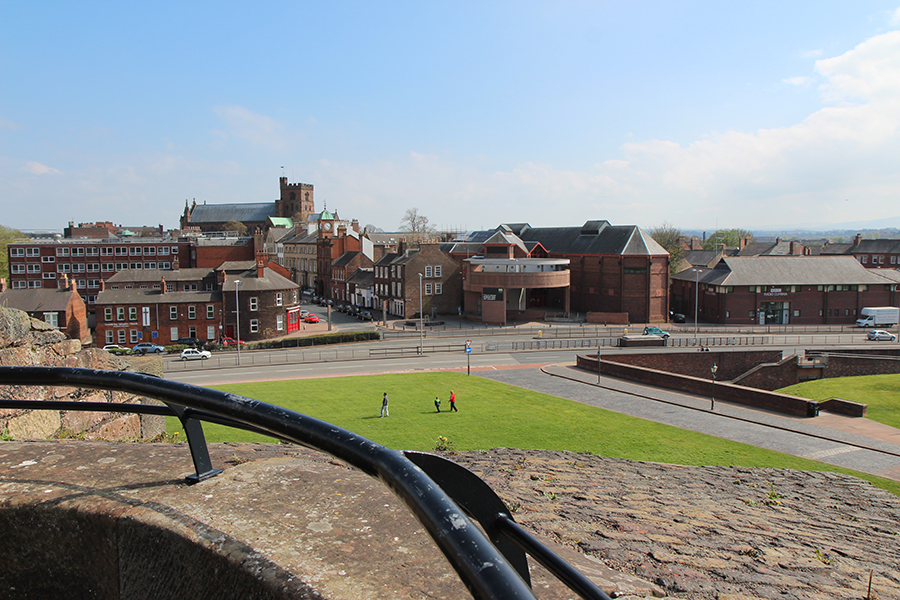
Sítio arqueológico da fortaleza romana de Isca Augusta / Archaeological site of Isca Augusta Roman barracks
Some say that Arthur’s grave at Glastonbury is fake, priests’ fabrication to attract pilgrims and their money. History shows that the main spots of British resistance against all invasions were concentrated in the Scottish borders, Cornwall and Wales – where Caerleon is located. That may confirm a theory of these places having counted on the best warriors and generals, Arthur and his Knights among these. The author Stephen E. Lawhead imputes Arthur’s fatherhood to Aurelianus Ambrosius.

Murais nas ruas sugerindo que Caerleon era a Camelot de Arthur / Street boards suggesting that Caerleon was Arthur’s Camelot
Assim, o País de Gales também reclama a origem de Arthur. De toda forma, é significativo que o Pendragon, título de Uther, seja o símbolo do país. A lenda também conecta o mago Merlin a Gales. A estória é a seguinte: o rei Vortigern* decidiu construir uma fortaleza em Snowdonia (uma região de Gales) e escolheu um local estratégico. Porém, uma coisa estranha ocorreu quando os trabalhadores começaram a lançar as fundações e paredes de pedra do castelo. Tudo que era construído durante o dia desabava misteriosamente durante a noite.
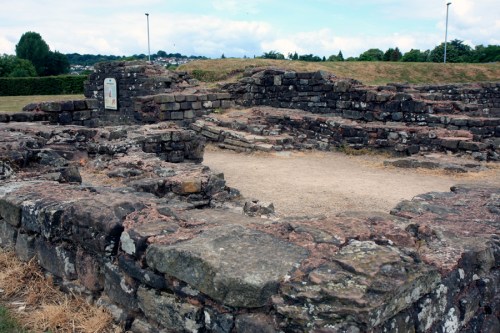
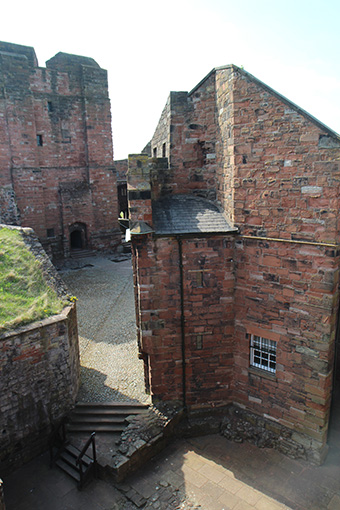
Vista do sítio arqueológico da fortaleza romana de Isca Augusta / View of the archaeological site of Isca Augusta Roman barracks
So, Wales claims Arthur’s origins too. Anyway, it’s meaningful that the Pendragon, Uther’s title, is the symbol of Wales. The legend also links the wizard Merlin to Wales. It goes like this: King Vortigern* had decided to build a stronghold in Snowdonia ( a region in Wales) and had chosen a proper place, strategically located. But the weirdest thing happened when the building began. The foundations, the stone walls, everything that was built in the daytime collapsed mysteriously by night.

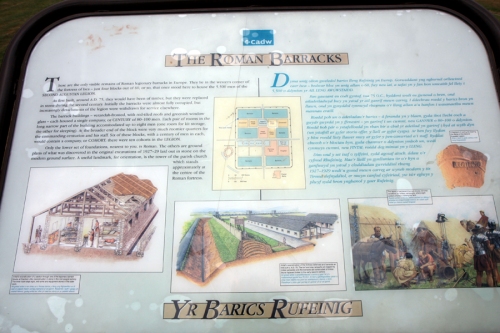
Painéis explicativos nas ruínas / Explanatory panels in the ruins
Os magos da corte de Vortigern recomendaram que o sacrifício de uma criança que não tivesse pai fosse feito no local, para que o sangue derramado fortalecesse a terra. Tal criança foi localizada e trazida à presença do rei. Tratava-se, entretanto, de Merlin, que seria reconhecido como o maior druida de todos os tempos.
* Vortigern foi um general do sec. V, um rei dos britânicos, ou pelo menos assim considerado pelo escritor Bede. Diz-se que ele contratou os mercenários saxões Hengist e Horsa para lutar contra os Pictos e os Escoceses. Porém estes acabaram por se voltar contra ele, e mataram seu filho. Hengist conquistou Kent, tornando-se o primeiro de uma linhagem de reis. Por este erro, atribui-se a Vortigern a perda da Grã- Bretanha para os saxões.

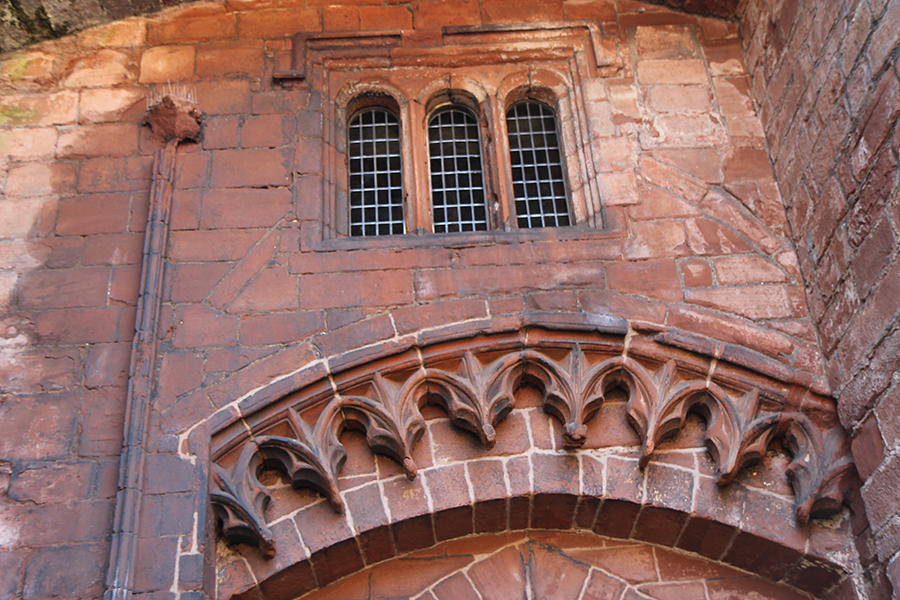
Outra vista das ruínas do quartel de Isca Augusta / Another view of Isca Augusta’s barracks ruins

Vortigern’s magicians consulted their oracles and recommended a blood sacrifice to strengthen the soil. The victim should be a fatherless child, and such a kid was eventually found and brought to the King’s presence. But the child happened to be Merlin, who would be renowned as the greatest Druid ever.
* Vortigern was a 5th-century warlord, a king of the Britons, at least connoted as such in the writings of Bede. He’s said to have hired the saxon mercenaries Hengist and Horsa to fight the Picts and the Scots. But they eventually betrayed him, killing his son and Hengist successfully conquered Kent, becoming the forefather of its kings. So, Vortigern is blamed for his misjudgement and the loss of Britain to the saxons.
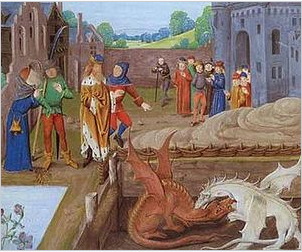
O encontro de Vortigern e Merlin, de acordo com Geoffrey de Monmouth em sua História dos Reis Britânicos / Vortigern meeting the young Merlin, as related in Geoffrey of Monmouth’s Historia Regum Britanniae
Merlin se dirigiu ao rei afirmando que aqueles magos ignoravam que, sob o lugar escolhido para a construção, havia um lago subterrâneo, onde habitavam dois dragões, um vermelho e um branco, que lutavam durante a noite e dormiam de dia. A construção desabava em consequência da luta.
Merlin told Vortigern that his magicians ignored that under the exact building ground, there was an underground pond, home to two dragons, one red and the other white, who would sleep the day and wake up at night to fight each other. Their fierce battle caused the building to collapse.

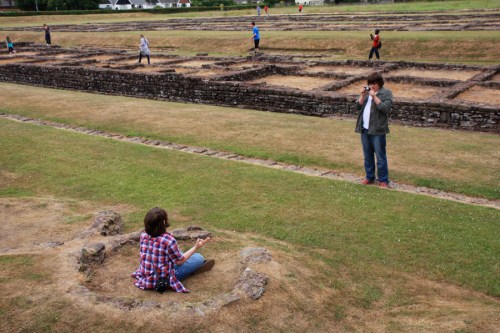
Há escolas em volta das ruínas. Aqui, estudantes no intervalo de aula / The ruins are surrounded by schools. Here, students during class break
Vortigern ordenou que os servos cavassem; o lençol d’água foi localizado e, à noite, escondidos, os nobres presenciaram o surgimento das criaturas. O dragão branco parecia vencer o vermelho, mas, no último instante, este revidava e derrotava seu oponente que, ao se retirar para as profundezas, derrubava toda a estrutura da fortaleza. Intrigado, o rei pediu ao garoto que interpretasse o significado daquela visão.
Vortigern ordered his subjects to dig in the spot; the pond was found and, at night, the noblemen, hidden in the bushes, witnessed the dragons show up. The white one at first appeared to beat the red but, in the last moment, the red would fight back and defeat his opponent. The white dragon’s retreat to the depths made the whole built structure fall to the ground. The king, puzzled, asked the boy to interpret the meaning of such vision.

Turistas se divertem / Tourists having fun
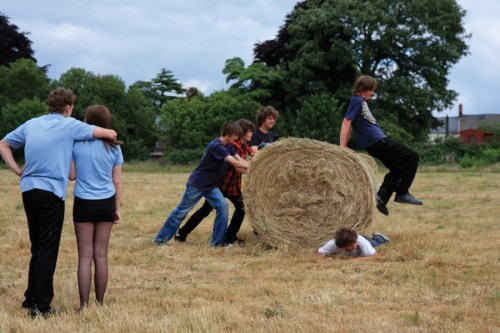
Estudantes se divertem / Students having fun
Merlin explicou que o dragão branco representava o povo invasor que quase chegaria a dominar a ilha de uma ponta à outra, enquanto que o vermelho representava o povo bretão que se levantaria e viria a expulsar os invasores. Impressionado, Vortigern libertou Merlin e o elevou à categoria de seu conselheiro. Daí o dragão vermelho ser o emblema dos galeses.
Merlin explained that the white dragon impersonated the invaders, who would almost succeed to conquer the isle from one end to the other. The red dragon was the British people, who would raise to defeat and kick out the invaders. Impressed, Vortigern freed Merlin and made him his counsellor. And this is why the red dragon is the Welsh symbol.
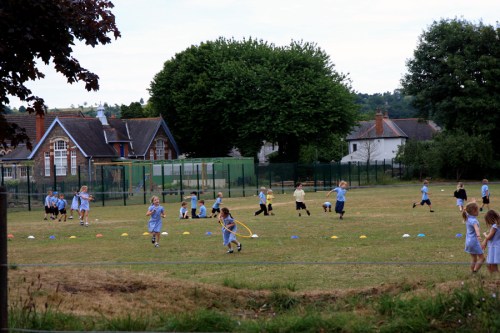
Outra escola – primária – junto às ruínas / Other school – elementary – neighbor to the barracks
Eu tinha comprado, na loja de souvenirs do Cardiff Castle, um irresistível dragãozinho vermelho de pelúcia. Nem lembrei que teria de carregá-lo na mochila todo o resto da viagem.
I had bought an irresistible stuffed red dragon at Cardiff Castle’s souvenir shop. It hadn’t crossed my mind that I’d have to carry it in my backpack all along the trip.


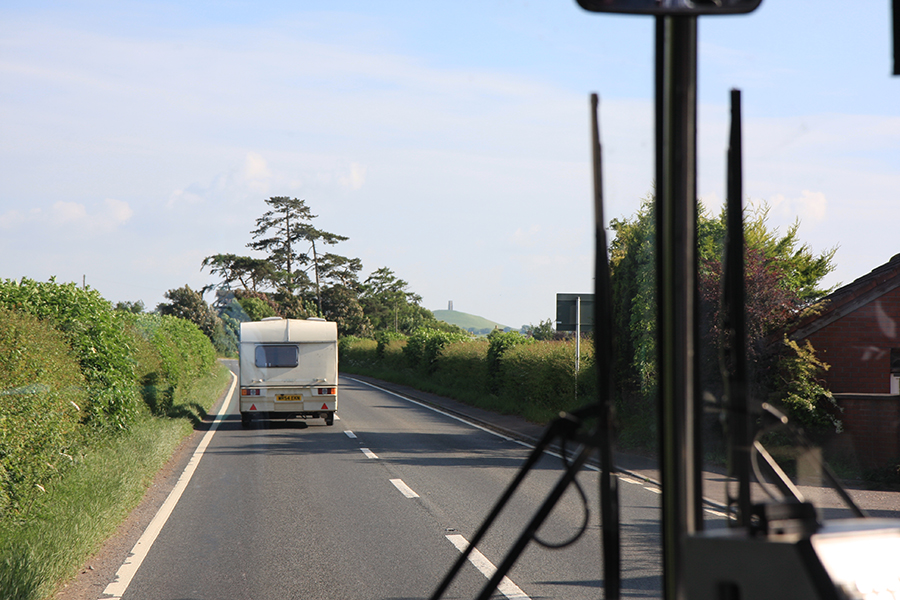











































 Avalon