
Rua em Forres / Street in Forres
Fiquei bastante tempo junto à Pedra das Bruxas, fazendo minhas orações para as mulheres que foram queimadas ali, e só fui embora porque começou a ameaçar chuva. Não havia nem um ponto de ônibus na longa rua, mas achei um posto de gasolina e fui pedir informações. Não havia frentista, mas um homem entrou para abastecer o carro, a ele me dirigi. Por sorte, conhecia Findhorn e ofereceu carona até o local de onde saía um shuttle gratuito para a Fundação. Sem pestanejar entrei no carro. Em dez minutos chegamos a um lugar que, a pé, eu levaria o dia todo para alcançar: Cluny, no alto de um morro, que foi um hotel na década de 60 e hoje faz parte da Fundação Findhorn, aonde chegaremos. Agradeci efusivamente ao gentil escocês de meia idade que se dispôs a sair de seu caminho para me levar até lá.
I stood longtime by the Witches stone, alone with my prayers for the women that had been scorched there, but under the threat of a gathering storm I eventually left. There was no bus stop in the long street, only a gas station, where I could ask for direction. There was no attendant, but a car came in to fuel so I addressed the driver. Fortunately he knew Findhorn and offered me a ride to a place where I could take a free shuttle to the Foundation. I accepted without a blink. The way up to the top of a high hill took us ten minutes; by foot it would take me the whole day to reach Cluny Hill College, a former hotel which now belongs to Findhorn Foundation, where we’re just about to arrive. I thanked heartily the Scot gentleman who had kindly strayed off his path to take me there.
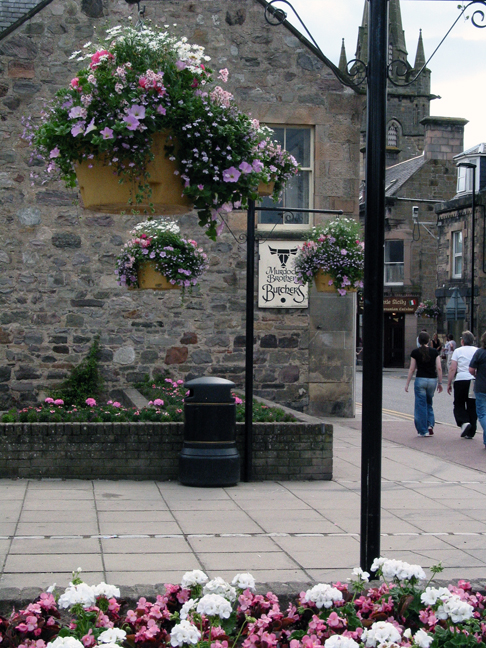
Forres
A salvo da chuva que realmente caiu com vontade, esperei uma hora pelo shuttle, minha mente ainda ocupada pela questão da dominação cultural. Sabemos que a história é geralmente contada pelo ponto de vista do vencedor. A história do Rei Arthur, foco deste blog, também foi acrescida de elementos que não pertenciam à original, em momentos distintos, servindo a diferentes propósitos. No livro Aventuras da Távola Redonda (2003), o Prof. Antonio L. Furtado (org.) divide a literatura Arthuriana em três momentos distintos:
1ª fase – Crônicas pseudo-históricas;
2ª fase – Romances de cavalaria;
3ª fase – Histórias exemplares.
Next shuttle would leave in one hour, which I spent quietly sitting sheltered from the hard rain, my mind still busy with cultural subdue. It’s said that History is always told by the winner’s point of view. To King Arthur’s story, the main focus of this blog, elements were added which didn’t exist in the original tale, serving different purposes. In his book Adventures of the Round Table (2003), Prof. Antonio L. Furtado (org.) splits Arthurian literature in three distinct periods:
1st. – Pseudo-historical chronicles;
2nd. – Chivalry romances;
3rd. – Exemplary tales.

Praça principal de Forres / Forres main square
A primeira fase trata de relatos de batalhas e outras citações nas quais aparece o nome de Arthur, como em A história dos Reis da Bretanha, de Geoffrey de Monmouth, e nos Anais de Cambria (cidade no País de Gales) do ano 516, onde está escrito que “na Batalha de Badon, em que Artur levou a cruz de Nosso Senhor Jesus Cristo por três dias e três noites sobre seus ombros, e os bretões foram vitoriosos”. Um autor chamado Nennius, do século IX, afirma em sua História dos Bretões, que na batalha do Monte Badon, “morreram, em um dia, 960 homens numa investida de Arthur, e ninguém os abateu senão ele somente. E em todas as batalhas saiu vencedor”. Um certo Lucius Artorius Castus é citado por ter atingido o posto de “dux bellorum”, isto é, o Duque de Guerra. Foram encontradas duas placas com inscrições que atestam esta afirmação e a situam entre meados dos séculos II e III. Estes são exemplos de escritos em prosa, em latim, que sustentam a existência real de um Arthur.
The first phase concerns battle accounts and other reports where Arthur’s name appears, like Geoffrey de Monmouth’s “History of the Kings of Britain” and the “Annals of Cambria”(Welsh city), year 516, where the author states that “in the Battle of Mount Badon, where Arthur led the forces under our Lord Jesus Christ’s Cross banner for three days and three nights over his shoulders, and the Britons were victorious, utterly defeating the Saxons”. Nennius, a IXth century writer, asserts in his “Historia Brittonum” that in Mount Badon “960 men died in one single day under Arthur’s onslaught and nobody slaughtered them but himself alone, and of all battles he was the winner”. A certain Lucius Artorius Castus is mentioned as “dux bellorum”, what means “commander of war(s)”. Two plaques were found bearing inscriptions that prove this man’s existence in the late 2nd century or early 3rd century. These are a few examples of texts, written in latin prose, that support an Arthur’s true existence.

Lancelot & Guinevere
Na segunda fase, o romance é introduzido nestas histórias, que tratavam antes apenas de cavaleiros, seus duelos, sua coragem, feitos de bravura e guerras vencidas – aliás, um tanto enfadonhas. Os romances de cavalaria viraram moda nos salões da corte francesa, formatados em versos neste idioma. Chrétien de Troyes (escritor que traduziu A História dos Reis da Bretanha, de Geoffrey de Monmouth, para o francês) recebeu de sua patronesse a “encomenda” de uma história de Camelot, onde seria acrescida a narrativa de um romance entre a rainha e o melhor cavaleiro do rei, Lancelot, que até então nem existia nos relatos pseudo-históricos. A mecenas era a condessa Maria de Champagne, filha de Eleanor da Aquitânia (mulher de Henrique II da Inglaterra) que empregou Chrétien entre 1160 e 1172, ou seja, início do século XII.
The second phase had place when Chivalry Romances became the new fashion trend in Royal Courts, translated into French poetry, embodying chivalrous love in tales that formerly consisted only of jousts, knight bravery, victories in battle, very boring stuff, by the way. The writer Chrétien de Troyes, who translated the “History of the Kings of Britain” into French was hired to produce a Camelot novel, and the love story between Guinevere and Lancelot was thus inserted. Arthur’s best knight didn’t even exist in the original tale. Chrétien’s sponsor was the Countess Mary of Champagne, daughter of Eleanor of Aquitania (who married the English King Henry II), from 1160 to 1172, early XIIth century.
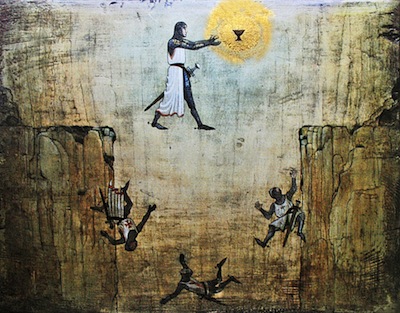
A busca do Cálice Sagrado / The quest for the Holy Grail
A terceira fase é formada por escritos em francês, em prosa, onde o Santo Graal entra na narrativa. Isto se dá justamente quando a Igreja Católica quer incitar os cristãos às Cruzadas, mais adiante no século XII. O catolicismo varreu do mapa a antiga religião, nunca mais se concebeu nenhuma versão da história de Arthur sem a busca do Graal. O interessante é que a cultura pagã foi preservada no próprio interior dos monastérios por druidas que, para sobreviver, declararam-se convertidos ao catolicismo. Estes sábios registraram por escrito suas tradições, que até então eram transmitidas oralmente através das gerações. Devemos a eles tudo que hoje se conhece da cultura celta.
In the third phase, written in French prose, the quest for the Holy Grail is added to Arthur’s story. That happened a bit later in the XIIth century, when Catholic Church was urging the Christians to join the Crusades. Catholicism overwhelmed the ancient rites. Not a single version of the Round Table legend was written, after that, without the Grail quest. What’s interesting is that pagan culture was preserved in the very heart of Catholic Monasteries, by druids who, in order to survive, pretended to be converted to this new religion. These wise men put down in written words all they could about their traditions which were, so far, orally transmitted through the generations. To them we owe all our present knowledge of celtic culture.

Morgana em “Excalibur”: a bruxa má / the bad witch
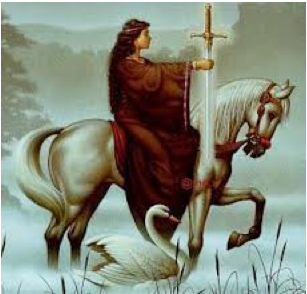
Morgana em “Brumas de Avalon”: a sacerdotisa
Morgana in “Mists of Avalon”: the priestess
As Brumas de Avalon, da americana Marion Zimmer Bradley, lançado em 1979, é a abordagem da lenda de Arthur sob o ponto de vista feminino, reelaborando todo o universo mítico da trama. Pela primeira vez o estereótipo de bruxa má é retirado do personagem de Morgana.
The Mists of Avalon, by Marion Zimmer Bradley, 1979, approaches King Arthur’s legend under a feminine point of view, changing the mythical universe of the plot and for the first time releasing Morgana’s character of the bad witch stereotype.
 Avalon